Connect with us

Showbiz

Valentine’s Day in Nigeria: Love, Heartbreak, and Connection

Published

on

Spotify Valentine’s Day in Nigeria

Spotify’s latest Valentine data signals that Nigerian listening is becoming more emotionally expansive, not more predictable. Across the Jan 1 to Feb 4 comparison window, Nigeria saw strong growth in mood-led playlist creation from 2024 to 2025, with rizz up +58%, simp up +66%, and yearn up +305%. From 2025 to 2026, we could see rizz up +82% and yearn up +170%. Together, these shifts point to a culture that is naming attraction, vulnerability, and longing in real time.

A New Language for Modern Love

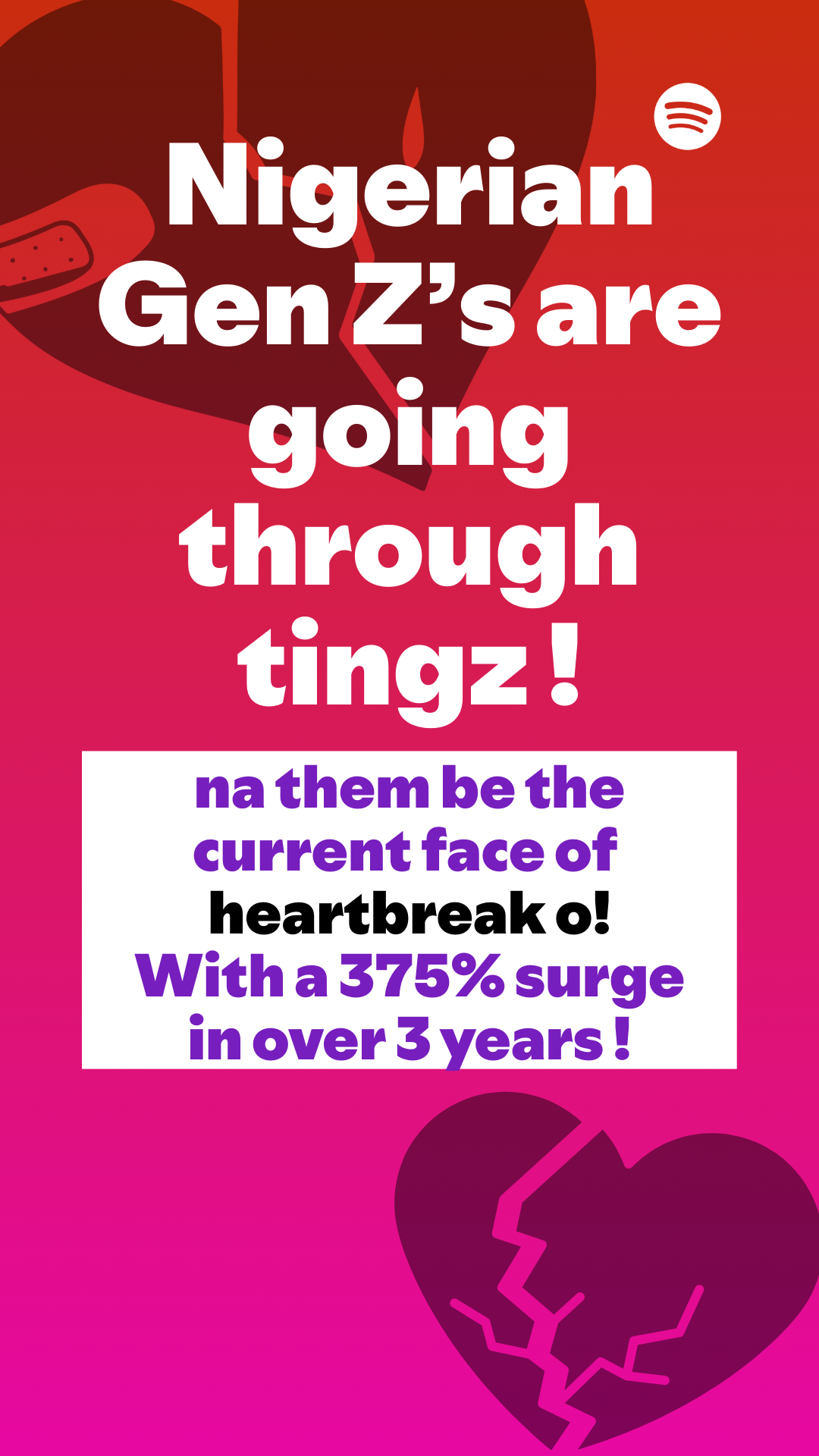
On Valentine’s Day, Nigerian listeners moved between local and global love soundtracks, with Burna Boy, John Legend, and Billie Eilish appearing in the same emotional universe. What stands out is not one dominant mood but the growth of multiple moods at once. Using rizz and simp as love-coded signals, and yearn as a heartbreak-coded signal, Spotify data shows both sides rising sharply. Love-coded playlist, rizz behaviour grew by +58%  to +82% from 2024 to 2026, while heartbreak-coded behaviour yearn grew by +305% and then +170% over those same periods.

This is emotional literacy in action, with listeners using playlists to process what they feel without having to flatten it into one story.

Nigerian Gen Z is driving this change. Data points to a generation building a working vocabulary for modern relationships, one that allows confidence, tenderness, and uncertainty to exist side by side.

The Duality Generation

Among 18 to 24-year-olds on Valentine’s Day, nearly 60% of listeners skewed heartbreak, while almost 40% leaned into love. They are not choosing one emotion over another. They are holding both at once and building listening habits that reflect that complexity.

The pattern is visible across gender, too. Men accounted for over 65% in heartbreak and 61% in love song streaming, while women represented just over a third in both cases, showing that both groups are actively engaging the full emotional spectrum on the day.

Geographically, heartbreak listening is concentrated in urban centres, with Lagos leading, followed by Abuja, Port Harcourt, Ibadan, and Benin. The map is culturally telling. Young Nigerians in major cities are using music as a live emotional archive of romance, ambiguity, and recovery.

Sharing the Feeling

Nigerians are not processing these emotions in isolation. Valentine’s Day 2025 was the “Blendiest” day in the preceding year, signalling peak shared listening behaviour through Spotify Blend. Partners, friends, and crushes used collaborative playlists to merge Afrobeats, street-pop, and R&B into shared mood spaces.

Top Blend tracks on the day included  Fido’s Awolowo, Smur Lee’s, Shallipopi, ODUMODUBLVCK’s JUJU (with Smur Lee & Shallipopi),  BNXN, Rema’s “Fi Kan We Kan,” and Rema’s “OZEBA.” In direct song shares, listeners chose emotionally direct records such as Future’s “WORST DAY,” Drake’s “GIVE ME A HUG, Asake’s “WHY LOVE”,  Rema’s “Baby (Is it a Crime)”, and Drake’s “NOKIA”. The signal is clear: sharing is not just social behaviour, it is emotional communication.

Beyond Romance: Community, Friendships, and Faith

Valentine’s listening also shows Nigerians broadening the meaning of connection. Globally, Galentine playlist creation rose by over +70% year on year, with +20% growth already recorded this year. In Nigeria, this aligns with how friendship and peer support are increasingly central to how young listeners mark the day.

The podcast picture adds another cultural layer. Faith-based voices remained highly visible on 14 February, alongside relationship-centred conversations, reflecting a listening culture where romance, spirituality, and community wisdom coexist rather than compete.

Spotify also recorded a +20% increase in Valentine’s Day playlist creation globally in the latest comparable seasonal window, reinforcing that this period remains one of the strongest emotional moments in the listening calendar.

“Valentine’s Day in Nigeria is no longer a single-note romance moment. We are seeing listeners embrace love and heartbreak as equally valid emotional realities, and use music to move through both with honesty. What stands out is the confidence to name complex feelings and the willingness to share them with others,” says Phiona Okumu, Spotify’s Head of Music for Sub-Saharan Africa.

This year’s Valentine’s data presents a portrait of a generation redefining connection: emotionally fluent, culturally hybrid, community-oriented, and unafraid of contradiction.


Click to comment

Leave a Reply

Your email address will not be published. Required fields are marked *

Showbiz

MasterChef Nigeria: Loye Gets Burnt by Jollof Challenge

Published

on

MasterChef Nigeria Loye Jollof Challenge

The heat was turned all the way up in the MasterChef Nigeria kitchen as the Top 6 faced another Black Apron Day, where one contestant’s dream would come to a boil.

This week’s challenge was a true Nigerian classic with a competitive twist: the contestants had to create a Jollof Rice Feast inspired by two regions of Nigeria. With jollof rice sitting proudly at the heart of Nigerian food culture, the judges were looking for bold flavours, regional identity, strong execution and, most importantly, a dish where jollof was the star of the plate.

For Loye, however, the challenge did not come together the way he had hoped. He was not fully satisfied with the dish he presented, and the judges shared the same concerns. While there were elements of promise, they felt he did not hero the jollof rice enough in a challenge where the beloved dish needed to take centre stage.

Chef Stone acknowledged Loye’s potential, saying he could build himself into a MasterChef, but on the day, the dish was not enough to keep him in the competition. Chef Eros encouraged him to cook with more heart, reminding him that great food is not only about technique, but also emotion, confidence and connection.

After a tough tasting, Loye’s MasterChef Nigeria journey came to an end.

Also feeling the heat were Isabella and David, who joined Loye in the bottom three.

For Isabella, the challenge was an important opportunity to prove that she belonged in the MasterChef kitchen after last week’s disastrous cake bake. She hoped her jollof rice feast would be the dish to take her out of the danger zone, but the judges felt there were too many flavours competing on the plate.

David also found himself under pressure after failing to complete his dish on time, a costly mistake that landed him among the weakest cooks of the day.

But while some dishes struggled to find their rhythm, Favy had every reason to celebrate. Even with the immunity pin in her possession, she cooked with confidence and delivered the standout plate of the day. Her dish earned high praise from the judges for its great flavours, leaving her visibly emotional and overjoyed. In recognition of her outstanding performance, Favy was rewarded with a one-year supply of Sonia products, as well as an exclusive dining experience for her and her family at Ile Eros.

With Loye now eliminated, the competition has officially reached boiling point. The remaining contestants will need to bring more than just seasoning to survive — they will need heart, hustle and plates packed with purpose.

Produced by Primedia Group, MasterChef Nigeria is supported by a strong coalition of leading Nigerian brands, including headline sponsor Power Oil, alongside Indomie, Dano Milk, Malta Guinness, Sonia Tomato, Kiara Rice, Golden Penny Flour, Golden Penny Sugar, Golden Penny Garri, Golden Penny Semolina, Golden Penny Chocolate Spread, and Golden Penny Wheat.

MasterChef Nigeria continues on Africa Magic, where the search for Nigeria’s next MasterChef gets hotter with every challenge.

The show airs weekly on Sundays at 7 pm on Africa Magic Showcase and Africa Magic Family, with rebroadcasts on Wednesdays at 6 pm on Africa Magic Showcase and Thursdays at 12 pm on Africa Magic Family. 

Next week on MasterChef Nigeria, the kitchen gets even hotter as the remaining contestants fight to stay in the competition. With Loye gone and the finale getting closer, there is no room for half-baked ideas, shaky execution or dishes that miss the brief. The pressure is rising, the judges are watching every move, and one wrong plate could send another contestant packing.

Continue Reading

Showbiz

Veteran Nigerian Actor Kola Oyewo Dies at 80

Published

on

kola oyewo

By Modupe Gbadeyanka

Veteran Nigerian actor, Mr Kola Oyewo, is reported to have breathed his last at the age of 80.

A popular Nollywood actor, Mr Kunle Afod, confirmed the news of the passing of the scholar, dramatist and filmmaker on Friday in a post on his Instagram page.

Before his passing, Mr Afod recently visited the university teacher at his residence, where he made monetary donations to him.

In his post on Friday, he announced the death of the thespian, saying “Tonight, we lost a true legend. Kola Oyewo has taken his final bow.”

“His remarkable talent, timeless performances, and immense contributions to the Nigerian theatre and film industry will never be forgotten. His legacy will continue to inspire generations to come,” he further wrote.

Recall that in an interview with Mr Afod, the deceased disclosed how his battle with prostate enlargement affected his acting career, which spanned over six decades.

Mr Oyewo began his acting career in 1964 with the Oyin Adejobi Theatre Group after he was born on March 27, 1946, in Oba-Ile, Osun State.

During his lifetime, he acted in several movies, including Saworoide, Super Story, Sango, and Koseegbe, amongst others. He also played the role of Odewale in Ola Rotimi’s play, The Gods Are Not to Blame.

In 1996, he became a lecturer at Obafemi Awolowo University and retired in September 2011 as a senior lecturer. He later moved to Redeemer’s University as the Head of the Department of Dramatic Art. He later worked at Elizade University, Ilara-Mokin, Ondo State, as a performing arts lecturer.

Continue Reading

Showbiz

Watching BBN and the World Cup Is No Longer a Location Thing

Published

on

dstv stream

Big Brother Naija Reunion is on, the World Cup tournament is kicking off, or that new DStv/GOtv series everyone has been talking about just dropped, and somehow, you’re not at home. Maybe you’re in traffic, at work, or just not near a TV. In moments like these, the real question is no longer “what’s showing?” but “how do I not miss it?”

That shift is precisely why the DStv and GOtv Stream have become more than just viewing platforms. They are now part of how people actually experience television on the move, at home, on phones, and in real time.”

Whether it’s someone trying to catch a live show while commuting, watching highlights during a break at work, or simply preferring to stream directly from their device instead of using a decoder, these apps have quietly changed how entertainment is consumed.

But beyond streaming and access, many users still don’t fully understand how to navigate them properly. Here’s a simple guide.

1. Getting Started

Download the DStv Stream or GOtv Stream app from your device’s app store and sign in using your DStv or GOtv account details.

Once you’re logged in, you’ll land on the home page, where you’ll find a mix of live TV, recommended content, trending titles, and recently added shows.

2. Watching Live TV

One of the easiest ways to use the platform is through the Live TV section.

Simply:

  • Tap on Live TV

  • Browse available channels

  • Select the channel you want

  • Start watching instantly

This is especially useful for:

  • Big Brother Naija live broadcasts

  • Football matches and tournaments

  • News coverage

  • Reality shows

  • Live events

You can move between channels just as you would on a decoder.

3. Finding Shows and Movies

For viewers who already know what they want to watch, the search feature offers a quick way to find specific shows, movies, channels, or sporting events without scrolling through categories.

The platform also organizes content into categories, making it easier to discover something new.

4. Catch Up on Missed Episodes

If you missed an episode because you were busy, the catch-up feature allows you to watch selected programs after they have aired. Instead of waiting for reruns, you can simply search for the show and pick up right where you left off. This feature is especially useful during busy periods when it can be difficult to keep up with daily shows.

5. Explore Recommended and Trending Content

The home page regularly highlights:

  • Trending shows

  • Newly added content

  • Popular movies

  • Recommended titles based on viewing habits

If you’re not sure what to watch next, this section can help you discover content you may have otherwise missed.

6. Accessing Showmax Content

One of the biggest additions to the streaming experience is the integration of Showmax content.

Viewers can now access a wide range of Showmax movies, series, and entertainment content directly through the streaming platform, making it easier to move between live TV and on-demand viewing without constantly switching services.

From international blockbusters to local favorites, there’s significantly more content available to explore.

7. Creating a Personal Viewing Experience

The platform allows users to:

  • Continue watching from where they stopped

  • Save favorite content

  • Browse viewing history

  • Discover personalized recommendations

This makes it easier to keep track of ongoing series and find content that matches your interests.

With the DStv Stream and GOtv Stream, live channels, catch-up viewing, on-demand entertainment, and Showmax content are all available in one place, making it easier than ever to watch what you want, when you want, and wherever you are.

Continue Reading

Trending