General
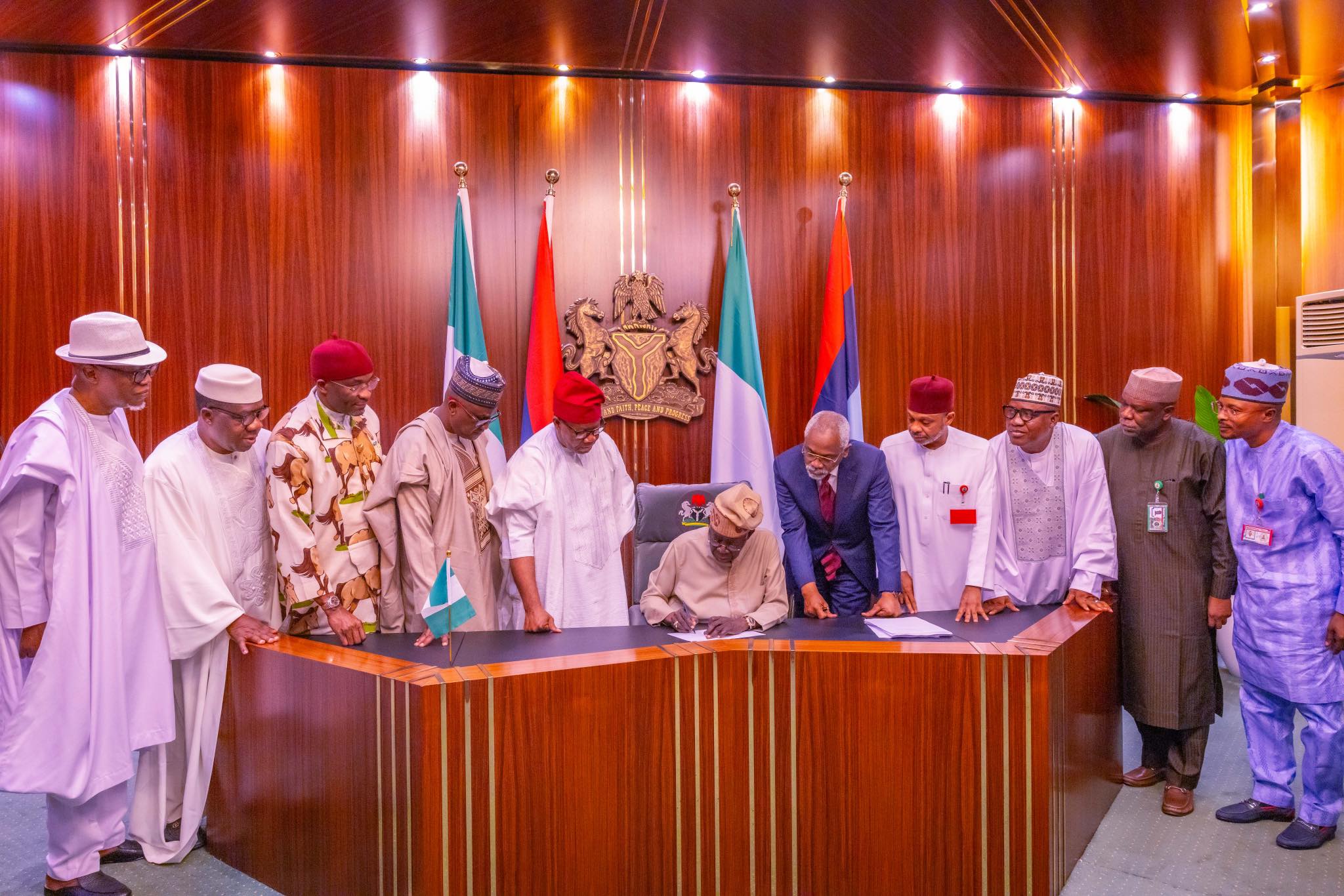
Tinubu Signs Electoral Bill into Law
By Modupe Gbadeyanka
The Electoral Act, 2022 (Repeal and Re-Enactment) Bill 2026, harmonised by the National Assembly on Tuesday, has been signed into law.
The new law was assented to by President Bola Tinubu on Wednesday in Abuja in the presence of some principal officers of the federal parliament.
Present were the Senate President, Mr Godswill Akpabio; the Speaker of the House of Representatives, Mr Tajudeen Abbas; his deputy, Mr Benjamin Kalu; as well as the Chief of Staff to the President, Mr Femi Gbajabiamila, among others.
The Special Adviser to the President on Information and Strategy, Mr Bayo Onanuga, on Wednesday night quoted his boss as saying the electoral act amendments are not about politics, but about a process.
“After every election cycle, we owe Nigerians an honest look at what worked and what must work better. That is how serious democracies behave, and our laws must grow with experience.
“Today, I signed the final amendments to the 2022 Electoral Act into law.
“These amendments are not about politics. They are about process. They are about closing gaps, strengthening procedures, and providing greater clarity to those who conduct and participate in our elections.
“When citizens walk into a polling unit, they must do so with confidence. When results are declared, they must be trusted. That confidence is built deliberately, and not by chance.
“I sincerely thank the National Assembly for its cooperation and sense of national responsibility in bringing this process to a successful conclusion. Our responsibility remains to keep improving the system so that the people’s will is expressed clearly, peacefully, and credibly.
“The work of strengthening our democracy continues, and we shall not relent,” he stated.
The new law generated controversies over the refusal of the lawmakers to accept the electronic transmission of election results into a server of the Independent National Electoral Commission (INEC).
General
N68.7m Contract: Court Sentences ex-Reps Member With N50,000 Fine Option
By Aduragbemi Omiyale
A former member of the House of Representatives, Mr Onamusi Onadeko, has been sentenced to nine months’ imprisonment with an option of a fine of N50,000.
The former lawmaker, who represented Ogun East Federal Constituency in the National Assembly from 1999 to 2003, was sentenced by Justice Chizoba Oji of the Federal Capital Territory High Court in Abuja on Thursday, July 30, 2026.
He was found guilty on count 11 and convicted for making inconsistent statements but discharged and acquitted on counts 2, 3, 4, 6, 7, 8, 9 and 10.
Mr Onadeko’s journey to the court started in 2017, when he was charged by the Independent Corrupt Practices and Other Related Offences Commission (ICPC) for his alleged involvement in the award and execution of a N68.7 million contract.
The politician, according to a statement from the ICPC, was accused of using his private companies, Stanton Engineering Limited and Haines and Baines Limited, to execute several constituency projects while working as a Senior Legislative Aide to late Senator Buruji Kashamu, who represented Ogun East Senatorial District between 2015 and 2019.
The commission, had in the course of the eight years trial told the court that several contracts like buying of ambulance vehicles, supply of hospital equipment and drugs for Primary Health Centres, as well as construction of classrooms for some selected schools in six communities of Ogun East Senatorial District, were awarded to both Stanton Engineering Limited and Haines and Baines, where the convict doubles as a Managing Director and nominal Director, respectively, an action that violates Sections 12 and 19 of the Corrupt Practices and Other Related Offences Act, 2000.
ICPC also accused Mr Onadeko of making an inconsistent statement that contradicted the one previously made to the Commissioner for Oaths, where he stated that he is a Director of Haines and Baines Limited in an affidavit dated June 30, 20216, but subsequently wrote another statement while under investigation on May 5, 2017, that he is not a shareholder or Director of Haines and Baines Limited.
This action violates Section 25(1)(b) of the ICPC Act and, upon conviction, is liable to a fine not exceeding N100,000 or to imprisonment for a term not exceeding two years or to both such fine and imprisonment.
However, Mr Onadeko, through his counsel, Mr Wahab Olatoyebi, argued in the course of the trial that his client was not a public officer as his appointment at that material time was on a short-term basis and non-pensionable, hence he, (Onadeko) did not fall within the category of those that could be tried under Sections 12 and 19 of the Corrupt Practices and Other Related Offences Act, 2000 which criminalize and punish abuse of office by public officers.
But this argument was rejected by Justice Oji, who stressed that based on the defendant’s letter of appointment as well as the decision of the Supreme Court in the case of Federal Government of Nigeria v. Farouk Lawan, legislative aides are public officers and therefore could be prosecuted under the relevant provisions of the Corrupt Practices and Other Related Offences Act, 2000.
General
Makinde Inaugurates Judicial Panel to Probe Oriire School Abduction
By Adedapo Adesanya
The Governor of Oyo State, Mr Seyi Makinde, has inaugurated a Judicial Commission of Inquiry to investigate the abduction of students and teachers from Esinele and Yawota communities in Oriire Local Government Area of Oyo State.
The governor formally inaugurated the commission at the Executive Council Chamber of the Governor’s Office, Secretariat, Agodi, Ibadan.
Speaking at the event, Governor Makinde said that although the successful rescue of the victims brought relief to the state, it did not provide complete closure.
He explained that the decision to set up an independent commission was not intended to undermine the efforts of security agencies but to ensure that every question surrounding the incident is thoroughly addressed and lessons are learnt to prevent a recurrence.
He charged members of the commission to conduct a thorough, impartial, and evidence-based investigation, assuring them of the state government’s full support. He also called on individuals and relevant institutions to cooperate fully with the panel.
Speaking on behalf of the commission, its chairman, Professor Mojeed Owoade, pledged that members would carry out the assignment with integrity, professionalism, and fairness. He added that the panel would seek an extension if necessary to complete its work.
Governor Makinde gave the commission four weeks to submit its report.
Earlier this month, the pupils and teachers abducted in Oriire Local Government Area of Oyo State regained their freedom after 56 days in captivity.
According to the Special Adviser to the President on Information and Strategy, Mr Bayo Onanuga, eight of the kidnappers had been arrested, but the Federal High Court in Abuja on July 23 sentenced three suspects in the abduction to life imprisonment.
According to the court, the sentencing of Mr Abdulrazak Umar, known under the alias Abu Khalifa/Abu Khalid; Mr Yunusa Musa, alias Yunusa Bin Musa; and Mr Shamsu Adamu Sani, alias Abu Itisar, will start from the date of their arrest.
Before their sentencing by Justice Salim Ibrahim, counsel for the defendants pleaded with the court to sentence them on liberal terms, adding that they were first-time offenders and had pleaded guilty.
General
Court Sentences Two Chinese for Illegal Mining in Lagos
By Modupe Gbadeyanka
Two Chinese, Mr Zhang Hong Lin and Mr Gao Pei Hai, have been convicted and sentenced by Justice Akintayo Aluko of the Federal High Court in Ikoyi, Lagos, for conspiracy and the illegal mining of solid minerals.
They were both found guilty on all five counts levelled against them by the Economic and Financial Crimes Commission (EFCC) and sentenced each to five years’ imprisonment on each count, with an option of a N50 million fine covering all five counts.
The court also ordered the forfeiture of the mineral resources recovered from them to the Federal Government of Nigeria.
The defendants were arraigned on a five-count charge bordering on conspiracy and the unlawful possession of mineral resources intended for export without lawful authority.
“That you, Zhang Hong Lin, Gao Pei Hai, and Gao Pei Yu (currently at large), sometime in 2025 in Lagos, within the jurisdiction of this court, conspired among yourselves, with the intent to defraud the Federal Government of Nigeria of revenue accruing therefrom, and without the permission of the appropriate authority, engaged in the exportation of mica products, copper-bearing, and lithium-bearing mineral resources out of Nigeria, thereby committing an offence contrary to Section 1(8)(a) of the Miscellaneous Offences Act, 1983, and punishable under Section 8 of the same Act,” one of the charges read.
The defendants pleaded guilty when the charges were read to them, with the prosecution counsel, H.U. Kofarnaisa, calling the investigating officer, Matthew Orogwu, who reviewed the facts of the case and tendered documentary evidence before the court.
After presenting the evidence, Kofarnaisa urged the court to convict and sentence the defendants in line with the charges.