Connect with us

Economy

Nigeria Eyes Oil Windfall as Brent Hits $80 on US-Israel-Iran Conflict

Published

on

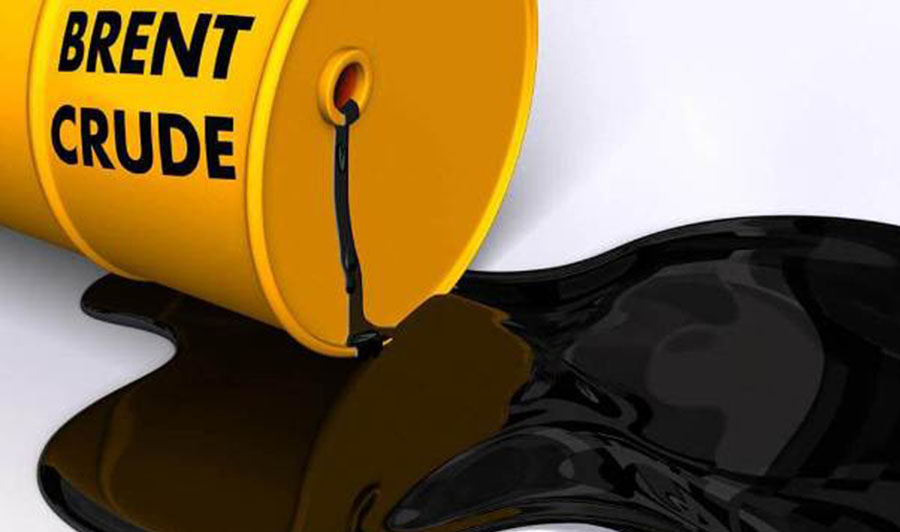
Brent crude futures

By Adedapo Adesanya

Nigeria could face a windfall from rising oil prices as Brent crude, the international crude benchmark, hit $80 per barrel on Monday as the United States and Israel air strikes on Iran plunged the Middle East into crisis.

Following the action, which commenced on Saturday, most tanker owners, oil majors and trading houses have suspended crude oil, fuel and liquefied natural gas shipments via the Strait of Hormuz, responsible for around 20 per cent of global oil flows.

Energy analysts and investment banks expect oil prices to surge this week to $90, with a chance of hitting $100 per barrel if disruptions to traffic in the crucial Strait of Hormuz persist.

As of press time, oil prices had already spiked by 10 per cent to above $80 per barrel for Brent. This could have a positive ripple effect for Nigeria, which is an oil-producing country despite challenges to production, as it uses the Brent crude price to gauge the value of its crude grades, including Bonny Light, Qua Iboe, Forcados, Escravos, among others.

Nigeria, which depends on crude for over 80 per cent of export earnings and a substantial share of government revenue, could see elevated prices translate to higher foreign exchange earnings, stronger reserves, and improved balance of payments.

Seeing the scale of the conflict and the already disrupted traffic through the Strait of Hormuz, analysts expect further spikes at least this week. This could mean higher oil export receipts, which could boost Nigeria’s foreign exchange liquidity, which can support the Naira and reduce FX volatility if the gains translate into actual FX inflows.

However, the country is plagued by volatile oil production, with oil output below the 1.5 million quota ascribed by the Organisation of the Petroleum Exporting Countries and its allies (OPEC). Latest data released last month showed that Nigeria’s production increased to 1.45 million barrels per day in January 2026 from 1.42 million barrels per day in December 2025.

Meanwhile, eight members of OPEC+, excluding Nigeria, on Sunday agreed to raise output by 206,000 barrels per day from April, a modest increase representing less than 0.2 per cent of global demand.

Analysts See Oil Prices at $90 a barrel in the Near Term

Citigroup expects Brent Crude to trade in the $80 to $90 per barrel range over at least the coming week in the bank’s base case.

“Our baseline view is that the Iranian leadership changes, or that the regime changes sufficiently as to stop the war within 1-2 weeks, or the US decides to de-escalate, having seen a change in leadership and set back Iran’s missiles and nuclear program over the same time frame,” analysts at Citigroup wrote in a note carried by Bloomberg.

Goldman Sachs sees an $18 a barrel real-time risk premium in oil prices. However, if only 50 per cent of flows through the Strait of Hormuz are halted for a month, the war risk premium to prices would moderate to $4 per barrel, according to Goldman.

Wood Mackenzie sees disruption in flows to push oil to above $100 per barrel.

“Higher oil and gas prices are certain as the closure of the Strait of Hormuz threatens to disrupt 15% of global oil supply and 20% of global LNG supply, with oil prices potentially exceeding $100/bbl if tanker flows are not quickly restored,” it said in a press release.

Rystad expects prices to rise by $20 to about $92 a barrel.

Adedapo Adesanya is a journalist, polymath, and connoisseur of everything art. When he is not writing, he has his nose buried in one of the many books or articles he has bookmarked or simply listening to good music with a bottle of beer or wine. He supports the greatest club in the world, Manchester United F.C.

Advertisement
Click to comment

Leave a Reply

Your email address will not be published. Required fields are marked *

Economy

SEC Revokes Operating Licence of Kensington Agro Trading Ltd

Published

on

Kensington Agro Trading

By Aduragbemi Omiyale

The operating licence of a capital market operator, Kensington Agro Trading Limited, has been revoked by the Securities and Exchange Commission (SEC).

The capital market regulator, in a circular dated February 09, 2026, disclosed that the action “pursuant to the powers of the commission under Section 61(6) of the Investments and Securities Act, 2025, and Rule 34(1) of the SEC Rules and Regulations 2013, as amended.”

The disclosure noted that the revocation of the licence of the company was “with immediate effect.”

The reason for withdrawing the operating licence of Kensington Agro Trading Limited was not stated in the notice.

“The Securities and Exchange Commission hereby notifies the general public of the revocation of the registration of Kensington Agro Trading Limited as a capital market operator (Commodity Broker/Dealer and Collateral Manager) with immediate effect.

“The revocation of the company’s registration is invoked pursuant to the powers of the Commission under Section 61(6) of the Investments and Securities Act, 2025, and Rule 34(1) of the SEC Rules and Regulations 2013, as amended.

“Accordingly, Commodity Exchanges, the investing public, commodity traders, and all Capital Market Stakeholders are advised to discontinue capital market-related dealings with the company,” the circular signed by the management noted.

Continue Reading

Economy

CBN Data Shows 25% Drop in Nigeria’s Oil Earnings to N877bn in December

Published

on

oil earnings

By Adedapo Adesanya

The latest off-cycle data released by the Central Bank of Nigeria (CBN) has revealed that Nigeria’s revenue from the oil and gas industry dipped by 25.04 per cent to N877.176 billion in December 2025, compared with N1.17 trillion received from energy firms in November 2025

In its presentation to the Federation Account Allocation Committee (FAAC) on receipts and expenditures for December 2025, the CBN disclosed that the amount earned from the oil and gas industry in the month under review represented 95.65 per cent of the sector’s budgeted revenue of N917.064 billion for the month.

In comparison, revenue from the petroleum industry in November 2025 accounted for 96.38 per cent of the N1.474 trillion budgeted for the sector in November 2025.

Providing a breakdown of revenue from the industry in December 2025, the CBN stated that the country earned N772.727 million from crude oil sales, dropping by 97.92 per cent from N37.134 billion recorded in November 2025; while the it recorded revenue of N9.019 billion from gas sales, rising by 24.14 per cent from N7.265 billion recorded in November.

Furthermore, the financial sector apex regulator noted that revenue from crude oil royalties dipped by 12.52 per cent to N514.288 billion in the month under review, from N587.865 billion recorded in the previous month; while receipts from miscellaneous oil revenue grew by 97.5 per cent to N2.678 billion in December 2025, from N1.356 billion in the previous month.

It also stated that royalties from gas appreciated by 124.91 per cent to N21.153 billion in December, from N9.405 billion in November 2025; revenue from gas flared penalties stood at N48.858 billion, down by 5.76 per cent from N51.842 billion in November, while revenue from Companies’ Income Tax (CIT) from upstream oil industry operations stood at N73.066 billion, as against N106.106 billion in the previous month.

The CBN further revealed that revenue from Petroleum Profit Tax (PPT) stood at N79.247 billion; rentals – N1.5 billion; while taxes stood at N126.594 billion, compared with N301.471 billion. N775.162 million, and N67.242 billion, respectively, in November 2025.

In addition, the CBN reported that from the country’s oil and gas revenue in December 2025, N18.163 billion was deducted for 13 per cent refund on subsidy, priority projects and Police Trust Fund from 1999 to 2021; while N8.761 billion was deducted by the Nigerian National Petroleum Corporation Limited (NNPCL), in respect of its 13 per cent management fee and frontier exploration fund.

It added that N23.724 billion was deducted and collected by the Nigerian Upstream Petroleum Regulatory Commission (NUPRC) in December 2025, being four per cent of the cost of collection; while N46.903 billion was transferred to the Midstream and Downstream Gas Infrastructure Fund from gas flared penalties in the same month.

Continue Reading

Economy

Nigeria Begins Implementation of Executive Order 9 on Oil Earnings

Published

on

executive order 9

By Aduragbemi Omiyale

On Saturday, February 28, 2026, the Implementation Committee for Executive Order 9 held its inaugural meeting, headed by the Minister of Finance and Coordinating Minister of the Economy, Mr Wale Edun.

The panel, at the gathering, reaffirmed the directive of President Bola Tinubu that revenues accruing to the federation from petroleum operations must be handled in a manner that upholds constitutional principles, protects revenues accruable to the nation, and supports the fiscal stability of all three tiers of government.

It approved the establishment of a technical subcommittee to develop the detailed guidelines for the transition to direct remittance within three weeks, and commence a review of the Petroleum Industry Act (PIA) to address structural and fiscal anomalies that weaken Federation revenues.

It was agreed that the subcommittee would be led by the Special Adviser to the President on Energy, and will include the Solicitor-General of the Federation and Permanent Secretary Federal Ministry of Justice, the Chairman of the Nigeria Revenue Service, and the Chairman of the Forum of Commissioners of Finance, representatives of the Minister of State Petroleum Resources, Oil, with secretarial support from the Budget Office of the Federation.

The committee promised to provide coordinated guidance and timely updates as implementation progresses. It commended the cooperation of all stakeholders in advancing the President’s efforts to ensure that Nigeria’s petroleum resources deliver tangible, measurable benefits to citizens across the Federation.

Under the new order, Mr Tinubu directed that NNPC Limited shall cease, with immediate effect, the collection of the 30 per cent management fee and the 30 per cent frontier exploration fund deductions from profit oil and profit gas under Production Sharing Contracts (PSCs).

Additionally, all remittances of gas flare penalties into the Midstream and Downstream Gas Infrastructure Fund (MDGIF) are suspended with immediate effect, in line with the Executive Order.

With respect to Section 2, Sub-section 3 of the Executive Order on direct payments by contractors into the Federation Account, the panel agreed that this transition must be implemented in a manner that respects existing contractual and financing arrangements, and maintains investor confidence.

For this reason, the committee approved a defined transition period for the operationalisation of direct payments by contractors of profit oil, royalty oil, and tax oil into the Federation Account.

Until the Committee issues detailed guidelines, contractors will continue to remit under the current process. During the transition period, the Committee will issue clear, standardised guidance to ensure an orderly changeover.

Continue Reading

Trending