Connect with us

Economy

Customs Street Resumes With 1.07% Loss as Traders Book Profit

Published

on

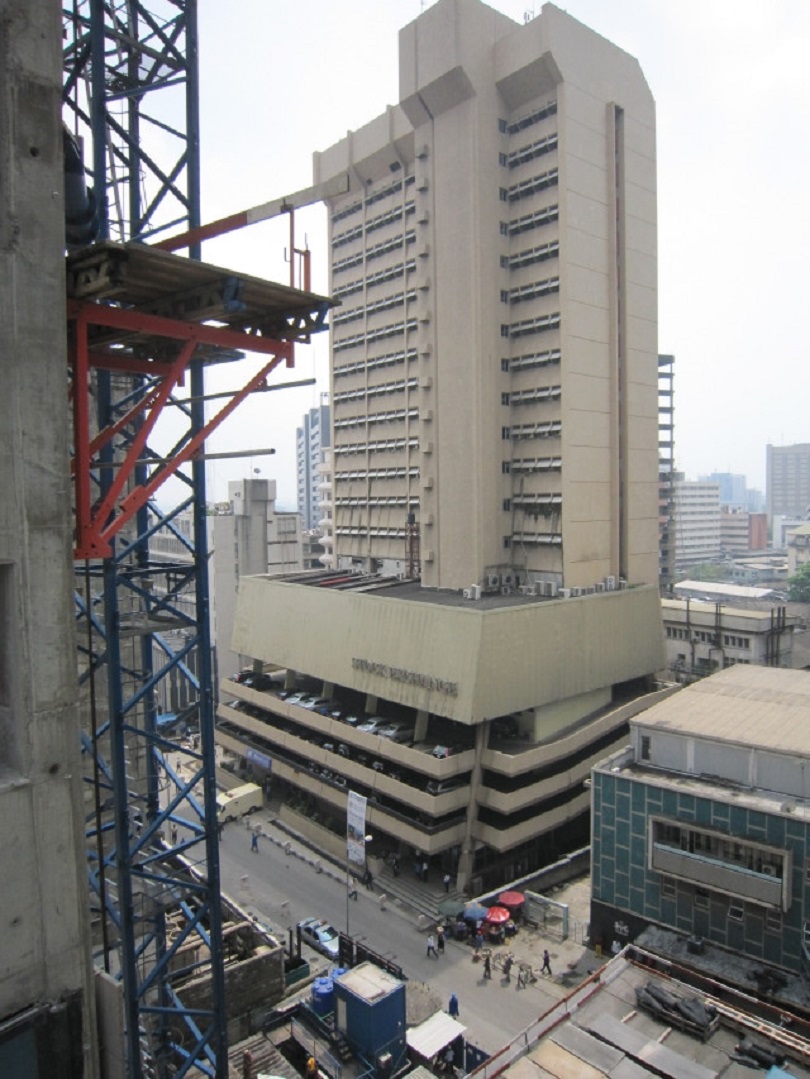
Customs Street

By Dipo Olowookere

The Nigerian Exchange (NGX) Limited resumed trading activity on Monday after a two-day break last Thursday and Friday for Eid al-Fitr.

At the resumption of trading of shares yesterday, investors embarked on profit-taking, crashing Customs Street by 1.07 per cent at the close of transactions.

The sell-offs were mainly in the banking, consumer goods and insurance sectors, which closed lower by 2.02 per cent, 1.13 per cent, and 0.16 per cent, respectively.

The trio made nonsense of the 0.31 per cent growth posted by the energy index and the 0.17 per cent increase recorded by the industrial goods counter.

Consequently, the All-Share Index (ASI) contracted by 2,142.83 points to 199,014.02 points from last Wednesday’s 201,156.85 points, and the market capitalisation decreased by N1.376 trillion to finish at N127.750 trillion compared with the previous N129.126 trillion.

Consolidated Hallmark was the worst-performing stock for the day after it lost 9.64 per cent to close at N4.50, Deap Capital depreciated by 8.37 per cent to N5.91, GTCO declined by 8.18 per cent to N105.00, International Energy Insurance lost 7.67 per cent to trade at N2.77, and Nigerian Breweries slumped by 7.29 per cent to N70.00.

Conversely, Presco appreciated by 10.00 per cent to N1,871.20, Zichis improved by 9.91 per cent to N9.43, John Holt expanded by 9.70 per cent to N13.00, Premier Paints grew by 9.62 per cent to N25.65, and Sovereign Trust Insurance gained 8.74 per cent to settle at N2.24.

Market participants transacted 848.8 million equities worth N53.3 billion in 139,458 deals on the first trading session of this week compared with the 6.1 billion equities valued at N130.1 billion traded in 58,562 deals in the preceding trading day, indicating a spike in the number of deals by 138.14 per cent, and a shrink in the trading volume and value by 86.09 per cent and 59.03 per cent apiece.

UBA was the most active stock on Monday, with a turnover of 114.2 million units worth N5.5 billion. Wema Bank traded 112.0 million units valued at N2.9 billion, Access Holdings transacted 54.8 million units for N1.4 billion, Zenith Bank exchanged 38.2 million units worth N4.1 billion, and Zichis sold 32.2 million units valued at N272.6 million.


Dipo Olowookere is a journalist based in Nigeria that has passion for reporting business news stories. At his leisure time, he watches football and supports 3SC of Ibadan. Mr Olowookere can be reached via [email protected]

Advertisement
Click to comment

Leave a Reply

Your email address will not be published. Required fields are marked *

Economy

Naira Falls 2.6% Against Dollar as FX Pressure Mounts

Published

on

currency in circulation eNaira

By Adedapo Adesanya

The Naira returned from break with more pressure, losing 2.6 per cent or N35.38 against the Dollar in the Nigerian Autonomous Foreign Exchange Market (NAFEX) on Monday, March 23, to trade at N1,388.38/$1 compared with last Wednesday’s closing price of N1,353.00/$1.

It was the same outcome for the Nigerian Naira against the Pound Sterling in the official market, where it tumbled by N58.36 to sell for N1,860.29/£1 versus the preceding session’s N1,801.93/£1, and crashed against the Euro by N53.19 to N1,609.41/€1 from N1,556.22/€1.

Similarly, the domestic currency depreciated against the US Dollar at the GTBank FX counter by N8 yesterday to close at N1,371/$1 versus the previous rate of N1,363/$1, and in the black market, it depreciated by N5 to quote at N1,400/$1 versus N1,395/$1.

The projection for the Naira appears to be changing course as it edged towards consecutive weaknesses due to disruptions to global oil supply, which have increased volatility in energy markets, making investors jittery.

This is also causing outflow for international payments, as evidenced by Nigeria’s external reserves recording drops.

Regardless, Coronation Merchant Bank’s research subsidiary expects the Naira to trade within a relatively stable range in the near term, supported by sustained foreign portfolio inflows (FPI) and improved exporter participation in the FX market.

Meanwhile, the cryptocurrency market saw the price of Bitcoin rise by 4.5 per cent to $70,827.12 after US President Donald Trump announced a five-day pause to airstrikes against Iranian energy infrastructure, citing “productive” diplomatic talks. Meanwhile, Iranian officials denied the existence of talks, but the crypto market largely brushed it off.

Solana (SOL) improved by 6.7 per cent to $91.66, Ethereum (ETH) expanded by 5.8 per cent to $2,157.56, Dogecoin (DOGE) grew by 5.7 per cent to $0.095, Cardano (ADA) jumped 5.2 per cent to $0.2630, Ripple (XRP) soared 4.2 per cent to $1.43, and Binance Coin (BNB) climbed 2.3 per cent to s$639.92.

However, TRON (TRX) dropped 2.8 per cent to $0.3049, while the US Dollar Tether (USDT) and the US Dollar Coin (USDC) traded flat at $1.00 each.

Continue Reading

Economy

Oil Prices Fall Below $100 as US Holds Off on Iran Attack

Published

on

oil prices fall

By Adedapo Adesanya

Oil prices dropped over 10 per cent on Monday after US President Donald Trump said he would postpone any military strikes against Iranian power plants for five days.

Brent futures fell by $12.25 or 10.9 per cent ‌to settle at $99.94 a barrel, while the US West Texas Intermediate (WTI) crude lost $10.10 or 10.3 per cent to trade at $88.13 per barrel.

President Trump claimed that constructive talks to resolve hostilities in the Middle East were going, hours before a deadline that threatened to escalate the four-week-old war over the Strait of Hormuz, where roughly 20 per cent of global oil and liquefied petroleum gas (LNG) flows through and which disruption has already driven a sharp spike in crude prices and heightened fears of a prolonged supply shock.

The Iranian media claimed there had been no direct or indirect contact with President Trump.

Iran’s Revolutionary ​Guards had said they would attack Israel’s power plants and those supplying US bases across the Gulf region if America follows through with Mr Trump’s threat to “obliterate” Iran’s ​power network. The war has already damaged major energy facilities in the Gulf and effectively halted shipping through the strait.

Amid the tussle, it was reported that two tankers bound for India sailed through the Strait of Hormuz on Monday carrying LNG loaded in the United Arab Emirates and Kuwait.

The head of the International Energy Agency (IEA), Mr Fatih Birol, estimated that since the current crisis, which started with bombings against the regime in Tehran on 28 February, there have been losses of 11 million barrels of oil per day and about 140 billion cubic metres of gas.

Mr Birol said that about 5 million barrels of oil had been lost in the two previous crises in 1973 and 1979, while Russia’s 2022 invasion of Ukraine removed about 75 billion cubic metres of natural gas from international markets.

The supply crunch has led to a temporary waiver of US sanctions on Russian and Iranian oil already at ‌sea. Indian ⁠refiners plan to resume buying Iranian oil while refiners elsewhere in Asia are examining such a move.

There was a surplus in global oil markets at the start of 2026, but recent developments have sparked shortages and growing anxieties around the world.

Beyond supply, some demand has also been affected as global air travel remains severely disrupted after the Iran war forced the closure of key Middle Eastern hubs including Dubai, Doha and Abu Dhabi, stranding tens of thousands of passengers.

Continue Reading

Economy

NECA DG Warns of Growing Pressure on Businesses, Households

Published

on

NECA Adewale Smatt-Oyerinde

By Aduragbemi Omiyale

The Director General of the Nigeria Employers’ Consultative Association (NECA), Mr Adewale-Smatt Oyerinde, has run to the rooftop to warn of the negative impact of rising crude oil prices on businesses and households in the country.

In a statement on Monday, he said the Middle East crisis was pushing up domestic energy costs, placing pressure on businesses and eroding the purchasing power of citizens, warning that without urgent intervention, the situation could escalate.

According to him, fuel prices have risen sharply in recent days, with petrol exceeding N1,300 per litre in some locations and diesel approaching N1,800 per litre, reflecting the impact of global oil price movements.

He stressed that energy costs sit at the heart of Nigeria’s economy, and energy is the engine of production and distribution, noting that businesses, particularly in manufacturing, agriculture, and logistics, are already under significant pressure. “What we are witnessing is Nigeria’s oil paradox. Rising crude oil prices are pushing up domestic energy costs, squeezing businesses and worsening the cost of living for citizens.

“Once fuel prices rise, the effects are immediate and widespread: transport costs increase, food prices rise, and the overall cost of doing business escalates.

“For many firms that rely on diesel for operations, current price levels are becoming increasingly difficult to sustain. Profit margins are shrinking, and businesses are being forced to either pass on costs or scale down operations,” Mr Oyerinde stated.

The NECA DG further noted that global oil prices have surged amid geopolitical tensions, with Brent crude rising above $110 per barrel, intensifying cost pressures across energy markets.

He clarified that while the Middle East conflict has contributed to the rise in oil prices, the impact is exposing deeper structural weaknesses, underinvestment, weak infrastructure, and inefficiencies in Nigeria’s energy value chain.

“This situation is not only driven by external factors, but it is also reflecting ongoing constraints within the energy value chain, including supply inefficiencies and infrastructure limitations,” he disclosed.

“The government must act swiftly to ease supply constraints, stabilise prices, and provide targeted relief to critical sectors, he declared, emphasising that, “If this trend continues unchecked, we risk business closures, job losses, and a deeper cost-of-living crisis.”

On the long-term outlook, Mr Oyerinde emphasised the need for structural reforms. Nigeria’s resilience will not be determined by oil prices, but by how effectively we manage them. This is a moment to strengthen institutions, improve transparency, and invest in sustainable energy solutions.

He concluded with a caution that if properly managed, “this could strengthen our economy. If not, the gains from rising oil prices will be completely eroded by inflation and economic hardship.”

Continue Reading

Trending