Connect with us

General

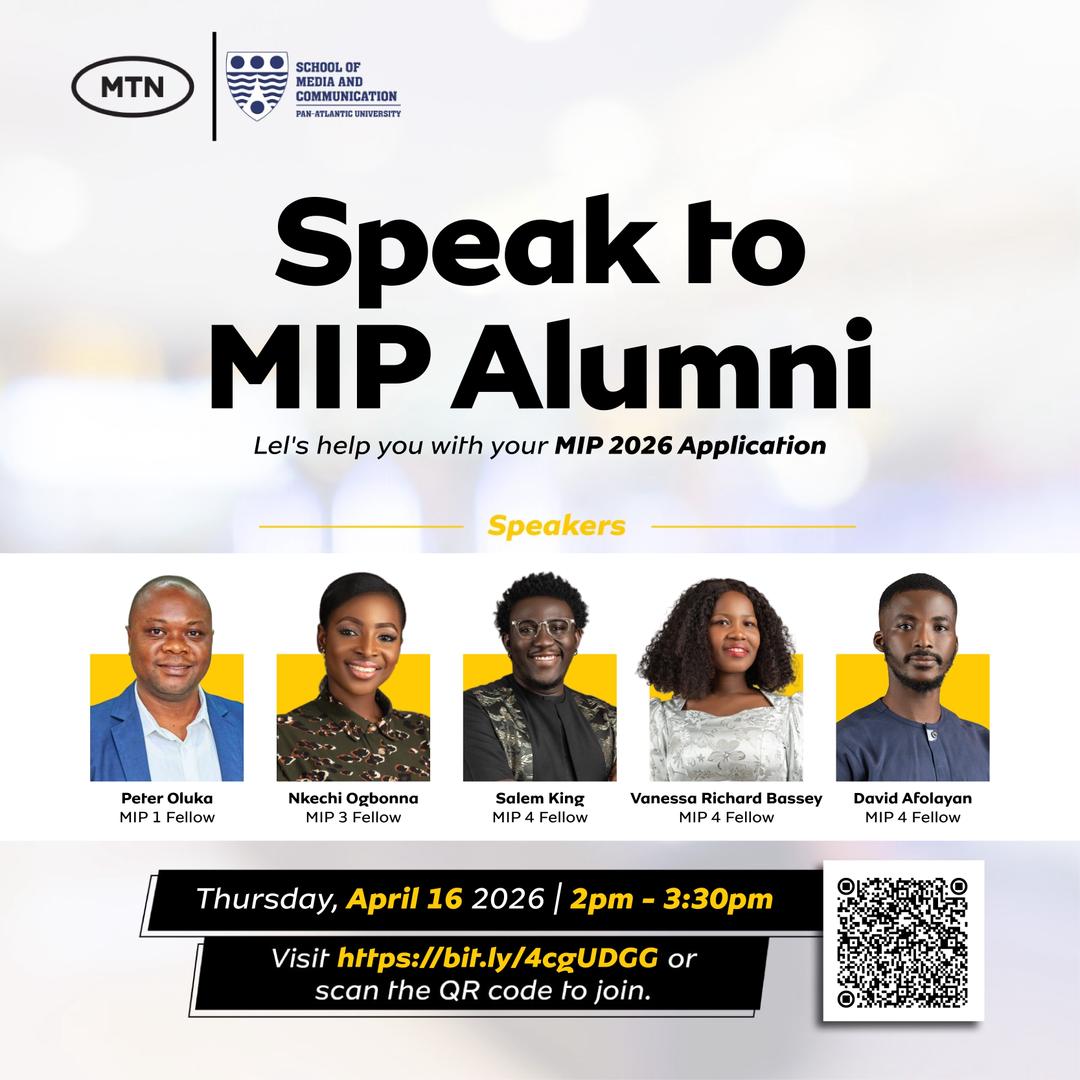
10 Reasons to Join the MTN MIP 2026 Webinar April 16

Published

on

MTN MIP 2026 Webinar

If you work in media and have been watching the industry shift around you, faster news cycles, shrinking revenues, AI in the newsroom, the MTN Media Innovation Programme may be exactly the kind of intervention your career needs right now.

Now in its fifth edition and bigger than it has ever been, MIP 2026 is calling for applications. The webinar on April 16 is your best first step.

What Is the MTN Media Innovation Programme?

The MTN Media Innovation Programme (MIP) is a certificate course run by the School of Media and Communication, Pan-Atlantic University, with a focus on the convergence between ICT and the media. It is a fellowship for journalists and media practitioners across the entire spectrum, including social media, designed to help them build capacity at both professional and business levels, delivered over a six-month period.

The programme gives participants skills to create better content, run media businesses, and earn money in a tough industry. It mixes classroom time, international trips, and real-world visits.

This year, the programme crosses a significant milestone. The cohort has been expanded to 25 fellows, up from 20 in previous editions, as a deliberate reflection of MTN Nigeria’s 25-year anniversary.

Tobe Okigbo, Chief Corporate Services and Sustainability Officer at MTN Nigeria, explained the thinking behind it: “The expansion to 25 fellows this year is a deliberate reflection of our 25-year milestone, and a reminder that as the media industry continues to evolve, there is a continued need to invest in the people and ideas that will shape its future.”

MTN is hosting a webinar on April 16 to walk prospective applicants through everything they need to know. Here is why you should be on that call.

  1. You will understand exactly what MIP is built to do. MIP is designed to increase participants’ knowledge and skill base and help them understand the changing media landscape and how to effectively use technology to create impactful media content. The webinar is your clearest path to grasping that mission before you apply.
  2. You will learn how to apply correctly, before it is too late. With less than a week between the webinar and the closing date, attendance gives you just enough time to fix mistakes and strengthen your submission before the April 22 deadline.
  3. You will know for certain whether you qualify. MIP is open to media practitioners and digital content creators across the entire spectrum, including social media. But eligibility has specific requirements. The webinar helps you confirm your fit before you invest time in the application.
  4. You will understand what the selectors are actually looking for. Shortlisted candidates are reviewed independently based on professional merit, potential impact, and their commitment to the evolution of African media. Knowing this helps you position your application more effectively.
  5. You will grasp the full scope of the curriculum. Fellows build skills in three main areas: the telecom industry, media innovation, and writing and reporting. Modules cover media entrepreneurship, ethics, fintech, 5G, financial reporting, and more. The webinar will walk you through what that looks like in practice.
  6. You will learn about the international component. Accepted participants get a seven-day, all-expenses-paid trip to South Africa for special training in Johannesburg, including a day at MTN Nigeria Headquarters and another at MTN Group Headquarters, plus industry visits and tours at an Innovation Hub.
  7. You will hear what past fellows actually experienced. The alumni speak for themselves. Oloye Ayodele Samuel, CEO of Rock FM Jalingo and a past MIP fellow, described it this way: “This fellowship is a transformative experience that has completely shifted my perspective. From Nigeria to South Africa, the training and conversations have ignited a burning desire to push beyond the status quo. It’s a new future reimagined, and it’s coming soon.”
  8. You will see the career value of the alumni network. The programme has built a strong alumni network, with participants occupying key roles across media organisations and contributing to public discourse through impactful storytelling. The webinar will show you what that network looks like and what it can open up for growth.
  9. You will get your questions answered live. A few things sharpen an application like a direct answer to the question you were afraid to ask. A live session removes the guesswork that costs candidates competitive ground.
  10. You will leave with the momentum to apply actually. Content Strategist and MIP 2 fellow Anu Odubanjo put it plainly: “If you are in the media industry, here is a life-changing opportunity you shouldn’t miss. Being selected as one of the 20 fellows for the second cohort of the fully funded media fellowship out of over 2,500 applications was definitely the highlight of 2023 for me. Truly an unforgettable experience and one I will forever cherish.”

Applications for MIP 2026 are now open.

Application Deadline: April 22, 2026.

Apply here: mtnmip.smc.edu.ng

Have questions? Join the webinar on April 16.

Click to comment

Leave a Reply

Your email address will not be published. Required fields are marked *

General

Dangote Refinery Cuts Petrol to N1,250 Per Litre, Diesel N1,700 Per Litre

Published

on

Dangote refinery petrol

By Dipo Olowookere

The ex-depot prices of two major petroleum products, Premium Motor Spirit (PMS), otherwise known as petrol, and Automotive Gas Oil (AGO), also known as diesel, have been slashed by Dangote Petroleum Refinery and Petrochemicals.

The company announced the reduction in prices of the products in a statement on Saturday evening.

The Lagos-based private refinery said its latest action was to reinforce its commitment to making refined petroleum products more affordable and supporting economic activities across Nigeria.

The cut in the prices of petrol and diesel by Dangote refinery comes as the global crude oil prices continue to moderate, amid expectations that the United States of America and Iran will agree on a ceasefire very soon and reopen the Strait of Hormuz.

This narrow vessel passage accounts for 20 per cent of the world’s crude oil consumption. It has been closed for more than two months because of the Middle East crisis.

On February 28, 2026, America and Israel launched airstrikes in Iran, killing its Supreme Leader and other top government officials.

Iran fought back by attacking US bases in the Middle East, including in Saudi Arabia, Qatar, the United Arab Emirates and others. It also shut down the Strait of Hormuz, causing the price of oil to almost hit $120 per barrel.

The crisis faraway in the Middle East, rather than becoming a blessing to Nigeria, put citizens under untold hardship, as the price of petroleum products, especially PMS, jumped from around N800 per litre to almost N1,500 per litre.

On Friday, the price of Brent crude was about $94 per barrel, while the West Texas Intermediate (WTI) crude was about $89 per barrel.

Ostensibly in response to this, the Dangote refinery has reduced the ex-depot price of petrol to N1,250 per litre from N1,275 per litre, while the price of diesel has been cut to N1,700 per litre from N1,800 per litre.

Since commencing operations, the 650,000 barrels per day refinery has increasingly supplied the domestic market with refined products aimed at eliminating the country’s dependence on imported fuels.

The company claimed it decided to slash the price to improve supply efficiency, deepen domestic refining, and provide cost relief to consumers and businesses that depend heavily on petroleum products for transportation, power generation and industrial operations.

Continue Reading

General

Customs Agents Ask Tinubu to Halt Planned Shipping Charge Hike

Published

on

National Shipping Line

By Adedapo Adesanya

The National Council of Managing Directors of Licensed Customs Agents (NCMDLCA), the umbrella body of customs agents in Nigeria, has petitioned President Bola Tinubu to compel the Nigerian Shippers’ Council (NSC) to suspend the planned increase in shipping charges pending the review by the standing committee.

According to Mr Lucky Amiwero, the president of the body, in a letter to the President, the increase is a clear contravention of the Memorandum of Understanding (MOU) signed in respect of local shipping charges between providers and users of shipping/Port and related service approved by the federal government.

The MoU under Articles 2(b)&4 clearly states that any other charges shall require agreement between the Parties concerned through the Nigerian Shippers Council, which must be complied with.

“In line with the provisions of Articles 2 and 4 of the Memorandum of Understanding, there is a need to follow the prescribed procedure as contained in the MOU. First is by submitting the information of the increase to the standing committee, including the detailed information, why the increase, and the percentage, to the standing committee for consideration and review of any increase

“We hereby request the suspension of any Local Shipping Charges increase, pending the review by the standing committee, which entails the detailed information of the increase, the Percentage (%), and if the Increase is necessary, to be sent to the standing Committee as approved by the Federal Government,” he said.

The official said the NSC were supposed to forward all detailed information on the increase in the local shipping charges to the standing committee, who are signatory to the MOU, and then to review in line with the approved federal government directive.

“We refer the government to the usual procedure of initiating an increase in local shipping charges. Notification of increase as proposed is always forwarded to the standing committee, reference 2003 NSC/TOD/FPS/011/VOL.V/54 OF 20TH JUNE, and NSC/TOD/FPS/011/VOL.35 OF 14TH April 2003 in line with article 2(b)&4 of the MOU.

“In line with Article 2(b)&4 of the memorandum of understanding, the request made by Shipping Association of Nigeria (SAN), which was forwarded to the Shippers Council and the Shippers Council forwarded the same to the technical standing committee for review,” he added.

Continue Reading

General

Presidency Raises Alarm Over Politically Motivated Deepfake Campaigns

Published

on

tinubu VDM

By Adedapo Adesanya

The presidency has raised alarm over what it described as a growing pattern of digitally manipulated content aimed at exploiting religious sentiments for political purposes.

In a public service announcement issued by the Office of Digital Engagement and Strategy, it was disclosed that “deliberate attempts” to mislead Nigerians through deep fake videos and false narratives across online platforms had been identified.

According to the statement, a manipulated video surfaced on Tuesday, featuring altered audio and false attributions designed to portray President Bola Tinubu in a negative light.

It noted that a similar attempt followed shortly after, involving a fabricated video linked to a religious leader, allegedly intended to incite Muslim communities against the President.

The presidency said the recurring pattern suggests a coordinated effort to inflame religious tensions and sow division, particularly as political activities begin to intensify ahead of future elections.

It warned that “desperate actors” are likely to continue deploying misinformation tactics, including distorting religious messages, manipulating context, and spreading provocative content through social media and messaging platforms.

The presidency urged Nigerians to exercise caution before sharing sensitive or inflammatory content, encouraging citizens to question the motives behind such materials and to verify information through credible sources.

Describing the trend as “coordinated manipulation at scale,” it stressed that such actions are neither patriotic nor reflective of genuine political engagement.

The statement further warned that individuals and groups involved in the creation and dissemination of false information would be held accountable under relevant Nigerian laws, including those relating to cybercrime, incitement, and threats to public peace and national security.

It concluded by calling on citizens to remain vigilant and united in safeguarding the country’s social cohesion against digital disinformation.

Continue Reading

Trending