Connect with us

General

Court Sentences Two Chinese for Illegal Mining in Lagos

Published

on

Two Chinese for Illegal Mining

By Modupe Gbadeyanka

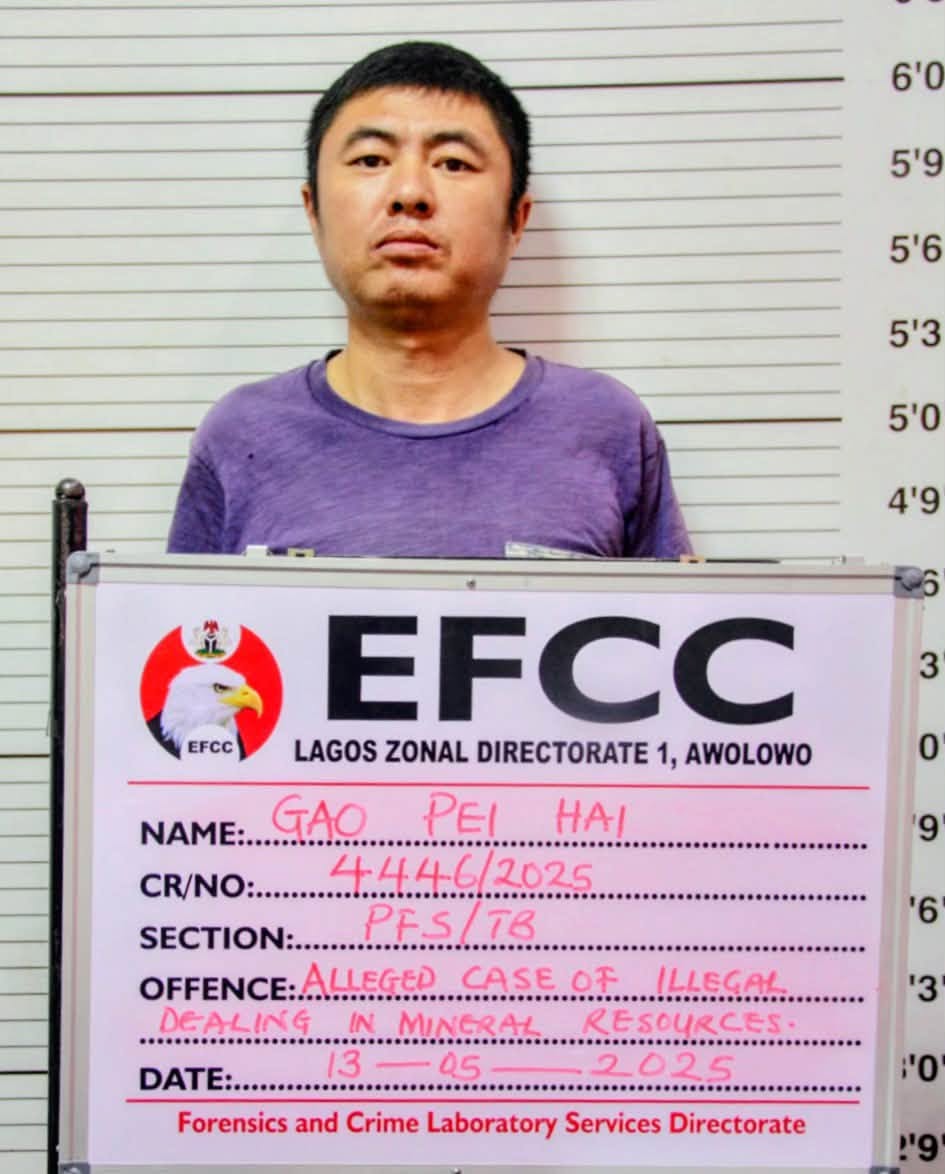
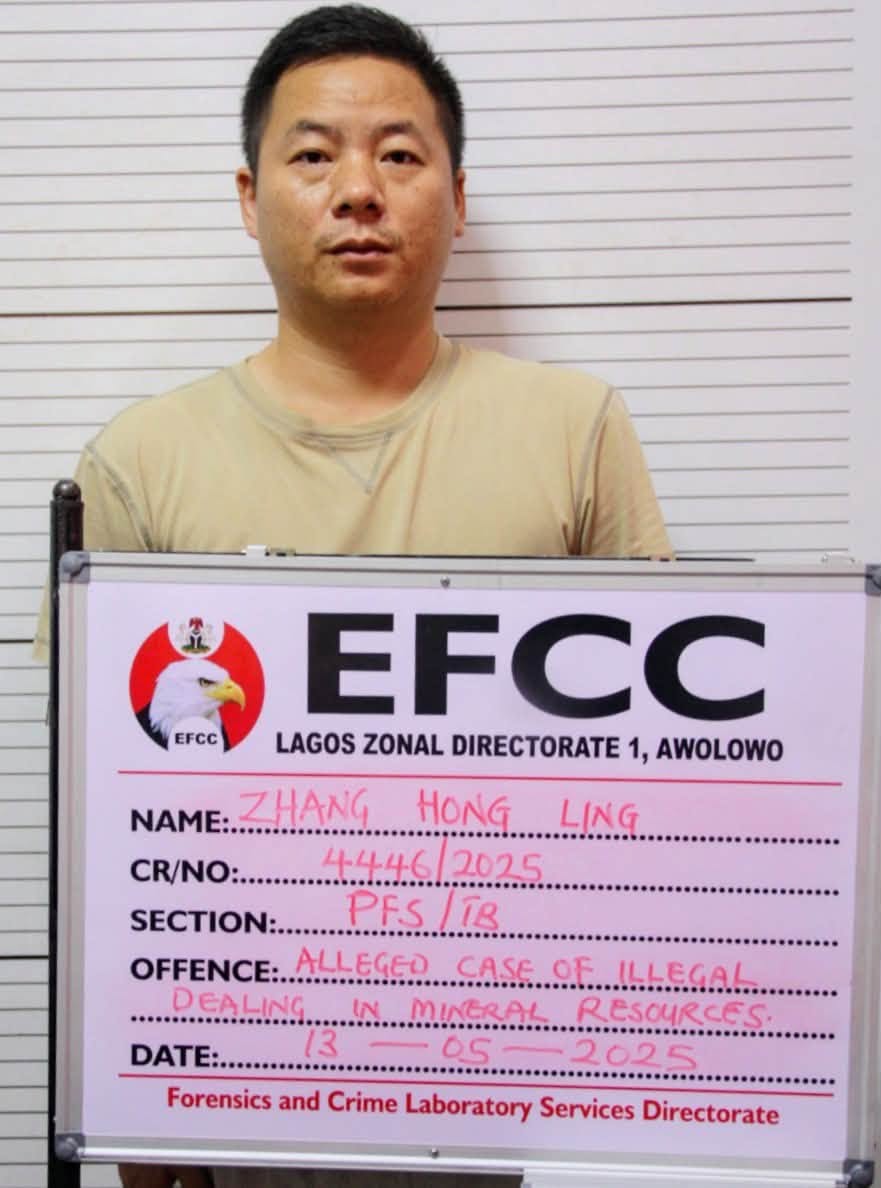
Two Chinese, Mr Zhang Hong Lin and Mr Gao Pei Hai, have been convicted and sentenced by Justice Akintayo Aluko of the Federal High Court in Ikoyi, Lagos, for conspiracy and the illegal mining of solid minerals.

They were both found guilty on all five counts levelled against them by the Economic and Financial Crimes Commission (EFCC) and sentenced each to five years’ imprisonment on each count, with an option of a N50 million fine covering all five counts.

The court also ordered the forfeiture of the mineral resources recovered from them to the Federal Government of Nigeria.

The defendants were arraigned on a five-count charge bordering on conspiracy and the unlawful possession of mineral resources intended for export without lawful authority.

“That you, Zhang Hong Lin, Gao Pei Hai, and Gao Pei Yu (currently at large), sometime in 2025 in Lagos, within the jurisdiction of this court, conspired among yourselves, with the intent to defraud the Federal Government of Nigeria of revenue accruing therefrom, and without the permission of the appropriate authority, engaged in the exportation of mica products, copper-bearing, and lithium-bearing mineral resources out of Nigeria, thereby committing an offence contrary to Section 1(8)(a) of the Miscellaneous Offences Act, 1983, and punishable under Section 8 of the same Act,” one of the charges read.

The defendants pleaded guilty when the charges were read to them, with the prosecution counsel, H.U. Kofarnaisa, calling the investigating officer, Matthew Orogwu, who reviewed the facts of the case and tendered documentary evidence before the court.

After presenting the evidence, Kofarnaisa urged the court to convict and sentence the defendants in line with the charges.
Two Chinese for Illegal Mining1

Modupe Gbadeyanka is a fast-rising journalist with Business Post Nigeria. Her passion for journalism is amazing. She is willing to learn more with a view to becoming one of the best pen-pushers in Nigeria. Her role models are the duo of CNN's Richard Quest and Christiane Amanpour.

Click to comment

Leave a Reply

Your email address will not be published. Required fields are marked *

General

NAFD, NBS Partner to Improve Nigeria’s Agricultural Database

Published

on

agriculture data analysis

By Adedapo Adesanya

The National Agricultural Development Fund (NADF) and the National Bureau of Statistics (NBS) have signed a Memorandum of Understanding (MoU) aimed at improving the generation, validation, sharing and analysis of agricultural data to support evidence-based financing, policymaking and investment in the country’s agricultural sector.

The agreement was signed on Thursday at the NADF headquarters in Abuja, marking the beginning of a strategic partnership designed to strengthen the quality and use of agricultural statistics for planning, programme implementation and impact assessment.

Speaking at the signing ceremony, the chief executive of NADF, Mr Mohammed Ibrahim, described reliable data as the foundation of effective agricultural development, saying the partnership would enable the fund to make better-informed investment decisions and deliver more impactful interventions across the country’s agricultural value chain.

He noted that although NADF was established by an Act of Parliament in 2022, the Fund has continued to build strategic partnerships that will enhance the delivery of its mandate.

According to him, the collaboration with the National Bureau of Statistics comes at a critical time as the Fund expands its support for agricultural financing, research, donor coordination and sub-national agricultural development.

“Data is our chief enabler. We want every intervention and every investment we make to be guided by credible evidence. Working with the National Bureau of Statistics will strengthen our ability to design programmes that respond to real needs and deliver measurable results,” Mr Ibrahim said.

On his part, the Statistician-General of the Federation and chief executive of NBS, Mr Adeyemi Adeniran, said the agreement represents a practical commitment by both institutions to strengthen Nigeria’s agricultural sector through better statistics and closer institutional collaboration.

He explained that the partnership would create a common framework for agricultural data exchange, validation and harmonisation, ensuring that policymakers and investors have access to reliable information.

“Agriculture deserves better data, and together we intend to build it. Reliable statistics remain the foundation of good governance, sound planning and effective investment,” Mr Adeniran said.

He added that the partnership would improve monitoring of agricultural programmes, support investment decisions and contribute to national food security by ensuring that critical decisions are driven by evidence rather than assumptions.

The Statistician-General also assured stakeholders that both organisations would maintain the highest standards of data governance and confidentiality throughout the implementation of the agreement.

He commended NADF for its growing role in agricultural development and expressed confidence that the partnership would deliver tangible benefits for farmers, policymakers and investors.

Also speaking, a representative of NADF’s Partnership and Investor Relations Department, Mr Nasir Ingawa, described the signing of the MoU as the culmination of a productive relationship between the two organisations.

He said the formal partnership would deepen collaboration and ensure that agricultural interventions are supported by credible and fit-for-purpose data.

The ceremony ended with the formal signing of the Memorandum of Understanding by the leadership of both organisations after legal representatives confirmed that the document reflected the agreed terms.

Continue Reading

General

Senate Committee Plans Public Hearing on NEITI Oil, Gas Audit Reports

Published

on

Senate old Naira notes

By Adedapo Adesanya

The Senate Committee on Public Accounts has announced a special legislative oversight and public hearing on the Nigeria Extractive Industries Transparency Initiative (NEITI) audit reports for the oil and gas sector covering the 2021, 2022 and 2023 fiscal years.

In a notice issued by the committee, its Chairman, Mr Ibrahim Dankwambo, disclosed that the exercise forms part of the committee’s constitutional oversight responsibilities under Sections 88, 89 and 85(5) of the 1999 Constitution (as amended), as well as Order 95(5)(d) of the Senate Standing Orders, 2026.

Mr Dankwambo stated that the NEITI audit reports contain detailed information on the operations, revenues, payments, remittances and financial obligations of stakeholders in Nigeria’s oil and gas industry.

According to him, the public hearing is aimed at assessing the level of compliance by ministries, departments and agencies (MDAs), government-owned enterprises, regulatory bodies and operators in the oil and gas sector with the provisions of the Constitution, the NEITI Act, Financial Regulations, the Fiscal Responsibility Act and other applicable laws governing the extractive industry.

He added that the committee would also examine issues raised in the audit reports to strengthen transparency, accountability, revenue assurance and the prudent management of public resources.

The committee has invited more than 50 public institutions and oil and gas companies to appear before it during the hearing, which is scheduled to be held in the month of August.

NEITI conducts independent audits of the extractive industries, monitors compliance with transparency standards, publishes reports on revenues, production, licensing, and financial flows, identifies discrepancies, and recommends policy reforms to strengthen accountability. It functions to improve governance and curb corruption in the management of the nation’s natural resource wealth.

Continue Reading

General

FG Rules Out Electricity Tariff Hike For Now, Eyes Stable Supply

Published

on

Joseph Tegbe Power Minister

By Modupe Gbadeyanka

The Minister of Power, Mr Joseph Tegbe, has declared that the federal government does not intend to increase electricity tariff at the moment, stressing that the priority remains improving supply to consumers across the country.

Speaking at a stakeholders’ session in Lagos on Friday, Mr Tegbe noted that, “Our objective is clear. To make electricity more available, make the grid more reliable, make the market financially sustainable and restore investor confidence. Ultimately, we want to ensure that electricity becomes a catalyst for national productivity rather than a constraint to economic growth.”

He stated that through the Presidential Metering Initiative, Nigeria is moving decisively towards universal metering because consumers deserve transparency, fairness and confidence that they only pay for the electricity they actually consume.

“This administration has also prioritised investment in transmission infrastructure, expanded rural electrification, strengthened institutional coordination across the electricity value chain, and continued to pursue reforms that encourage private capital while preserving the public interest,” the Minister said.

He affirmed the government’s commitment to improving electricity for Nigerians, having put in place adequate measures to achieve positive results in line with its renewed hope agenda.

According to him, resetting the sector does not imply that nothing has been achieved; it means building decisively upon the unprecedented reforms already initiated by President Bola Tinubu, whilst addressing long-standing structural deficiencies that have prevented the sector from reaching its full potential.

He disclosed that this administration has demonstrated strong political commitment to electricity sector reform since the liberalisation of the industry.

Mr Tegbe said the ministry has immediately commenced several significant interventions, including the inauguration of the Power Force. This initiative brings together 5,000 Nigerian Youths for meter installation across the country. This is to close the metering gap and also develop a strong, skilled pool of young Nigerians in the electricity field (NAPTIN).

Other interventions include significant progress in resolving the age-long challenges surrounding meter procurement, and encouraging improvements in electricity generation, as over the course of the last 2 weeks, the sector has consistently crossed the 5000MW mark.

“Our ambition is clear. Reliable electricity that powers our homes. Competitive electricity that powers our industries. Sustainable electricity that attracts investment. Inclusive electricity that reaches every Nigerian,” he stated.

Continue Reading