

General
Stakeholders Seek Policy Enforcement to Unlock Nigeria’s Recycling Potential

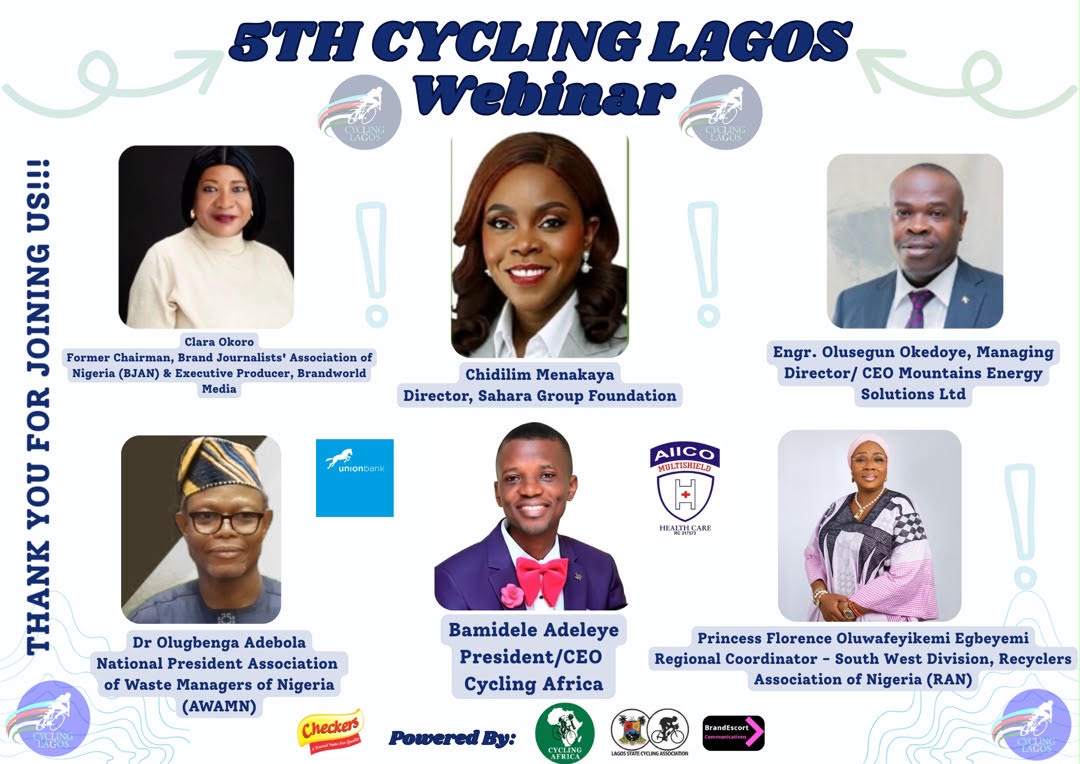
By Aduragbemi Omiyale
A call for stronger policy enforcement, increased investment, long-term financing, improved infrastructure, technology adoption and behavioural change to unlock Nigeria’s recycling potential and transform waste into economic value has been made by environmental advocates, waste managers, recycling practitioners and private-sector stakeholders.
At the 5th Cycling Lagos Webinar, themed Trash to Treasure: Unlocking Recycling Capacity for a Sustainable Future, they examined practical ways to expand recycling capacity, strengthen the circular economy and address Nigeria’s growing waste management challenges.
At the event held on Thursday, September 3, 2026, as part of activities leading up to the 5th Cycling Lagos scheduled for Saturday, September 12, 2026, at the National Stadium, Surulere, Lagos, one of the speakers, Mr Olugbenga Adebola, who is the president of the Association of Waste Managers of Nigeria (AWAMN), tasked the country to stop treating waste solely as an environmental problem and begin to recognise it as an economic resource.
“Waste is not waste unless you waste it. For a very long time, whether in Lagos, across Nigeria or across the continent of Africa, we have been wasting our waste,” he said, noting that accurate data is critical to effective waste management planning, particularly in Lagos, where he said current estimates may not adequately reflect the actual volume of waste being generated.
According to him, planning for approximately 13,000 metric tonnes of waste when actual generation exceeds 20,000 metric tonnes creates a significant deficit in collection, transportation, processing and disposal infrastructure, stating that although approximately 18 per cent of waste generated in Lagos is currently recycled, the figure remains low considering the enormous volume of recyclable materials entering the waste stream.
On her part, the Director of Sahara Group Foundation, Ms Chidilim Menakaya, called for increased investment in recycling infrastructure, technology, financing and public education, describing the country’s growing waste stream as both an environmental challenge and an economic opportunity, saying that the private sector has a critical role to play in bringing capital and investment into the sector to drive its transformation.
Also speaking, the Regional Coordinator for South-West Division of the Recyclers Association of Nigeria (RAN), Ms Florence Oluwafeyikemi Egbeyemi, said Nigeria needed to fundamentally change its approach to recycling by moving beyond waste collection to industrial transformation.
She submitted that Nigeria is generating enormous quantities of materials while industries simultaneously require reliable raw materials, creating an opportunity to connect waste recovery with industrial production.
Ms Egbeyemi identified poor product design, inadequate source separation, inefficient collection and logistics, contamination, insufficient processing equipment, energy challenges, inadequate working capital and unstable markets as some of the points where value is lost across the recycling chain, proposing a simple investment equation of Predictable feedstock + predictable quality + predictable buyer = bankability.
Another speaker, Mr Olusegun Okedoye, who is the chief executive of Mountains Energy Solutions Limited, identified weak policy enforcement, inadequate infrastructure, limited public awareness and cultural attitudes towards waste as major barriers to unlocking Nigeria’s recycling potential.
“Government has a lot of policies, there is no doubt about it, but the enforcement of those policies is nearly non-existent,” he said, calling for a sustainable infrastructure development programme that would go beyond one-off government interventions and provide a comprehensive, adequately funded and consistently implemented framework for waste segregation, collection, processing and recycling.
The convener of Cycling Lagos, Mr Bamidele Adeleye, said the Trash to Treasure theme was inspired by the urgent need to address Lagos’ growing waste challenge while unlocking the economic opportunities within the recycling value chain.
He noted that Lagos generates millions of tonnes of waste annually, including a significant volume of plastic waste, stressing that the challenge should not be viewed solely as an environmental burden.
Mr Adeleye urged participants and stakeholders to translate the discussions into concrete actions, emphasising that the waste generated today represents not only an environmental challenge but also an economic opportunity waiting to be unlocked.



Pingback: Las partes interesadas buscan la aplicación de políticas para desbloquear el potencial de reciclaje de Nigeria - Noticias Bolivia
Pingback: 【尼日利亚拉各斯】利益相关方呼吁强化政策执行,释放尼日利亚回收潜力 – 全球再生塑料资讯站