

Education
Nobel Prize 2026: Francis Halzen Wins Physics Award for Neutrino Discovery

By Adedapo Adesanya
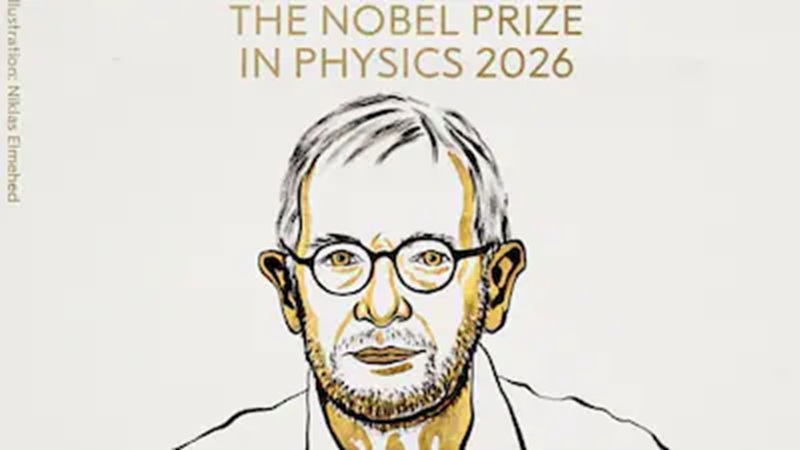
Belgian-American Particle physicist Francis Halzen won the 2026 Nobel Prize in Physics m for his decisive contributions to the IceCube Neutrino Observatory and the discovery of high-energy neutrinos of astrophysical origin.
The Royal Swedish Academy of Sciences announced the award on Tuesday, October 6, 2026, saying Halzen’s scientific vision and leadership were fundamental to the development of IceCube, a massive observatory embedded in the ice at the South Pole.
The observatory uses light sensors installed across about one cubic kilometre of clear Antarctic ice to detect neutrinos, elusive subatomic particles that can pass through the Earth and human bodies with little interaction.
According to the Academy, neutrinos produced by extremely energetic processes in distant parts of the universe can reach Earth without changing direction or losing energy. This makes them valuable messengers for studying some of the universe’s most violent environments and natural particle accelerators.
Halzen first proposed using the South Pole’s ice to detect neutrinos in 1988. When a neutrino collides with an atomic nucleus, it can produce a brief flash of light that sensors embedded in the ice can detect.
The scale of IceCube was necessary because extremely high-energy cosmic neutrinos are rare. Construction of the observatory was completed in 2011, after years of testing and development.
Researchers subsequently detected the first high-energy neutrinos and later established that some originated beyond the solar system, opening a new avenue for studying the sources and processes that produce the universe’s most energetic particles.
“Francis Halzen has led an international team of researchers and engineers who have provided us with a fantastic instrument,” said Mr Mark Pearce, Chair of the Nobel Committee for Physics.
The Academy said Halzen’s “tenacity and scientific vision” had paved the way for a new kind of astronomy, with the continuing data collected by IceCube expected to provide further insight into high-energy cosmic phenomena and potentially reveal previously unknown sources.
Halzen, born in 1944 in Tienen, Belgium, obtained his PhD from KU Leuven in 1969 before becoming a professor at the University of Wisconsin–Madison in the United States.
The 2026 Nobel Prize in Physics carries a prize amount of 12 million Swedish kronor.
The award was the second of this year’s Nobel prizes to be unveiled, following Monday’s medicine prize announcement, which went to three US-German Scientists for their work on neuroscience.
The next award will be chemistry on Wednesday.
Nobel medals are presented to the winners by Sweden’s King Carl XVI Gustaf at a ceremony in Stockholm on December 10, the anniversary of Alfred Nobel’s death. The awards are followed by an elaborate banquet at Stockholm City Hall.
The peace prize, the only Nobel not presented in Sweden, is awarded separately in Oslo.


