

Education
Nobel Prize 2026: Kagan, Soai Win Chemistry Award for Solving Mirror-Image Molecules Mystery

By Adedapo Adesanya
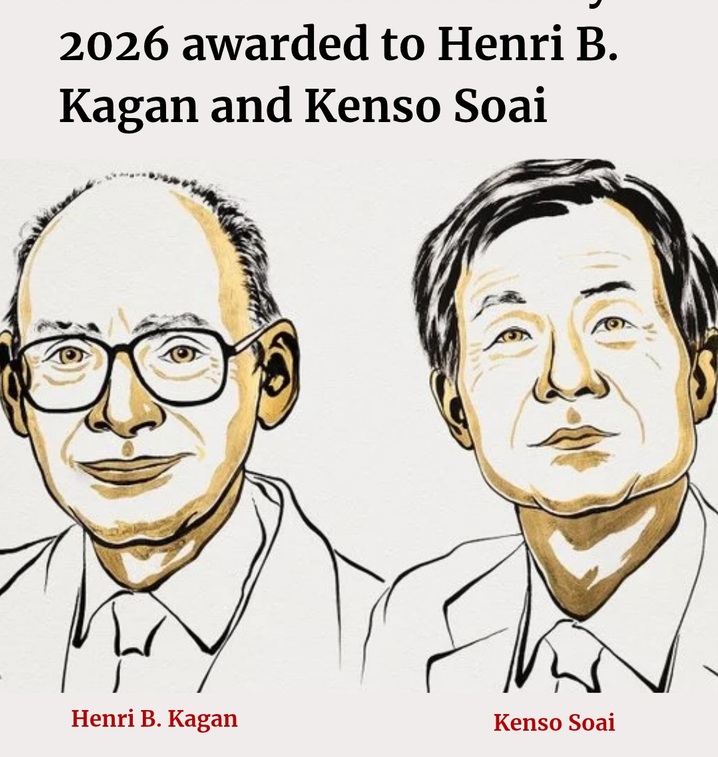
The duo of Henri B. Kagan of Université Paris-Sud, France, and Kenso Soai of Tokyo University of Science, Japan, have won the 2026 Nobel Prize in Chemistry for their discovery of non-linear effects and autocatalysis in asymmetric organic synthesis.
The Royal Swedish Academy of Sciences announced the award on Wednesday, October 7, 2026, recognising the scientists for solving a longstanding chemical puzzle over how molecules with a single “handedness” can emerge spontaneously.
According to the announcement explaining the science, some molecules, including amino acids, exist in two variants that are mirror images of each other. While both forms can be produced in chemical reactions, living organisms predominantly use only one of them.
The Academy said Kagan and Soai’s discoveries demonstrated how chemical reactions can be driven to produce predominantly, and ultimately exclusively, one of these mirror-image forms, a property known as homochirality.
The breakthrough is particularly important in pharmaceutical development, where the two mirror-image forms of a molecule can interact differently with living organisms, meaning that producing the desired form can be critical to a drug’s effectiveness.
“Henri Kagan and Kenso Soai have provided a solution to a chemical mystery that is over a century old: how homochirality can emerge spontaneously,” said Mr Heiner Linke, Chair of the Nobel Committee for Chemistry.
Kagan made the first decisive breakthrough in 1986 when he discovered a new way of manipulating chemical reactions, enabling scientists to produce a greater excess of one mirror image than had previously been considered possible.
Soai advanced the work in 1995 with a landmark publication describing the first chemical reaction with the potential to become homochiral. In 2003, he succeeded in producing a reaction in which only one of the two possible mirror-image molecules was formed.
According to the Academy, the achievement was unprecedented outside biological systems and established a new understanding of how homochirality can arise.
The discoveries have since become important to chemists developing reactions for the manufacture of pharmaceuticals and other molecules designed to interact with living systems.
Kagan, born in 1930 in Boulogne-Billancourt, France, obtained his PhD from the Collège de France in 1960 and is Professor Emeritus at the former Université Paris-Sud.
Soai, born in 1950 in Hiroshima, Japan, obtained his PhD from the University of Tokyo in 1979 and is Professor Emeritus at Tokyo University of Science.
The 2026 Nobel Prize in Chemistry comes with 12 million Swedish Kronor, which will be shared equally between the two laureates.
The next prize to be awarded will be literature on Thursday, followed by the peace prize on Friday and economics next Monday.


