Connect with us

Economy

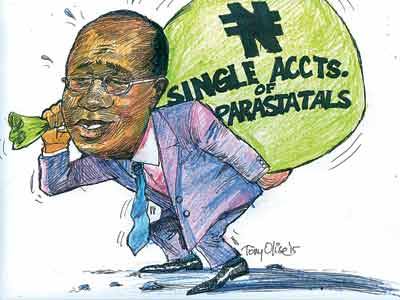
TSA: ‎Court Orders Skye Bank, UBA, 5 Others to Remit $793m to FG

Published

on

By Modupe Gbadeyanka

Seven banks operating in Nigeria have been directed by a Federal High Court sitting in Lagos to remit about $793.2 million allegedly hidden by them in violation of the Federal Government’s Treasury Single Account (TSA) policy.

The affected lenders include Skye Bank, United Bank for Africa (UBA), Diamond Bank, First Bank Nigeria Limited, Fidelity Bank, Keystone Bank Limited, and Sterling Bank.

In his ruling yesterday, Justice Chuka Obiozor ordered the banks to remit the various amounts into the designated Federal Government’s Asset Recovery dollars account domiciled with the Central Bank of Nigeria (CBN).

According to court documents filed by counsel to the Attorney General of the Federation (AGF), Mr Yemi Akinseye-George, “a total of $367.4 million was illegally hidden by three government agencies in UBA, while a sum of $41 million was illegally kept in a NAPIMS fixed deposit account with Skye Bank.”

The documents indicated that “$277.9 million was hidden in Diamond Bank; $18.9 million in First Bank; $24.5 million in Fidelity Bank; $17 million in Keystone Bank; and $46.5 million in Sterling Bank.”

A lawyer from Mr Akinseye-George’s law firm, Mr Vincent Adodo, who deposed to a 15-paragraph affidavit in support of an ex parte application filed by the AGF, stated that “seven banks colluded with federal government officials to hide the funds in breach of the government’s TSA policy.”

“The funds were revenues, donations, transfers, refunds, grants, taxes, fees, dues, tariffs etc accruable to the Federal Government from different ministries, departments, parastatals and agencies,” said Mr Adodo.

Mr Adodo said the banks had failed to remit the funds to the TSA domiciled in the CBN in violation of the guidelines issued by the Accountant General of the Federation which fixed September 15, 2015 as the deadline for such funds to be moved.

The 1st to 7th respondents (banks), he said, “in collaboration with and/or collusion with unknown officials of the Federal Government, conspired to disobey the relevant constitutional provisions, thereby depriving the Government of the Federal Republic of Nigeria of funds belonging to it, which are needed urgently to fund pressing national projects under the 2017 budget.”

Among the allegedly culpable government agencies is the National Petroleum Development Company.

Moving the ex-parte application on Thursday, Mr George said “it would best serve the interest of justice for Justice Obiozor to order the banks to remit the funds to the Federal Government, to prevent the funds from being moved or dissipated.

“The withheld funds are urgently required for the implementation of the 2017 budget. The budget has a lifespan of 12 months and we are already in the middle of the year. By hiding these funds, the Federal Government is being forced to borrow money from these commercial banks at exorbitant interest rate,” Mr Akinseye-George added.

After listening to the counsel, Justice Obiozor granted the interim orders.

He directed that the order should be published in a national daily newspaper.

He, subsequently, adjourned till August 8, 2017, for anyone interested in the funds to appear before him to show cause why the interim orders should not be made permanent.

‘We are not guilty’

In a swift response to the judge’s decision, Fidelity Bank Plc denied holding any wrongdoing.

Mr Charles Aigbe, the Divisional Head, Brand and Communications at the bank, said since the commencement of the TSA policy, all TSA related accounts held by the bank were fully disclosed to the authorities.

“We do not have any TSA related account with a balance of $24.5m in Fidelity Bank which has not been remitted to the authorities,” Mr Aigbe said in a statement.

“This matter is coming to us as a surprise. We are therefore reaching out to the Office of the Attorney-General of the Federation to ascertain which account or parastatal they are referring to with a view to carrying out a detailed reconciliation,” he added.

Also, UBA’s Group Head, Marketing & Corporate Communications, Bola Atta, in a statement on Friday afternoon, said her bank “has fully remitted all NNPC/NLNG dollar deposits since August 24, 2016.”

“We hereby emphasise that none of such funds are currently in the Bank’s books. Our action was further corroborated by a clearance memo published by CBN on its website on same date (http://www.cbn.gov.ng/Out/2016/CCD/UBAPress%20Statement240816.pdf).

“We would like to thank all our customers, business partners and other stakeholders who have reached out to us on account of this judgement,” she said.

Additional information from Premium Times

Modupe Gbadeyanka is a fast-rising journalist with Business Post Nigeria. Her passion for journalism is amazing. She is willing to learn more with a view to becoming one of the best pen-pushers in Nigeria. Her role models are the duo of CNN's Richard Quest and Christiane Amanpour.

Click to comment

Leave a Reply

Your email address will not be published. Required fields are marked *

Economy

NASD OTC Exchange Inches Up 0.03% as CSCS Outshines Four Price Decliners

Published

on

Nigerian OTC securities exchange

By Adedapo Adesanya

Central Securities Clearing System (CSCS) Plc bested four price decliners on the NASD Over-the-Counter (OTC) Securities Exchange on Monday, April 27. The alternative stock market opened the week bullish during the session with a 0.03 per cent uptick.

According to data, the security depository company added N2.61 to its share price to close at N76.26 per unit compared with the preceding session’s N78.87 per unit.

As a result, the market capitalisation of the platform increased by N820 million to N2.425 trillion from N2.424 trillion, and the NASD Unlisted Security Index (NSI) gained 1.38 points to finish at 4,053.97 points compared with the 4,052.58 points it ended last Friday.

The four price losers were led by NASD Plc, which slumped by N3.80 to sell at N34.70 per share versus N38.50 per share. FrieslandCampina Wamco Nigeria Plc fell by N1.45 to N98.10 per unit from N99.55 per unit, Food Concepts Plc slid by 27 Kobo to N2.43 per share from N2.70 per share, and Geo-Fluids Plc dipped by 9 Kobo to N2.91 per unit from N3.00 per unit.

The value of securities transacted by market participants went down by 82.0 per cent to N7.4 million from N41.3 million units, the volume of securities declined by 28.5 per cent to 319,831 units from 447,403 units, and the number of deals dropped by 34.1 per cent to 29 deals from 44 deals.

Great Nigeria Insurance (GNI) Plc was the most active stock by value on a year-to-date basis with 3.4 billion units worth N8.4 billion, followed by CSCS Plc with 59.6 million units sold for N4.0 billion, and Okitipupa Plc with 27.8 million units exchanged for N1.9 billion.

Also, GNI Plc was the most traded stock by volume on a year-to-date basis with 3.4 billion units valued at N8.4 billion, followed by Resourcery Plc with 1.1 billion units traded for N415.7 million, and Infrastructure Guarantee Credit Plc with a turnover of 400 million units worth N1.2 billion.

Continue Reading

Economy

Naira Opens Week Weaker at N1,364/$ at NAFEX After N5.80 Loss

Published

on

NAFEX Rate

By Adedapo Adesanya

The first trading day of the week in the currency market was bearish for the Naira in the Nigerian Autonomous Foreign Exchange Market (NAFEX) on Monday, April 27.

Yesterday, it lost N5.80 or 0.43 per cent against the United States Dollar to trade at N1,364.24/$1, in contrast to the N1,358.44/$1 it was traded last Friday.

In the same vein, the Nigerian currency depreciated against the Pound Sterling in the official market by N13.70 to close at N1,847.72/£1 versus the preceding session’s N1,834.02/£1, and slumped against the Euro by N11.56 to sell at N1,602.29/€1 versus N1,590.73/€1.

Also, the Nigerian Naira tumbled against the greenback during the trading day by N5 to quote at N1,385/$1 compared with the previous rate of N1,380/$1, and at the GTBank FX desk, it traded flat at N1,370/$1.

The poor performance of the domestic currency could be attributed to liquidity shortage at the official currency market on Monday, which came amid surging demand for international payments. At $76.50 million, interbank liquidity printed higher across 79 deals, up from the $43.572 million reported on Friday.

Nigeria’s gross external reserves declined to $48.45 billion amid a month-long decline in inflows, amid uncertainties in the global commodity market. The depletion of foreign reserves could be partly attributed to the Central Bank of Nigeria’s intervention in the FX market.

The market remains perturbed by persistent concerns over liquidity constraints, policy transparency, and weakening confidence in Nigeria’s FX market, while boosters, including oil prices, continue to look rocky due to stalled discussions and unclear ceasefire negotiations between the US and Iran.

A look at the cryptocurrency market, Bitcoin (BTC) has been rejected near $79,000 three times in eight sessions, leaving the level as the de facto ceiling of its current trading range even as major cryptocurrencies trade lower over the past day. It lost 0.9 per cent to sell at $77,003.61.

Analysts say that upcoming US Federal Reserve policy decisions and top tech firms’ earnings this week could provide the catalyst to push bitcoin decisively above $80,000.

The market also continued to weigh Iran’s interim deal proposal to reopen the Strait of Hormuz, which failed to advance over the weekend. The White House said US officials were discussing the latest Iranian proposal but maintained “red lines” on any deal to end the eight-week war.

Solana (SOL) dropped 1.8 per cent to $84.25, Ripple (XRP) went down by 1.6 per cent to $1.39, Ethereum (ETH) depreciated by 1.3 per cent to $2,290.00, Binance Coin (BNB) declined by 0.5 per cent to $625.18, and Cardano (ADA) fell by 0.2 per cent to $0.2480.

However, Dogecoin (DOGE) rose by 2.0 per cent to $0.1002, and TRON (TRX) appreciated by 0.2 per cent to $0.3242, while the US Dollar Tether (USDT) and the US Dollar Coin (USDC) remained unchanged at $1.00 apiece.

Continue Reading

Economy

NASCON Targets Deeper Cost Optimisation, Accelerated Digital Transformation, Others

Published

on

NASCON AGM shareholders

By Aduragbemi Omiyale

One of the leading salt makers in Nigeria, NASCON Allied Industries Plc, has set its eyes on some strategies aimed to deliver more value to shareholders.

The chief executive of the company, Mrs Aderemi Saka, said efforts are being made to surpass the performance of last year.

In the 2025 financial year, the organisation recorded a 27 per cent growth in revenue, while post-tax profit grew by over 100 per cent to N33.5 billion, with the earnings per share (EPS) expanding by 115 per cent to N12.41 from N5.77 Kobo in the previous year.

The impressive performance, attributed to a clear strategic vision, disciplined execution and sustained focus on cost-saving initiatives across production, logistics and fleet management, resulted in a 200 per cent increase in dividend payout to shareholders to N6 per share.

Mrs Saka, at the firm’s Annual General Meeting (AGM) in Lagos, said the strategic priorities for the coming year include deeper cost optimisation, expanded market penetration, strengthened energy diversification and sustainability initiatives, as well as accelerated digital transformation and process automation.

Earlier, the chairman of NASCON, Mr Olakunle Alake, informed shareholders that the achievements for last year were due to improved operational efficiency, strict cost management and the dedication of the company’s workforce.

“The operating environment in 2025 was characterised by economic volatility, persistent inflation and structural changes across key sectors. Yet, NASCON remained resilient and strategically focused, delivering outstanding value to shareholders,” Mr Alake said.

He noted that operational sustainability remains a core pillar of the organisation’s strategy, stressing that during the year, NASCON introduced Compressed Natural Gas (CNG) trucks into its logistics fleet to reduce fuel costs and minimise exposure to diesel price volatility.

In addition, the company’s state-of-the-art salt refinery, its largest production facility, now runs entirely on natural gas, significantly boosting efficiency while reinforcing NASCON’s commitment to environmental sustainability.

A director in the organisation, Mrs Tonya Lawani, emphasised that the firm remains firmly committed to the principles that have driven its excellent performance, noting that NASCON approaches the new financial year from a position of strength, with further opportunities for growth and improvement.

Speaking on behalf of shareholders, Mr Faruk Umar expressed strong confidence in the company’s trajectory, citing NASCON’s rising share price, which recently crossed the N100 mark, and projecting further appreciation.

He commended the quality of the Board and management team, noting that strong leadership and recent executive appointments have positioned the entity to deliver even greater value to all stakeholders.

Continue Reading

Trending