

Sports
How Playing Faster Can Increase Casino Losses

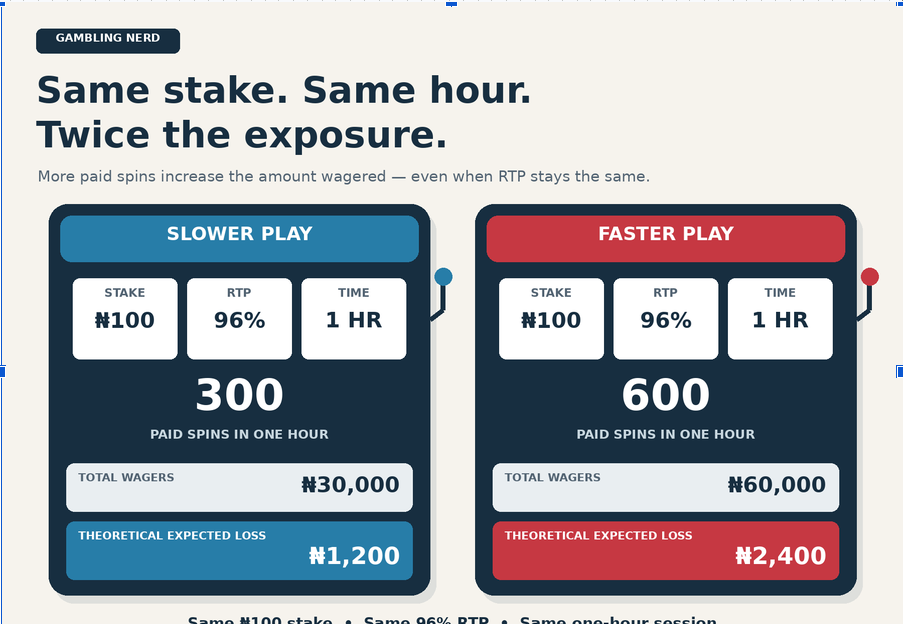
A casino player can keep the same stake, play for the same amount of time, and still put twice as much money through a game. The difference is how often the game accepts another bet.
For Nigerian readers comparing digital gambling products, speed is a cost factor that can be easy to overlook. GamblingNerd.com’s analysis shows how more paid rounds can increase theoretical expected losses even when the game’s rules and payout percentage remain unchanged.
The issue extends beyond slots. Live casino tables and game shows also create different opportunities to place bets within an hour. A product’s colourful features may attract attention, but its pace helps determine how much a customer can wager before the session ends.
The ₦100 Bet That Keeps Repeating
Consider Tunde, a fictional player staking ₦100 on each paid spin of a slot.
In the first scenario, he completes 300 paid spins in an hour. His total wagers reach ₦30,000.
In the second, he completes 600 paid spins during the same hour. His total wagers reach ₦60,000.
The stake has not changed. Neither has the session length. He has simply placed twice as many bets.
Now assume both scenarios use the same theoretical return to player, or RTP, of 96%. That means the game’s theoretical house edge is 4%: over the long run, its mathematical design returns 96% of wagers and retains the remaining 4%.
Across ₦30,000 in wagers, the theoretical expected loss is ₦1,200. Across ₦60,000, it is ₦2,400.
These are illustrative calculations, not observed results or predictions for Tunde’s next session. The spin counts are assumptions used to isolate the effect of speed, rather than measured rates for a particular game.
The comparison also assumes he has enough money available to complete every spin.
Total Wagers Are Different From Deposits
Tunde does not necessarily need to deposit ₦30,000 to generate ₦30,000 in wagers. Money returned from earlier spins can be bet again.
Suppose he stakes ₦100 and receives a ₦60 payout. His net loss on that spin is ₦40, although the game has returned some money to his balance. If he places another ₦100 bet, his cumulative wagers reach ₦200.
That repeated movement of funds explains why the amount passing through a game can be much larger than the initial deposit.
The house-edge guide from Gambling Nerd explains the underlying calculation: theoretical expected loss depends on the total amount wagered and the game’s mathematical advantage.
The guide forms part of the Nerd Nook Hub at GamblingNerd.com. For this example, the calculation is total wagers multiplied by 4%.
It does not establish how much money Tunde should deposit or how long his balance will last.
A Higher Return Percentage Can Be Offset by More Play
A game with a higher theoretical return can still produce greater expected losses per hour if the customer wagers substantially more.
Consider a second comparison at the same ₦100 stake.
A hypothetical game with 96% RTP and 300 paid spins generates ₦30,000 in wagers and ₦1,200 in theoretical expected losses.
Another game with a higher 97% RTP but 600 paid spins generates ₦60,000 in wagers. Its lower 3% house edge produces ₦1,800 in theoretical expected losses.
The second game has the more favourable return percentage. Yet the larger wagering volume produces a higher expected cost over the hour.
There is no contradiction. RTP describes the theoretical return per amount wagered. It does not account for how quickly a customer repeats the bet.
Why This Matters for Game Providers and Operators
Business Post’s coverage of recent live-casino releases highlights products from suppliers including Pragmatic Play, Evolution and Playtech. Different formats give operators more ways to present casino entertainment.
The calculations here do not describe the speed or return of those particular releases. Comparing actual products would require checking their rules, available bets and measured pace.
For operators and suppliers, however, the distinction between cost per bet and exposure per hour matters. Shorter intervals between paid rounds can create more wagering opportunities within a fixed session.
That does not mean customers will always use every opportunity. Some will pause, skip rounds or stop when they reach a spending limit. Technical delays, bonus sequences and changes in the available balance also affect the number of bets completed.
More wagers do not translate directly into an equal amount of operator profit, either. Actual payouts fluctuate, and businesses still face payment charges, supplier fees, taxes and operating expenses.
Game Speed Has Also Drawn Regulatory Attention
Britain’s Gambling Commission has treated game speed as a player-protection issue.
Its assessment of online slot design changes, published in 2023, reported evidence of reduced play intensity after a package of measures introduced in 2021. Those measures included restrictions on spin speed and the removal of certain features.
The assessment covered several changes together. It should not be read as proof that speed alone caused every observed difference, or as evidence that British requirements apply in Nigeria.
It does demonstrate why the design of a game deserves scrutiny alongside its advertised payout figures.
A Short Session Can Still Contain Many Bets
Setting a time limit can help control a gambling session, but elapsed time alone does not reveal the amount wagered.
Two players who each spend 30 minutes on a game may complete very different numbers of paid rounds. One may also use larger stakes or optional paid features.
A clearer record includes time spent, total wagers and the net change in balance. These measure different things.
Total wagers show how much money has passed through the game, including recycled payouts. The balance change shows the actual financial result. Time shows how long the activity lasted.
For operators, making those figures easy to find would give customers a more useful picture than a session timer alone.
Slower Play Does Not Remove the House Edge
Playing more slowly reduces wagering volume over a fixed period when the stake and other conditions remain the same. It does not change the game’s underlying mathematics.
A slower player can still lose the entire amount set aside. A faster player can finish a particular session ahead. Short-term outcomes vary, sometimes sharply.
The practical point is to set spending and time limits before playing, then account for the number and size of bets within those limits. A low stake can become a substantial cumulative amount when repeated often.
In Tunde’s example, the ₦100 stake never changes. The theoretical expected cost doubles because the number of paid spins doubles. The small number on the spin button tells only part of the spending story.
About Gambling Nerd
Gambling Nerd is an independent gambling media website publishing experience-based reviews, guides and analysis of online casinos, sportsbooks and poker sites for gamblers of all experience levels worldwide. Originally launched as gamblingsites.org in 2007 and rebranded as GamblingNerd.com in 2025, the site covers the United States, Canada, Australia and selected European jurisdictions. Its editorial team is based across the United States. Its Nerd Nook Hub covers the mathematics of casino games, betting systems and sports betting strategy.