Connect with us

Economy

Traders Jubilate as Wike Vows to Revamp Creek Road Market

Published

on

By Dipo Olowookere

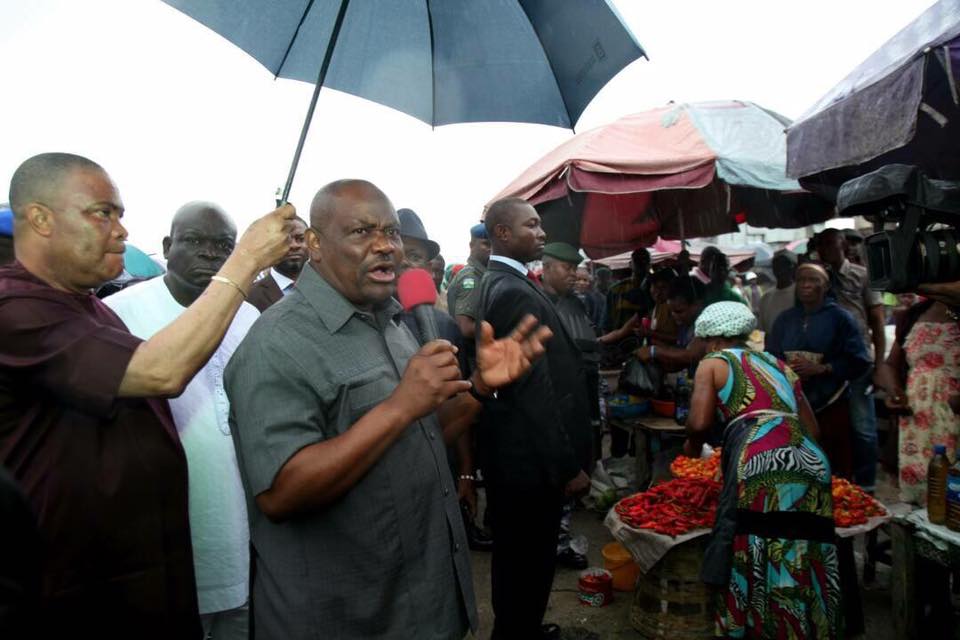
Traders at the Creek Road Market in Port Harcourt have been assured by the Rivers State Governor, Mr Nyesom Wike, that the market would be reconstructed.

The Governor made this known when he inspected projects in the area on Monday.

During the visit, Mr Wike appealed to some of the market women trading on the middle of the road to immediately vacate the road.

He explained that he had to personally interface with the market women because the contractor handling the road complained that the traders were obstructing ongoing construction work.

According to the Governor, there was no need to apply force because the construction of the road would be beneficial to the market women.

“I am here to personally appeal to you to stop trading on the middle of the road. This will allow the contractors to continue with their job.

“The contractors must finish this job. It will not be wise that the state’s money is lost because you are distracting the contractors. Please assist me by leaving the middle of the road, so that they can work,” he appealed to the trader.

In a related development, in line with the directive of Governor Wike, engineers from Julius Berger and the State Ministry of Works started preliminary work at different flood impacted locations in the state.

It will be recalled that the Rivers State Governor inspected flood impacted locations on Sunday where he directed immediate remedial measures.


Dipo Olowookere is a journalist based in Nigeria that has passion for reporting business news stories. At his leisure time, he watches football and supports 3SC of Ibadan. Mr Olowookere can be reached via [email protected]

Click to comment

Leave a Reply

Your email address will not be published. Required fields are marked *

Economy

Company Income Tax Falls 49.8% to N1.49trn in Q4 2025

Published

on

company Income Tax

By Adedapo Adesanya

Revenue from Company Income Tax (CIT) in the fourth quarter of 2025 decreased by 49.8 per cent to N1.487 trillion from N2.96 trillion in the third quarter of 2025, according to the National Bureau of Statistics (NBS).

The figure was contained in the NBS Company Income Tax (CIT) Q4 2025 Report released in Abuja on Wednesday by the stats office.

CIT is a statutory levy imposed on the profits of incorporated businesses in Nigeria. It is governed primarily by the Companies Income Tax Act (CITA) and administered by the Nigeria Revenue Service (NRS).

The report said domestic CIT received was N819.83 billion (55 per cent), while foreign CIT payment was N668.21 billion (45 per cent) in Q4 2025.

It said on a quarter-on-quarter basis, activities of extraterritorial organisations and bodies recorded the highest growth rate with 75.15 per cent,

The report said this was followed by Education and real estate activities at 54.20 per cent and 27.25 per cent, respectively.

“On the other hand, accommodation and food services activities recorded the least growth rate at -67.11 per cent, followed by activities of households as employers, undifferentiated goods and services producing activities of households for own use at -63.49 per cent.

“It said mining quarrying was recorded at -49.63 per cent.”

In terms of sectoral contributions, the report showed that the top three activities with the highest contribution in Q4 2025 were financial and insurance activities at 18.17 per cent, manufacturing at 17.30 per cent and mining and quarrying at 15.04 per cent.

It said, on the other hand, the activities of households as employers, undifferentiated goods and 0.002 per cent.

“This was followed by water supply, sewage, waste management and remediation activities with 0.04 per cent.

The report, however, said that, on a year-on-year basis, CIT collections in Q4 2025 increased by 13.38 per cent from Q4 2024.

Continue Reading

Economy

Nigeria’s Economic Recovery Yet to Improve Welfare, Says World Bank

Published

on

Covid nigerian economy1

By Adedapo Adesanya

The World Bank has warned that Nigeria’s economic recovery has yet to improve household welfare as wage growth continues to lag behind inflation, leaving real incomes under pressure.

This was disclosed in its April 2026 Nigeria Development Update titled Nigeria’s Tomorrow Must Start Today: The Case for Early Childhood Development.

According to the report, while the Nigerian economy recorded moderate growth in 2026, following expansions of 4.1 per cent in 2024 and 4.0 per cent in 2025, the gains have not translated into improved living standards for most citizens.

It stated that growth was largely driven by the services sector, particularly ICT, financial services, and real estate, while agriculture and crude oil production made modest contributions.

On inflation, the report said price pressures have eased but remain in double digits, partly due to the impact of the Middle East conflict.

The lender noted that multidimensional poverty and weak early childhood development outcomes are threatening Nigeria’s long-term economic potential, despite signs of macroeconomic recovery.

The report explained that Nigeria is facing a deep early childhood development crisis, with poor outcomes in health, nutrition, and learning undermining productivity and future growth.

It emphasised that early childhood development, especially from pregnancy to age five, is critical to reversing the trend.

“Investments during this period generate lasting benefits, including better education outcomes, higher earnings, lower health costs, and stronger social cohesion. Investments during this period are highly cost-effective,” the report said.

The report highlighted alarming child welfare indicators, noting that 110 out of every 1,000 Nigerian children die before the age of five, 40 per cent are stunted, and 52 per cent are not developmentally on track before entering school.

It attributed these outcomes to persistent gaps in maternal healthcare, nutrition, early learning, and access to water and sanitation, particularly within the first 2,000 days of a child’s life.

The bank added that these outcomes remain “weak and highly unequal,” with significant disparities across income levels, regions, and states.

The report further revealed that favourable external inflows boosted reserves, with net external reserves rising to $34.8 billion at the end of 2025, while gross reserves reached $45.5 billion, equivalent to 8.7 months of imports.

However, it noted that Nigeria’s fiscal deficit widened slightly in 2025, as increased non-oil revenues were offset by higher state-level capital spending and federal recurrent expenditure.

“Federation Account Allocation Committee (FAAC) gross revenues rose from 7.9 per cent of GDP in 2024 to 8.5 per cent in 2025, driven by strong non-oil tax collections reflecting improved tax administration.

“This includes expanded e-filing and e-payments, higher compliance ahead of the implementation of the new tax bills, and the rollout of VAT e-invoicing, alongside a 0.2 per cent of GDP rise in subnational internally generated revenues,” the report stated.

Continue Reading

Economy

We Don’t Know When Our FY 2025 Results Will be Ready—Caverton

Published

on

Caverton

By Aduragbemi Omiyale

One of the players in the Nigerian aviation sector, Caverton Offshore Support Group Plc, has informed the investing public that it is unsure when it will file its audited financial statements for 2025.

Companies listed on the Nigerian Exchange (NGX) Limited are required to submit their audited financial results at most three months after the end of the fiscal year.

For Caverton, it was supposed to release the financial statements for 2025 on or before March 31, 2026; however, it has not done the needful.

In a statement to explain the delay in the filing of the results, the company said it has not completed the audit, and does not know when this process will be concluded by its external auditor.

“The delay in filing the 2025 AFS arises from the fact that the audit of the company’s financial statements is still ongoing. The company is working closely with its external auditors to conclude the audit process.

“However, as at the date of this notice, the audit has not been finalised due to the need to complete certain outstanding review procedures and obtain final audit clearances to ensure the accuracy, completeness, and integrity of the financial statements,” Caverton explained.

It further said, “While significant progress has been made, the audit process has not reached completion, and as such, the company is currently unable to confirm a definitive timeline for the finalisation and filing of the AFS.”

“The company considers it prudent not to provide an anticipated filing date at this time in order to avoid providing information that may subsequently require revision,” it further stated in the statement signed by its scribe, Ms Amaka Obiora.

Caverton assured “its shareholders and the market that it remains fully committed to maintaining the highest standards of financial reporting, transparency, and regulatory compliance,” promising to promptly file the results “upon completion of the audit process.”

Continue Reading

Trending