Travel/Tourism
Lagos Slumps as Travel to Africa Displays Double-Digit Growth
By Dipo Olowookere
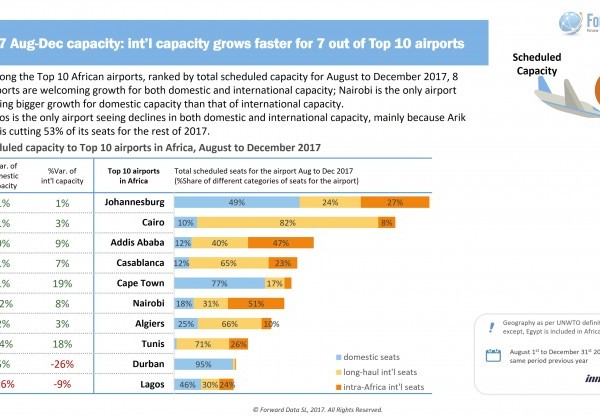
An analysis of seat capacity for travel to the top ten international airports in Africa, produced by ForwardKeys, reveals that Lagos is seeing substantial declines in both domestic and international capacity, mainly because Arik Air is cutting 53 percent of its seats for the rest of 2017.
During the coming five months, August – December 2017, there will be 16 percent fewer airline seats on domestic routes and 9 percent fewer and on international routes to and from Lagos.
Commenting on this data, Jon Howell, Managing Director of AviaDev, Africa’s leading airline route development conference, said: “One of the major reasons for falling arrivals by air to Nigeria, is the fact that many airlines could not repatriate funds after the currency crisis in 2016.
“As a result, Iberia and United Airlines have ceased operations to Nigeria, whilst Emirates and the other foreign carriers have scaled back services.
“The Nigerian airlines have suffered too and so this void has been filled by the ever-opportunistic Ethiopian Airlines, who began serving their fifth Nigerian destination, Kaduna on August 1, 2017 and are now the largest carrier in the Nigerian market.”
Most of the other airports in Africa’s top ten are seeing a healthy growth in capacity, which is more international than it is domestic. However, the most notable exception to this trend is Nairobi, which is seeing a 22 percent boost in domestic capacity.
These findings are part of a wider report on travel to Africa, produced by ForwardKeys, which predicts future travel patterns by analysing 17 million booking transactions a day. It shows double digit growth in flight arrivals for the first half of this year and little indication that the pace of growth will slow down soon.
The wider report will make encouraging reading for airlines, governments and hoteliers planning to discuss possible new aviation routes at AviaDev in Kigali in October. (AviaDev is organised by Bench Global Business Events.)
The report reveals that in the first seven months of the year, 1st Jan – 31st July 2017, total international flight arrivals grew by 14.0 percent over the same period in 2016.
Most significantly, growth was stronger for travel to and from the continent than within the continent.
Arrivals from Europe, which make up 46 percent of the market, were up 13.2 percent. From the Americas, arrivals were up 17.6 percent; from the Middle East, they were up 14.0 percent and from Asia Pacific, they were up 18.4 percent. By comparison, intra-African air travel, which makes up 26 percent of the market, was up 12.6 percent.
Looking at Africa’s top ten destination countries, there have been stand-out performances from Tunisia and Egypt, which are recovering from notorious terrorist attacks two years ago, up 33.5 percent and 24.8 percent respectively.
In addition, Morocco and Tunisia received a huge boost in arrivals from China, up 450 percent and 250 percent respectively, after they relaxed visa restrictions. The one disappointment is Nigeria, which has seen a 0.8 percent drop, in the wake of recession in 2016, caused by a collapse in the oil price to a 13-year low.
Looking forward to the end of the calendar year, bookings for flights to Africa are currently 16.8 percent ahead of where they were on July 31, 2016. Bookings from Europe are currently 17.5 percent ahead, from the Americas 26.6 percent ahead, from Asia Pacific 11.5 percent ahead, from the Middle East 8.2 percent ahead and bookings for intra-African air travel are 11.0 percent ahead.
A specific look at East Africa shows very similar trends in year to date performance and outlook to the end of the year.
However, it has stronger forward bookings from Europe, 22.9 percent ahead and less strong forward bookings from elsewhere; the Americas are 15.5 percent ahead and intra-African air travel 7.6 percent ahead.
However, bookings from the Middle East and Asia Pacific are 6.0 percent and 3.8 percent behind respectively.
On an individual airport level, the most significant capacity increase in East Africa is at Kigali, with new routes to Brussels, London and Mumbai. Other notable new capacity includes Kilimanjaro to Dubai and Nairobi to Muscat and to Yemen.
Olivier Jager, CEO, ForwardKeys, said: “The growth in air travel to Africa is impressive. However, it is notable that consumer demand and airline investment is greater in travel to African countries from outside the continent than it is between African countries.”
Jon Howell, Aviation and Tourism Development Manager, Bench Events, who is responsible for AviaDev, concluded: “As an international executive who has travelled around Africa for many years, I am longing for the day when it is easier to fly directly between African cities, as is possible on other continents.
“I am sure I’m not alone in that desire and I’m equally sure, it will happen eventually. That’s why I’m determined that the discussions that will take place at AviaDev will help bring that vision closer.”
Travel/Tourism
Tinubu Okays 30% Debt Relief to Airlines, Orders Fuel Price Talks
By Adedapo Adesanya
President Bola Tinubu has approved a 30 per cent relief on debts owed by local airlines to aviation agencies and ordered talks involving fuel marketers, airlines, and regulators to reach a fair jet fuel price.
He had earlier agreed in principle to write off part of domestic airlines’ debts to aviation agencies following successful talks with the Airline Operators of Nigeria (AON).
The group demanded a total waiver of debts owed to aviation agencies to cushion the effect of a 300 per cent increase in aviation fuel prices during a crucial high-level meeting with the Minister of Aviation and Aerospace Development, Mr Festus Keyamo and other critical stakeholders in Abuja.
Recall that the airlines had called off their impending strike due to commence on Monday over the rising cost of operations, particularly for fuel, triggered by the current Middle East crisis.
In an update on Thursday, Mr Keyamo said President Tinubu had approved the 30 per cent write‑off and tasked stakeholders, including fuel marketers, government representatives, airlines, and regulators, to reach a fair jet fuel price by Sunday.
Also, the federal government agreed to set up a committee to review taxes, levies and fees charged on domestic air tickets, to recommend cuts to ease pressure on airlines and passengers.
Engagements among representatives from government, airlines, fuel marketers, and regulators will continue to agree on what the minister described as “fair and reasonable” pricing for jet fuel, with any outcome to be made public.
The cost of fuel has generally risen in the last two months due to the escalating war with Iran by the US and Israel, which has triggered one of the most severe energy shocks in decades. Oil prices are currently above $100 per barrel as markets react to escalating tensions and the risk of prolonged disruption.
At the centre of the crisis is the Strait of Hormuz, a chokepoint through which roughly one-fifth of global oil supply flows. With shipping constrained, the effects are cascading across the global economy, raising fuel costs, fueling inflation, and increasing the risk of economic slowdown across many economies. This is forcing airlines to raise fares, curb growth plans and rethink forecasts.
Travel/Tourism
Nigeria Achieves 91.4% Safety Rating in ICAO Assessment
By Adedapo Adesanya
Nigeria has received a 91.4 per cent aviation safety rating following the latest assessment by the International Civil Aviation Organisation (ICAO) Coordinated Validation Mission (ICVM), marking one of its strongest performances in recent years.
This was disclosed by the Minister of Aviation and Aerospace Development, Mr Festus Keyamo, who announced the development on Wednesday at his office in Abuja, describing it as one of the highest safety ratings Nigeria has achieved under ICAO evaluations since 1960.
He explained that the outcome follows a comprehensive audit in which all aviation agencies and airlines operating in the country were assessed and certified safe based on the findings of the ICAO visiting team.
Speaking further, Mr Keyamo attributed the success to President Tinubu’s deliberate policy and support for the aviation industry.
The ICVM team concluded its on-site safety oversight audit in Nigeria on Wednesday after beginning its review last week.
The exercise was carried out as a follow-up to the ICAO Universal Safety Oversight Audit Programme (USOAP), conducted between August and September 2023.
Mr Keyamo had on Wednesday disclosed key federal government interventions aimed at reducing the financial pressure on airlines following rising concerns over the cost of Jet A1 fuel and the threat of service disruptions in the aviation sector.
Mr Keyamo stated that President Bola Tinubu had approved a generous discount on certain outstanding fees owed to the government by airline operators after they threatened to shut down over a 300 per cent surge in jet fuel price
He explained that the decision is part of efforts to provide immediate relief to the sector and prevent a breakdown in air transport services.
Travel/Tourism
FG to Write Off Part of Airlines’ Debts Amid Jet Fuel Price Surge
By Adedapo Adesanya
President Bola Tinubu has agreed in principle to write off part of domestic airlines’ debts to aviation agencies following successful talks with the Airline Operators of Nigeria (AON).
The group demanded a total waiver of debts owed to aviation agencies to cushion the effect of a 300 per cent increase in aviation fuel prices during a crucial high-level meeting with the Minister of Aviation and Aerospace Development, Mr Festus Keyamo and other critical stakeholders in Abuja on Wednesday.
Recall that the airlines had called off their impending strike due to commence on Monday over the rising cost of operations, particularly for fuel, triggered by the current Middle East crisis.
Mr Keyamo said President Tinubu asked for a formal request to be submitted immediately, with the percentage of the write‑off to be determined by him.
Also, the federal government will set up a committee to review taxes, levies and fees charged on domestic air tickets, to recommend cuts to ease pressure on airlines and passengers.
Speaking at the meeting, the chairman of Air Peace, Mr Allen Onyema, who spoke on behalf of airline operators, said airlines were “bleeding” financially due to the disproportionate hike in fuel costs, which he said had risen by about 300 per cent compared to global crude oil price movements.
According to him, “We are asking for a total waiver of all debts owed to aviation agencies. The airlines are under severe strain and cannot continue to borrow just to pay for fuel while neglecting critical obligations like maintenance.”
He explained that the threat to suspend operations was not a bargaining tactic but a reflection of the dire financial realities facing operators.
According to him, airlines had reached a breaking point where continued operations would compromise safety and sustainability.
Mr Onyema also called for urgent reforms in access to financing, noting that high interest rates—often above 30 per cent in Nigeria—were crippling airline operations, compared to single-digit rates obtainable globally.
On his part, Minister Keyamo confirmed that the federal government had stepped in swiftly to prevent disruption to air travel, following the operators’ warning.
He said that he had briefed President Bola Tinubu ahead of the meeting and secured presidential backing for immediate intervention.
Mr Keyamo said the president had directed that the formal requests from the airlines be submitted urgently, particularly regarding debt relief.
Meanwhile, the permanent secretary, Ministry of Petroleum Resources (Oil), Mrs Patience Oyekunle, said engagements with fuel marketers would continue, with a follow-up meeting scheduled to address pricing concerns and seek clarity on the steep increase.
-
Feature/OPED6 years agoDavos was Different this year
-
Travel/Tourism10 years ago
Lagos Seals Western Lodge Hotel In Ikorodu
-
Showbiz3 years agoEstranged Lover Releases Videos of Empress Njamah Bathing
-
Banking8 years agoSort Codes of GTBank Branches in Nigeria
-
Economy3 years agoSubsidy Removal: CNG at N130 Per Litre Cheaper Than Petrol—IPMAN
-
Banking3 years agoSort Codes of UBA Branches in Nigeria
-
Banking3 years agoFirst Bank Announces Planned Downtime
-
Sports3 years agoHighest Paid Nigerian Footballer – How Much Do Nigerian Footballers Earn