Connect with us

Health

GE, SHOFCO in $25,000 partnership to Help Expectant Mothers, Babies

Published

on

By Modupe Gbadeyanka

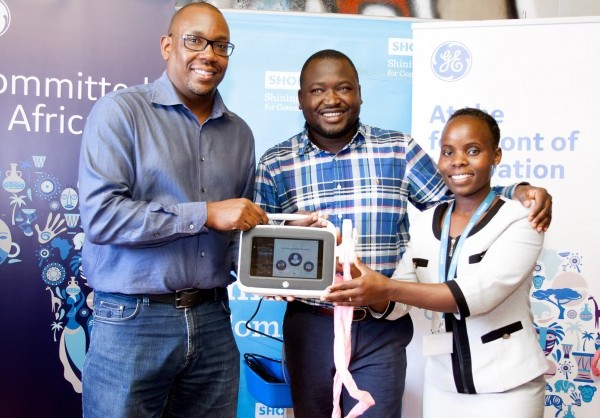
A partnership has been entered into between General Electric and a charity organisation known as Shining Hope for Communities Organization (SHOFCO) on a new maternal and infant care initiative aimed at increasing access to pre-natal screenings for expectant mothers in Kibera, believed to be the largest urban slum in Africa with an estimated 700,000 inhabitants.

A statement by GE explained that under the $25,000 partnership, GE Healthcare will provide hand-held ultrasound, training and advisory support to help SHOFCO’s mission to mobilize mothers to seek pre-natal screenings. Twenty-four SHOFCO nurses and clinical officers have each received over 40 hours of training.

Among the subsidized technologies provided is GE’s hand-held ultrasound device, designed to help primary health workers conduct examinations that may result in the earlier detection of potentially life-threatening pregnancy complications.

Slum dwellers lack access to quality healthcare infrastructure and are more vulnerable to HIV/AIDS and malnutrition amongst children.

Maternal and child mortality rates are about 50% higher than the national average, with an under-five mortality rate of 64 in every 1,000 live births. A lack of access to proper care during and immediately after delivery contributes to high mother and child mortality.

“Through a range of initiatives across the continent, GE is proud to support better outcomes for mothers and babies across Africa,” said Andrew Waititu, General Manager, GE Healthcare East Africa, during an event in Nairobi to celebrate GE and SHOFCO’s partnership. “We are firmly committed to serving as a partner in the development of healthcare in Kenya and are humbled to contribute in expanding SHOFCO’s capabilities and reach in the community where it is needed most.”

“Most of the health facilities available in the slums lack appropriate equipment to deal with prenatal and maternal health emergencies, in addition to a shortage of skilled personnel needed to provide emergency obstetric care.

“This solution, to be deployed at SHOFCO’s Subra and Makina satellite clinics, will help in reducing unnecessary referrals and decongesting the main health facility in Kibera.” said Kennedy Odede CEO and Co-founder of SHOFCO. “Through this program, expectant mothers will have access to ultrasound scanning before 24 weeks of gestation, that according to guidelines, assists clinicians in better estimating gestational age, improve detection of fetal anomalies and overall, help us improve a woman’s pregnancy experience.”

“We are grateful to GE for their support in helping us expand our services to serve more patients and through capacity building, empowering our clinical officers and nurses with the know-how to deliver proper care to the most vulnerable.”

SHOFCO is anchored under four pillars: Education, Health, Community Empowerment and Water and Sanitation. Key under the health pillar is the Mother and Child Health incentives program, provided for free to mothers in Kibera. The program is designed to counteract the high child morbidity and mortality rates by encouraging mothers to seek regular antenatal, post-natal, and child welfare services to ensure positive health outcomes for themselves and their children.

According to WHO data for Kenya in 2015, maternal mortality rates accounted for 510 deaths per 100,000 live births and an infant mortality rate of 36 per 1,000 live births.

Led by a commitment to improving access and quality of maternal, newborn, and child health care services towards the attainment of Kenya’s Vision 2030 and the Sustainable Development Goal 3 agenda, the Kenyan government has made significant progress towards reducing the burden of maternal and infant mortality rates.

A 2013 program providing free maternity services in the public sector has shown a doubling of the number of women accessing skilled birth attendance to over one million deliveries in 2016, with 2,000 maternal deaths and 30,000 child deaths avoided annually since 2013.

In 2016, the government announced a new program seeking to reach 400,000 underserved expectant mothers by expanding the network of institutions including faith organizations that offer free maternity services.


Modupe Gbadeyanka is a fast-rising journalist with Business Post Nigeria. Her passion for journalism is amazing. She is willing to learn more with a view to becoming one of the best pen-pushers in Nigeria. Her role models are the duo of CNN's Richard Quest and Christiane Amanpour.

Click to comment

Leave a Reply

Your email address will not be published. Required fields are marked *

Health

WHX in Lagos 2026: Nigeria Open for Healthcare Investment—FG

Published

on

WHX in Lagos 2026

By Modupe Gbadeyanka

The federal government has urged global investors and innovators to tap into the Nigerian healthcare ecosystem, which is projected to grow by 7.1 per cent, reaching a market value of $161.7 million by 2027.

This advice was given by the Minister of State for Health and Social Welfare, Mr Isiaq Salako, at the opening of the World Health Expo (WHX in Lagos 2026), formerly known as Medic West Africa, on Tuesday in Lagos.

The broader West African market is expected to reach more than $11 billion, providing investors with an opportunity to get a good return on investment.

“Nigeria is open for healthcare investment. We want platforms like WHX in Lagos to serve as a critical conduit for translating this investment ambition into tangible technology access for our hospitals and patients,” the Minister, who declared the event open on behalf of President Bola Tinubu, said.

He praised the organisers of the expo, which welcomed over 8,000 healthcare professionals and 500 exhibitors spanning 40 countries, for growing the programme into a vital catalyst for West African healthcare transformation.

Addressing the stark reality that between 85 per cent and 99 per cent of medical equipment and in vitro diagnostics in West Africa are currently imported, Mr Salako outlined aggressive federal interventions designed to dismantle supply chain vulnerabilities and skyrocket local manufacturing capabilities.

He also spotlighted key presidential directives, including the Presidential Initiative to Unlock Healthcare Value Chains (PVAC) and the Presidential Executive Order for the Pharmaceutical and Allied Sectors, both engineered to catalyse health security, drive economic growth, and generate employment through strategic private-sector collaborations and Public-Private Partnerships (PPPs).

“Our commitment to improving access to modern equipment and technologies in hospitals is backed by concrete action. The government has inaugurated the $1.2 billion Sector-Wide Approach (SWAP) initiative, a comprehensive overhaul addressing financing, workforce development, and infrastructure.

“Furthermore, for the 2025 fiscal year, the Federal Government committed N402 billion specifically for health sector infrastructure investment,” he stated, also highlighting an expansive health infrastructure upgrade program in partnership with the Nigeria Sovereign Investment Authority (NSIA).

According to him, this phased initiative is actively delivering oncology and nuclear medicine centres across six tertiary hospitals, alongside establishing 22 modern medical diagnostic centres, seven cardiac catheterisation laboratories, and expanded radiology and clinical pathology capabilities distributed across Nigeria’s six geopolitical zones.

Also speaking, the chief executive of EHA Clinics, Dr Ifunanya Ilodibe, stressed the urgent need to support and unify fragmented growth within the healthcare system, noting that WHX serves as the precise ecosystem platform required to bring together policymakers, clinicians, and investors to move actionable strategies forward.

Also, the President of the Healthcare Federation of Nigeria (HFN) and Country Director of PharmAccess, Njide Ndili, said, “HFN bridges the gaps in health financing, opening up critical connections to achieve true health sovereignty,” praising Africa CDC’s historical intervention, particularly during the Ebola crisis and urged participants to utilise the WHX exhibition floor to forge collaborations capable of scaling locally produced medical equipment.

The Lagos State Commissioner for Health, Mr Akin Abayomi, on his part, highlighted the enforcement of the National Health Insurance Authority (NHIA) Act in Lagos State as a landmark regulatory milestone. The Act mandates health insurance for all residents, structuring the financial environment to guarantee medical protection across various socioeconomic levels.

Delivering the keynote address, the Special Regional Representative of the Director General of the Africa CDC Western Regional Coordinating Centre, Prof. Aliko Ahmed, called on leaders in geopolitical positions to enact liberating trade policies aligned with the African Continental Free Trade Area (AfCFTA) to shape the continental agenda, emphasising that the Africa CDC will fiercely prioritise building trust in locally manufactured healthcare products.

WHX in Lagos 2026 runs for three days, featuring accredited forums, cutting-edge product showcases, and high-level networking tracks designed to translate billions in public and private investment into immediate technology access for hospitals and patients.

Continue Reading

Health

Euracare Secures Court Order Halting Inquest into Chimamanda Son’s Death

Published

on

Euracare

By Adedapo Adesanya

The coroner’s inquest into the death of 21-month-old Nkanu Adichie-Esege, son of renowned author Chimamanda Ngozi Adichie, suffered a major setback on Wednesday after Euracare Multi-Specialist Hospital informed the coroner’s court that it had obtained an order of the Lagos State High Court staying further proceedings in the probe.

The matter came before Coroner Magistrate Atinuke Adetunji at Court 9, Igbosere Magisterial District, Yaba, Lagos, and was scheduled for the commencement of witness’ testimony.

Counsel to Euracare Multi-Specialist Hospital, Professor Taiwo Osipitan (SAN), told the court that the hospital had initiated judicial review proceedings challenging, among other issues, the jurisdiction of the Coroner’s Court to conduct the inquest in the absence of the deceased’s body.

He disclosed that the High Court had granted leave for the judicial review application and ordered that the leave operate as a stay of proceedings pending the determination of the suit.

The senior advocate also informed the court that although the Lagos State Attorney-General’s Office denied seeing the originating processes from the High Court, proof of service was available.

Responding on behalf of the family, Mr Kemi Pinheiro (SAN) confirmed receipt of both the originating processes and the High Court order.

While acknowledging the obligation of all parties to comply with court orders, he informed the coroner that the family had already filed four witness statements on oath, including that of Dr Ivara Esege, as well as statements from independent medical experts from Nigeria and the United States, who are expected to testify at the inquest.

Mr Pinheiro urged the court not to adjourn the matter indefinitely, but to a definite date after the court vacation to enable parties to report on developments in the High Court proceedings.

He also highlighted the need for transparency and public confidence in the fact-finding process, saying, “He who is innocent does not fear an open inquest.”

Counsel representing Atlantis Paediatric Hospital supported the request for a definite adjournment rather than an indefinite postponement.

Following submissions by counsel, the Coroner adjourned the matter until October 8, 2026, for a report on the status of the High Court proceedings.

Continue Reading

Health

Gavi Promises $50m for Bundibugyo Ebolavirus Vaccines

Published

on

Bundibugyo Ebolavirus Vaccines

By Modupe Gbadeyanka

About $50 million has been promised by Gavi, the Vaccine Alliance, through its First Response Fund (FRF), to support the response to the ongoing Bundibugyo ebolavirus outbreak.

A statement from the organisation made available to Business Post on Monday said up to $40 million would be available to enable accelerated access to investigational doses and, eventually, approved vaccines, while a further $10 million would support outbreak response and protection of routine immunisation services in impacted countries.

“We need to act now to ensure that, once one or more vaccine candidates are ready, manufacturers are in a position to start producing doses at scale,” the chief executive of Gavi, Dr Sania Nishtar, was quoted as saying.

“Leveraging this allocation, Gavi will work closely with CEPI and partners to design the right incentives to achieve this goal, exploring all options, including potential Advance Purchase Commitments.

“This effort, alongside ensuring emergency funds are on hand to support outbreak response and protect routine immunisation services in the communities impacted, is exactly what our First Response Fund was designed for,” Dr Nishtar added.

The First Response Fund is the only globally approved mechanism that allows “at-risk” financing for scaled-up production of vaccines under development. This means Gavi is able to make vital early investments even when development outcomes are uncertain.

The $40 million in immediate surge financing that has been approved today will enable manufacturers of the leading candidates of a vaccine against the Bundibugyo virus to directly commit to high-capacity manufacturing.

This, in turn, will ensure that, as soon as clinical trials demonstrate positive outcomes, investigational vaccine doses could be deployed rapidly to support outbreak response.

Looking to the longer-term, Gavi will also provide incentives for manufacturers to adopt the fastest pathways towards WHO Emergency Use Listing (EUL) and/or WHO Prequalification (PQ), which are critical global approvals that will enable the rapid use of these vaccines in future emergencies.

In the coming weeks, Gavi will finalise the design of a financial mechanism that leverages the $40 million FRF allocation to achieve these vaccine access goals, in close partnership with the Coalition for Epidemic Preparedness Innovations (CEPI) as well as WHO, Africa Centres for Disease Control and Prevention (Africa CDC) and UNICEF.

The final design will take into account the characteristics of individual vaccine candidates and the needs of their manufacturers and may include mechanisms such as Advance Purchase Commitments. Work will also be undertaken to ensure successful candidates from African-based vaccine manufacturers can benefit from accelerated support through Gavi’s African Vaccine Manufacturing Accelerator (AVMA) initiative.

In addition to these investments, Gavi will also immediately release US$ 10 million to support countries and partners with outbreak response.

This funding will support implementation of national outbreak response plans, including targeted investments to protect routine immunisation, protect health care workers and ensure readiness for future vaccines. Gavi will work closely with countries, partners including Africa CDC, WHO, UNICEF, World Bank, and donors to ensure these investments complement other efforts.

Continue Reading

Trending