Connect with us

General

Nigerian Among Africa’s Leading Architects

Published

on

By Dipo Olowookere

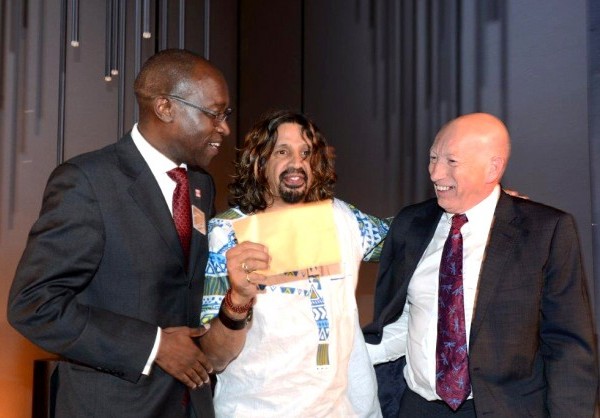
At a gala awards ceremony held on the rooftop of the Zeitz MOCAA in Cape Town, the inaugural Grand Prix and Category Winners of the Africa Architecture Awards were announced on the evening of Thursday, September 28, 2017.

Over 130 VIP guests were in attendance at this glittering event, including the Consul-General of France in Cape Town, Mr Laurent Amar, the Chairman of the French South African Chamber of Commerce and Industry, Philip Geromont, and Claude van Wyk of the Kingdom of The Netherlands Consulate General in Cape Town.

The shortlisted finalists were flown into South Africa from across the continent and the world, and hosted by awards founder and sponsor Saint-Gobain.

The much-anticipated gala was the culmination of an ambitious two-year awards programme that was initiated and supported by construction industry innovator Saint-Gobain with the ultimate aim of stimulating conversations about African architecture as it cements its place in a global continuum. The Africa Architecture Awards is the first-ever Pan-African awards programme of its kind.

A steering panel headed by Professor Lesley Lokko guided the awards with strategic input from Ambassador Phill Mashabane, advisor Zahira Asmal, and patron Sir David Adjaye, one of the globe’s most influential voices in architecture.

According to Adjaye, “The Africa Architecture Awards are very critical. Now is the time to promote excellence and best practice on the continent. The Africa Architecture Awards are particularly important because this is the moment that a lot is happening on the continent in terms of development, in terms of the architecture that’s being produced.”

Adjaye’s statement is borne out by the high level of interest the competition has received from architects working on projects located in Africa. Over 300 projects from 32 African countries were entered into the awards.

For the inaugural edition of the Africa Architecture Awards, the organisers set themselves an initial target of 150 entries from 20 African countries. Consider then, what a huge task faced the Master Jury when the awards exceeded all expectations and grew to 307 entries from 32 countries in Africa – more than double the size of what was initially envisaged.

The initial shortlist of 21 projects was chosen by the Master Jury and announced earlier in 2017. Chaired by Dr Mark Olweny, the jury comprised leading African architects and academics including: Anna Abengowe (Nigeria), Guillaume Koffi (Ivory Coast), Professor Edgar Pieterse (South Africa), Patti Anahory (Cape Verde), Tanzeem Razak (South Africa), and Phill Mashabane (South Africa).

The Master Jury then reconvened for two days prior to the awards ceremony to evaluate the 21 shortlisted projects and decide on the most deserving entries across four categories.

Through the Master Jury’s dedication and considered response to an unprecedented challenge, the final category winners – each of whom received a specially designed bronze trophy – were decided as follows: Critical Dialogue: Forum de Arquitectura – by CEICA, Angola; Speculative: The Territory In-between, Cape Verde – by Guinea’s Aissata Balde, Graduate School of Architecture, University of Johannesburg; Emerging Voices: The Exchange Consulate: Trading Passports for Hyper-Performative Economic Enclaves, South Africa – by Nigerian student Ogundare Olawale Israel of the Graduate School of Architecture, University of Johannesburg; Built: Umkhumbane Museum, South Africa – by Choromanski Architects, South Africa.

The Grand Prix was awarded to the project that best describes the ultimate objective of the Africa Architecture Awards, which is to inspire the future of African architecture. The Grand Prix winner received both a bespoke trophy and the cash prize of USD$10 000. Umkhumbane Museum, South Africa by Choromanski Architects was named the overall winner.

In addition to the projects highlighted by the Master Jury, the awards programme ran a public participation component earlier in 2017, where members of the public could vote for their favourite project. The People’s Choice Award had over a million viewers and votes across a range of projects stretching from kiosks to urban regeneration schemes. The winning project received a Certificate of Excellence at the ceremony and this went to James Cubitt Architects Lagos for the speculative project titled Bank Head Office in Lagos, Nigeria.

Commenting on the outcome of the first iteration of the awards, the MD of Saint-Gobain Retail Division, Evan Lockhart-Barker states that, “Although this is only the first edition of the Africa Architecture Awards, we believe we have captured an incredible moment in time for Pan-African architecture. Having launched the first-ever awards of its kind, we’ve seen the incredible response from architects working across the continent. The values and aspirations displayed in the awards have led to incredible insights about the continent and its shape-shifting ways.”

“Yet we still have a way to go to write our own story about architecture and its role here. Africa is indeed rising but due to the continent’s resourcefulness and complex regional identities, we’ve already learnt that our awards programme requires even more diversity to capture Africa and all its spectrums. We look to future editions of the awards to achieve this.”

Following the awards ceremony on the Thursday evening, a thought-provoking public colloquium titled ‘Celebrating Architecture in Africa’ was held on Friday, 29 September 2017 at the University of Cape Town. With a speaker line-up of 21 specialists from across the world, the free event, which was also supported by Saint-Gobain, provided a platform to discuss the awards in more detail and explore architecture within the African context.

Providing access to information about architecture in Africa and ensuring that this knowledge is shared widely and freely to the continent is a primary and ongoing aim of the awards. This is evidenced in events such as the colloquium, as well as publications such as the Africa Architecture Awards’ digital portal, Documenting all 307 projects entered into the awards via video, images and text, this digital asset now stands as one of the most vibrant and extensive repositories of contemporary African architecture to date.

Described as the “4th Revolution” in Africa, digital channels and technology shift paradigms daily on the continent. From the outset, awards founder Saint-Gobain has embraced the role of digital media to promote architectural practice and dialogue to broader audiences than traditionally enjoyed by institutional award structures.


Dipo Olowookere is a journalist based in Nigeria that has passion for reporting business news stories. At his leisure time, he watches football and supports 3SC of Ibadan. Mr Olowookere can be reached via [email protected]

Advertisement
Click to comment

Leave a Reply

Your email address will not be published. Required fields are marked *

General

Church Confirms Release Of 151 Abducted Members in Kaduna

Published

on

Cherubim and Seraphim Movement Church Worldwide

By Adedapo Adesanya

The Cherubim and Seraphim Movement Church Worldwide, Ayo Ni O, has confirmed the release and safe return of 151 of its members abducted from Iburu community in Kajuru Local Government Area of Kaduna State.

The abduction, which affected about 177 people, occurred on January 18, 2026. It was initially denied by the Nigeria Police Force and other government agencies, but was later confirmed.

In a statement issued by the Conference Secretary General of the church, Mr Anthony Olusesan Samaiye, it was disclosed that the release of the abducted persons was confirmed through reports from its liaison officers in Kaduna.

According to the statement, Mr Emmanuel Abiodun Adewale Alogbo (JP), described the release as a victory for faith, prayer and dialogue, noting that the breakthrough followed an emergency visit to Kaduna by its leadership and a series of high-level engagements aimed at securing the freedom of the abducted worshippers.

The Cherubim and Seraphim Church expressed gratitude to the Kaduna State government, particularly Governor Uba Sani, for what it described as his commitment to dialogue and the coordination of state resources that contributed to the successful outcome.

Special appreciation was also extended to the Governor’s Chief of Staff, Mr Sani Liman Kila, and the Senior Special Assistant on Religious Affairs (Christian Matters), Mr Ishaya Jangado, for facilitating engagement between the church and the state government.

The church noted that the incident demonstrated the importance of cooperation between religious leaders and government authorities in addressing security challenges and protecting citizens.

It also acknowledged prayers and support from the Christian Association of Nigeria (CAN), the Organisation of African Instituted Churches (OAIC), the international community and Christians worldwide.

While celebrating the release, the church said it was mindful of the trauma experienced by the victims and disclosed that its welfare and medical teams had been mobilised to provide psychosocial support and care to the affected members and their families.

The church called for sustained peace in Kaduna State and across Nigeria, urging authorities to continue efforts to ensure the safety of all citizens, regardless of religious affiliation.

Continue Reading

General

2027 Elections: I Won’t be Vice Presidential Candidate—Peter Obi Insists

Published

on

peter obi tax system

By Adedapo Adesanya

As activities for the 2027 general elections begin to take shape, the former presidential candidate of the Labour Party in the 2023 presidential poll, Mr Peter Obi, has again ruled out the possibility of contesting as a vice presidential candidate next year, saying he is contesting to be on the ballot.

Speaking ahead of the Abuja Municipal Area Council (AMAC) election in the Federal Capital Territory, he said, “You see this coming election, support us in AMAC; it will help me. Your support in AMAC is critical to our journey. I am involved and contesting the coming election as number one. When I come back, you will see. I assure you.”

Mr Obi vied for the 2023 presidency on the LP platform, emerging third overall behind Mr Atiku Abubakar and President Bola Tinubu.

In December 2025, he defected to the African Democratic Congress (ADC), where his teeming supporters popularly known as Obidients have urged him to only pursue the presidential ticket.

Mr Abubakar, who chose Mr Obi as his vice presidential candidate in the 2019 polls, is also a member of the ADC. The men finished in second and third places, respectively in the last presidential election, which President Tinubu won with 37 per cent of the votes.

Speaking at the campaign venue, Mr Obi emphasised to his supporters the importance of backing the ADC candidate in the AMAC election, noting that their support at the grassroots would go a long way in bolstering his national political journey.

The ADC coalition includes many former allies of Mr Tinubu, including Mr Nasir El Rufai, the former governor of Kaduna State; Mr David Mark, a former Senate President who is serving as the National Chairman of the party, and Mr Rauf Aregbesola, a former Osun Governor and currently the National Secretary of ADC.

The party will be hoping to emulate the success of the ruling All Progressives Congress (APC), which was formed by an alliance of opposition politicians (including Mr Abubakar) in 2013 and caused the ouster of former President Goodluck Jonathan, the first-ever defeat of an incumbent Nigerian president in 2015.

Continue Reading

General

CPPE Urges FG to Create Farm Price Stabilisation Plan for Food Security

Published

on

Price of Food

By Adedapo Adesanya

The Centre for the Promotion of Private Enterprise (CPPE) has called on the federal government to urgently establish a National Farm Price Stabilisation and Farmer Income Protection Framework to safeguard Nigeria’s long-term food security.

This was contained in a policy brief signed by the chief executive of the think tank, Mr Muda Yusuf, on Sunday.

The group warned that while recent import surges have lowered food prices to the delight of consumers, they have simultaneously inflicted severe financial losses on farmers and agricultural investors, creating what it described as “troubling trade-offs and unintended consequences.”

He advised that Nigeria cannot afford a policy regime that undermines confidence in agriculture, one of the country’s most strategic sectors and largest employers of labour.

“The welfare gains from cheaper food have been profound and should be acknowledged. However, the cost to farmers and other investors across the agricultural value chain is equally high and cannot be ignored,” Mr Yusuf stated.

The CPPE boss emphasised the urgent need to strike a sustainable balance between keeping food affordable for consumers and protecting farmers’ incomes, while safeguarding agricultural investment.

According to the policy document, recent import surges of staples such as rice, maize and soybeans have caused serious dislocations in the agricultural investment ecosystem, inflicting severe hardship on farmers and weakening production incentives.

“Although consumers have welcomed the decline in food prices, the long-term consequences are adverse: farmer incomes fall, production declines over time, investment confidence weakens, and the country risks returning to cycles of scarcity and higher prices,” the document warned.

The CPPE identified several structural factors driving recurring farm price collapses in Nigeria, beyond the immediate impact of food imports.

The think tank warned that harvest glut remains a major challenge, with many farmers harvesting the same crops within the same period, causing sudden oversupply. This is compounded by the limited availability of storage facilities, drying centres and cold-chain systems, which forces farmers to sell immediately regardless of market conditions.

The organisation said this is also affected by weak rural logistics, characterised by poor roads, insecurity, high transport costs, and limited aggregation hubs, which make it difficult to move produce efficiently from production zones to high-demand markets.

Continue Reading

Trending