Connect with us

Economy

Africa Needs Young Agropreneurs to Tackle Food Security—AfDB

Published

on

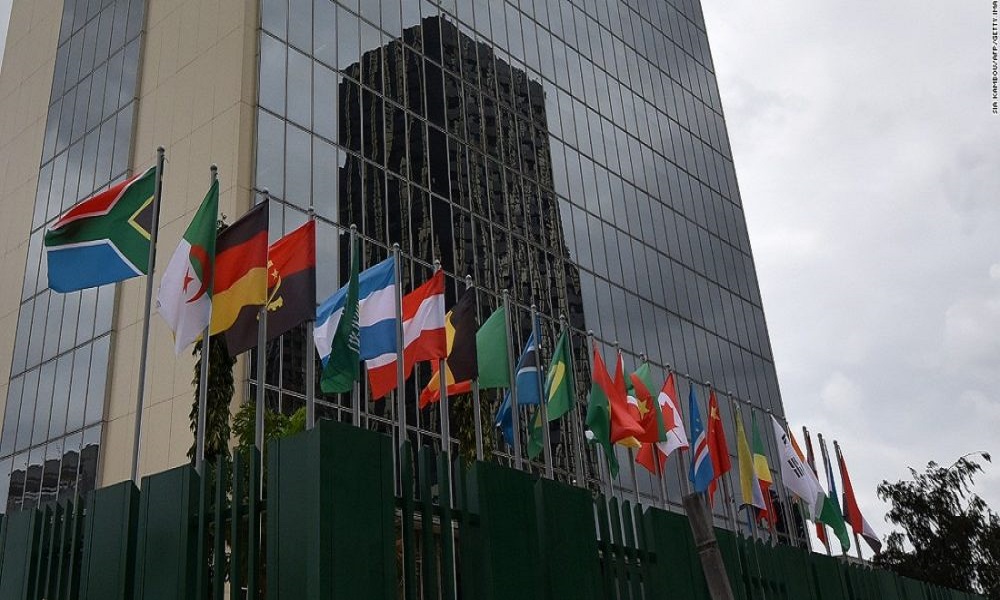
afdb complex

By Dipo Olowookere

The need for African leaders to engage youths in agriculture and make them see the sector as a profitable business venture and not a sign of lacking ambition has been emphasised by the President of the African Development Bank (AfDB), Mr Akinwumi Adesina.

According to this, apart from tackling food security in the continent through this, it would also stem migration of African youths to Europe and the United States of America (USA) in search of greener pastures.

AfDB, while commenting on the occasion of the 2017 World Food Day, highlighted how Africa’s food security depends on attracting young people to agriculture and agribusiness, pointing out that the sector can potentially create wealth and employment for African youth, thereby stemming migration.

World Food Day, celebrated yearly on October 16, promotes worldwide awareness and action for those who suffer from hunger and the need to ensure food security and nutritious diets for all. This year’s theme focuses on the need to ‘Change the future of migration; Invest in food security and rural development’.

The AfDB’s ENABLE Youth program, which grooming a crop of young agriculturists, is on course to make this happen.

Mahmud Johnson, 26, is the Founder of J-Palm Liberia which works to improve income for Liberia’s smallholder oil palm farmers by 50-80%. He is also creating additional jobs for over 1,000 young people to work as sales representatives for his products.

“Despite the tremendous odds, we (African youth) are determined to maximize our abundant agricultural resources to create wealth, jobs, and socioeconomic opportunities in our countries and across the continent. We need our stakeholders to view us as serious partners in Africa’s transformation, and to work with us to expand our enterprises,” Mahmud said.

Mahmud and some of his employees have benefited from capacity building programs under the AfDB’s Empowering Novel Agri-Business-Led Employment for Youth initiative.

Like Mahmud, many African youth are passionate about staying back on the continent to create wealth and employment, if given the tools and opportunities to put their skills to use. Under the ENABLE Youth program, the Bank is working with the International Institute for Tropical Agriculture (IITA) to develop a new generation of young commercial farmers and agribusiness entrepreneurs.

“Our goal is to develop 10,000 such young agricultural entrepreneurs per country in the next 10 years. In 2016, the Bank provided $700 million to support this program in eight countries and we’ve got requests now from 33 countries,” said Adesina.

The Bank considers investment in agriculture as key to making Africa youths prosperous, thereby stemming the tide of migration.

This goal, and theme of 2017 World Food Day, are well aligned with two of the AfDB’s High 5 development priorities – Feed Africa and Improve the quality of life for the people of Africa– said Jennifer Blanke, Vice-President, Agriculture, Human and Social Development at the AfDB.

“A thriving business sector in Africa will provide the jobs and returns that will attract and retain Africa’s best talent on the continent, while improving the quality of life of all Africans,” she said.

With more than 70% of Africans depending on agriculture for their livelihoods, it is imperative for the sector’s full potential to be unlocked, and by doing so help to vastly improve the lives Africans.

Accordingly, one of the goals of Feed Africa is to eliminate hunger and malnutrition by 2025.

Due to the finite nature of mineral resources such as gold, diamonds, crude oil, among others, African countries must diversify their economies. This cannot be done without a significant emphasis on agriculture given that the great majority of Africans depend on it for their livelihoods.

Increased food demand and changing consumption habits driven by demographic factors such as urbanization (internal migration) are leading to rapidly rising net food imports, which will grow from $35 billion in 2015 to over $110 billion by 2025 if trends are left unchecked.

Given that African smallholder farmers are on average about 60 years old, Africa’s food security depends on attracting young people into agriculture and agribusiness and empowering them. Governments can support these shifts through the right enabling environments via policy reforms for increased private investment in agriculture and agribusiness. And also by better articulating the importance of agriculture for their economies in their interaction with the public.

“Food security and rural development are closely interlinked with issues of migration, fragility and resilience. The Horn of Africa and the Sahel provide compelling examples of how global factors such as food insecurity, radical extremism and migration reinforce state fragility and have devastating effects on development,” said Khaled Sherif, AfDB Vice-President for Regional Development, Integration and Business Delivery.

“The lack of economic opportunities, infrastructure, employment opportunities and unpredictable climactic changes in these countries are key sources of fragility that often times result in the forced migration of peoples seeking a desperate alternative. The Bank has, where appropriate, adopted risk-based approaches at both country and regional levels in addressing fragility.”

Ahead of the World Food Day, the AfDB joined Côte d’Ivoire’s Minister of Agriculture and Rural Development and other developing partners on October 14 in a day-long set of activities to promote agriculture as a business. They emphasized the need for governments to invest in agriculture to create jobs and stem the flow of migration that has undermined the security and economies of African countries.


Dipo Olowookere is a journalist based in Nigeria that has passion for reporting business news stories. At his leisure time, he watches football and supports 3SC of Ibadan. Mr Olowookere can be reached via [email protected]

Economy

CSCS, Afriland Properties, MRS Oil Weaken NASD Exchange by 1.12%

Published

on

CSCS Stocks

By Adedapo Adesanya

Three stocks further weakened the NASD Over-the-Counter (OTC) Securities Exchange by 1.12 per cent on Wednesday, April 8, with the Unlisted Security Index (NSI) down by 44.43 points to 3,930.91 points from the previous day’s 3,975.34 points, and the market capitalisation went down by N26.59 to N2.351 trillion from N2.378 trillion.

MRS Oil lost N11.00 during the session to close at N161.00 per share compared with Tuesday’s closing price of N172.00 per share, Central Securities Clearing System (CSCS) Plc dipped by N3.74 to N67.95 per unit from N71.69 per unit, and Afriland Properties Plc fell by N1.10 to sell at N15.95 per share versus N17.05 per share.

There were two gainers at the midweek trading session, led by IPWA Plc, which appreciated by 55 Kobo to N6.61 per unit from N6.06 per unit, and First Trust Mortgage Bank Plc improved its value by 4 Kobo to N2.32 per share from N2.28 per share.

Yesterday, the volume of securities rose by 620.4 per cent to 5.7 million units from 797,264 units, the value of securities increased by 25.1 per cent to N32.7 million from N26.1 million, and the number of deals climbed by 12.1 per cent to 37 deals from the preceding session’s 33 deals.

Great Nigeria Insurance (GNI) Plc ended the day as the most traded stock by value on a year-to-date basis with 3.4 billion units sold for N8.4 billion, trailed by CSCS Plc with 57.2 million units exchanged for N3.9 billion, and Okitipupa Plc with 27.5 million units traded for N1.8 billion.

GNI Plc also finished the session as the most traded stock by volume on a year-to-date basis with 3.4 billion units valued at N8.4 billion, followed by Resourcery Plc with 1.1 billion units worth N415.7 million, and Infrastructure Guarantee Credit Plc with 400 million units transacted for N1.2 billion.

Continue Reading

Economy

Naira Grows 1.07% to N1,371/$1 at Official Market as FX Pressure Eases

Published

on

yuan-naira $10bn

By Adedapo Adesanya

Foreign Exchange (FX) demand pressure eased on the Naira on Wednesday, April 8, in the Nigerian Autonomous Foreign Exchange Market (NAFEX) after gaining N14.84 or 1.07 per cent against the greenback to quote at N1,371.82/$1 compared with the previous day’s N1,386.66/$1.

Also, the local currency appreciated against the Euro in the same market window at midweek by N1.54 to close at N1,604.07/€1 versus Tuesday’s closing rate of N1,605.61/€1, but lost N6.26 against the Pound Sterling to trade at N1,844.83/£1 versus N1,838.57/£1.

In the parallel market, the exchange rate of the Naira to the US Dollar remained unchanged yesterday at N1,410/$1, according to data sourced by Business Post.

There were indicators that the official FX market experienced a liquidity surge, which eased worries around the dominant US Dollar on Wednesday, as the Central Bank of Nigeria (CBN) revealed interbank deals rose to 220 from 71 reported the previous day.

The domestic currency has been in strong demand from foreign portfolio investors seeking to purchase OMO bills and other fixed-income instruments.

Forecasts also show that the local currency will remain relatively stable during the second quarter of the year, trading within the N1,340 to N1,430 per Dollar band on improved FX liquidity, stronger oil earnings, and rising external reserves, which have climbed above 50 billion dollars.

As for the cryptocurrency market, it fell after an initial ceasefire-fueled rally, with markets retracing Wednesday’s “ceasefire euphoria” as cracks emerge in the US-Iran truce while the Strait of Hormuz remains effectively closed.

Global risk assets face renewed pressure as geopolitical uncertainty combines with what analysts call “uncoordinated tightening” by major central banks, reinforcing higher-for-longer interest-rate expectations.

The price of Cardano (ADA) fell by 4.7 per cent to $0.2500, Ripple (XRP) slumped 3.7 per cent to $1.33, Dogecoin (DOGE) shrank by 3.5 per cent to $0.0915, Binance Coin (BNB) slipped 2.6 per cent to $600.02, Ethereum (ETH) went down by 2.5 per cent to $2,183.82, Solana (SOL) dipped 2.5 per cent to $82.24, and Bitcoin (BTC) depreciated by 1.1 per cent to $70,995.20.

However, TRON (TRX) appreciated by 0.4 per cent to $0.3173, while the US Dollar Tether (USDT) and the US Dollar Coin (USDC) remained unchanged at $1.00 apiece.

Continue Reading

Economy

Customs Street Surges 0.28% Despite Persistent Weak Sentiment

Published

on

Customs Street Nigerian Stock Exchange

By Dipo Olowookere

The Nigerian Exchange (NGX) Limited rallied by 0.28 per cent on Wednesday despite weak investor sentiment, as the bourse ended with 18 price gainers and 38 price losers, implying a negative market breadth index.

The growth recorded yesterday by Customs Street was influenced by the 2.11 per cent rise posted by the energy index, and the 1.79 per cent jump achieved by the banking sector.

The other sectors experienced profit-taking, with the consumer goods losing 1.07 per cent, the insurance counter down by 0.36 per cent, and the industrial goods space down by 0.19 per cent.

Universal Insurance chalked up 10.00 per cent to sell for N1.21, Omatek improved by 9.78 per cent to N2.47, VFD Group expanded by 9.71 per cent to N11.30, CWG appreciated by 9.64 per cent to N21.05, and Livestock Feeds gained 9.56 per cent to close at N7.45.

On the flip side, UPDC REIT lost 10.00 per cent to settle at N6.75, Fortis Global Insurance shed 9.92 per cent to quote at N1.18, Deap Capital depreciated by 9.85 per cent to N5.40, Chams went down by 9.47 per cent to N3.06, and Japaul declined by 8.82 per cent to N3.10.

Yesterday, the All-Share Index (ASI) went up by 562.43 points to 202,585.53 points from 202,023.10 points, and the market capitalisation advanced by N389 billion to N130.404 trillion from N130.015 trillion.

During the session, 1.0 billion stocks worth N40.6 billion exchanged hands in 52,723 deals compared with the 1.1 billion stocks valued at N40.3 billion executed in 78,006 deals a day earlier, indicating an uptick in the trading value by 0.74 per cent, and a shortfall in the trading volume and number of deals by 9.09 per cent and 32.41 per cent apiece.

The activity chart was led by Access Holdings, which sold 233.0 million units valued at N6.1 billion, Fidelity Bank exchanged 113.1 million units worth N2.2 billion, Wema Bank recorded a turnover of 103.3 million units valued at N2.7 billion, Zenith Bank transacted 60.6 million units for N6.5 billion, and Chams traded 47.5 million units worth N154.6 million.

Continue Reading

Trending