Economy
Lagos Budgets N1.046tr for 2018, Targets N720b IGR
By Modupe Gbadeyanka
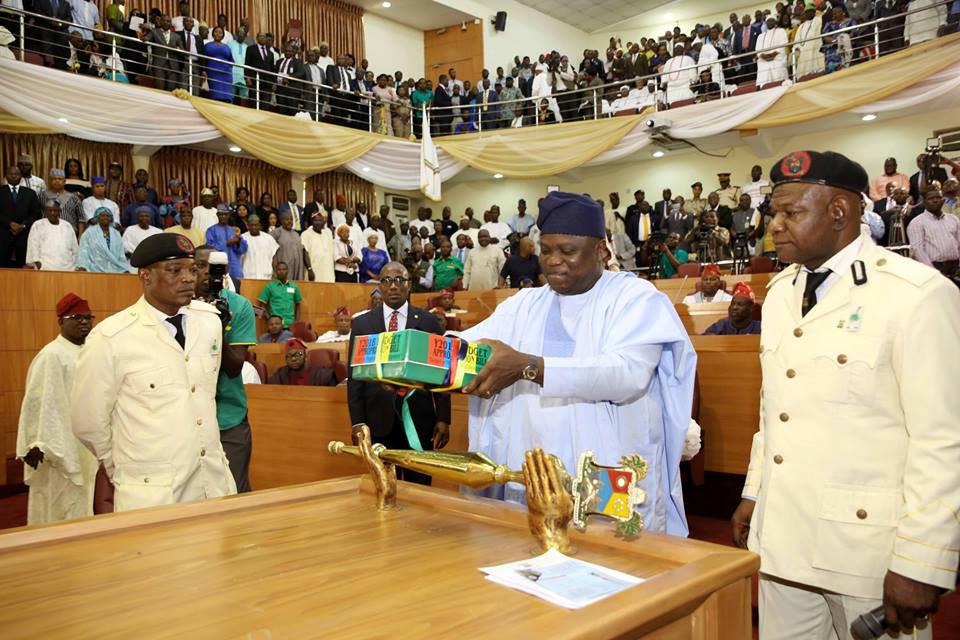
Governor Akinwunmi Ambode of Lagos State on Monday presented a budget of N1.046 trillion for the 2018 fiscal year to the state House of Assembly.
In the appropriation bill tagged ‘Budget of Progress and Development,’ 67 percent was earmarked for capital expenditure, while 33 percent was allotted for recurrent expenditure.
While addressing the lawmakers, the Governor promised to complete all ongoing projects in the state as well as initiate new ones to consolidate on the development recorded in the last 30 months of his administration.
He said more effort would be placed on infrastructure, education, transportation/traffic management, security and health sectors.
In addition, the state government will do more for civil servants though mandatory capacity building, which would be extended to all teachers in public secondary/primary schools, officers in the health service sector and women & youth empowerment alongside Medium and Small/Micro Size Entrepreneurs (MSMSE’s).
Outlining the key components of the budget, Governor Ambode said capital expenditure would gulp N699.082billion while N347.039billion would be dedicated to recurrent expenditure.
He said despite the modest achievements recorded in 2017, there was still much work ahead, assuring that government would not relent in its efforts to give Lagosians the best by way of continuous and efficient service delivery.
“Lagos has always been a trailblazer and we must consolidate on the economic gains made so far by initiating people-friendly programmes and projects that will attract more economic improvement in Y2018.
“It is our resolve in Y2018 to strive and complete all on-going projects in order to meet their specified completion period and embark on new strategic projects.
“We intend to improve on our Internally Generated Revenue (IGR) in the face of the dwindling accruable revenue allocation from the Federal Government, sustain our vision on wealth creation and poverty alleviation,” Mr Ambode said.
The Governor also listed key projects captured in the 2018 budget to include the Agege Pen Cinema flyover; alternative routes through Oke-Ira in Eti-Osa to Epe-Lekki Expressway; the 8km regional road to serve as alternative route to connect Victoria Garden City (VGC) with Freedom Road in Lekki Phase I; completion of the on-going reconstruction of Oshodi International Airport Road into a 10-lane road and the BRT Lane from Oshodi to Abule-Egba.
On infrastructural renewal, Mr Ambode said his administration remains committed to sustaining the tempo of continuous construction, rehabilitation, upgrading and maintenance of network of roads across the state including those within the boundary areas of Lagos and Ogun States and that the bus reform initiative would be consolidated with the introduction of high and medium capacity buses, construction and completion of bus depots at Oshodi, Anthony, Yaba and many others.
He also said the movement of Mile 12 market to Imota had reached an advanced stage and would be completed in good time to pave way for relocation next year, while the 181 Local Government roads will be commenced as contractors will be mobilized immediately, as well as continuous gridlock resolution, junction improvement, construction of more laybys and advancement of signalization that will improve traffic congestion especially along the Lekki-Epe corridor.
In the area of job creation, the Governor said the government would construct an ICT Focus Incubator Centre in Yaba, commence the development of Imota and Igbonla Light Industrial Park as well as the provision of additional small scale industrial estate at Shala, while the State Employment Trust Fund will disburse more funds to Lagosians to support business and stimulate the economy.
Mr Ambode also assured that his administration will vigorously pursue its planned direct intervention in the power value chain towards generating 3,000MW Embedded Power Programme within a three-year plan to achieving 24/7 power supply for the state, stressing that the challenge of inadequate power supply must be resolved for the economy to perform optimally.
He said within the 2018 fiscal year, the government would continue to rekindle its efforts in the area of tourism, sports, arts and culture as well as embark on some major projects that would ensure that the state emerges as the hub for tourism, sports and entertainment.
He listed some of the projects to include completion of the five new art theatres; establish a heritage centre at the former Federal Presidential State House recently handed over to the state government; build a world class museum between the former Presidential Lodge and the State House, Marina; fast-track construction of the proposed four new stadia in Igbogbo, Epe, Badagry and Ajeromi Ifelodun (Ajegunle) and complete the on-going Epe and Badagry Marina projects.
On housing, the Governor said all on-going projects especially those at Gbagada, Igbogbo, Iponri, Igando, Omole Phase I, Sangotedo and Ajara-Badagry would be completed for delivery under the rent-to-own policy.
While acknowledging the cooperation and support received from Lagosians, members of the business community, professional bodies, non-governmental organizations and the state civil servants in years past, the Governor noted that the modest achievements by his administration within a short period couldn’t have been possible without residents who have been paying their taxes willingly and faithfully.
Besides, Governor Ambode urged residents to embrace the Public Utility Levy as the Cleaner Lagos Initiative aimed at ensuring a cleaner and healthier environment would commence in 2018.
Governor Ambode also commended members of the House of Assembly for their selfless service and support, saying that they have proven themselves to be dynamic and robust lawmakers and partners in progress.
Giving a sectoral breakdown at a press briefing in Alausa, Commissioner for Finance, Mr Akinyemi Ashade said General Public Services got N171,623 billion, representing 16.41 percent; Public Order and Safety, N46.612 billion, representing 4.46; Economic Affairs, N473,866 billion, 45.30 percent; Environmental Protection, N54,582 billion, representing 5.22 percent while Housing and Community Amenities got N59,904 billion, representing 5.73 percent.
Mr Ashade also told journalists that Health sector got N92.676 billion, representing 8.86 percent; Recreation, Culture and Religion got N12.511 billion, representing 1.20 percent; Education got N126.302 billion representing 12.07 percent, while Social Protection got N8.042 billion representing 0.77 percent.
Receiving the budget, Speaker of the House, Mr Mudashiru Obasa, commended Governor Ambode for faithfully executing the year 2017 budget, saying the positive impact of such had been felt across the state with various projects such as the Abule Egba, Ajah and Pen Cinema Flyovers, among other numerous projects in various sectors.
Mr Obasa, who specifically lauded the fact that the 2018 budget estimate had provision for continuous infrastructural development in various sectors such as transport, security, environment, housing, health and capacity building for all public servants including teachers and health workers, however assured that the House would scrutinize it and ensure that the budget delivered on its promises to stimulate the economy of the state by focusing on infrastructure development, delivering inclusive growth and prioritizing the welfare of all Lagosians.
The event was attended by dignitaries in the State including members of the state executive council led by the Deputy Governor, Dr Idiat Adebule, former Speakers of the Lagos State House of Assembly, members of the National Assembly from Lagos State, former Deputy Governors of the state, party chieftains, traditional rulers, religious leaders, among others.
Economy
Naira Extends Losing Streak, Falls to N1,356/$1 at NAFEX
By Adedapo Adesanya
A 74 Kobo or 0.05 per cent decline was recorded by the Naira against the United States Dollar in the Nigerian Autonomous Foreign Exchange Market (NAFEX) on Wednesday, February 25, trading at N1,356.11/$1 compared with the N1,355.37/$1 it was traded on Tuesday.
The Nigerian currency also further depreciated against the Pound Sterling during the session in the official market by N6.70 to settle at N1,834.96/£1 versus the preceding day’s rate of N1,828.26/£1, and against the Euro, it tumbled by N4.94 to quote at N1,598.59/€1 compared with the previous session’s N1,596.36/€1.
In the same vein, the Nigerian Naira lost N6 against the Dollar at the GTBank forex desk to close at N1,367/$1, in contrast to N1,361/$1 it was exchanged a day earlier, and in the parallel market, it traded flat at N1,365/$1.
The continuation of the decline of the local currency has been tied to the Central Bank of Nigeria (CBN) buying US Dollars from the market to slow the rapid rise of the Naira.
The apex bank bought about $189.80 million to reduce excess Dollar supply and control how fast the Naira was gaining value.
The monetary policy committee (MPC) of the CBN on Tuesday reduced interest rates by 50 basis points to 26.50 per cent from 27 per cent after inflation eased in January 2026, a move analysts say is the best not to unsettle FX market, especially the Foreign Portfolio Investors (FPI_ inflows which have anchored much of the recent supply and weakened the recently restored monetary credibility.
“The 50bps move therefore provides a clear directional signal while still keeping overall monetary conditions restrictive, indicating the start of a shallow, data-dependent easing cycle rather than a radical shift to accommodative policy,” said Mr Kayode Akindele, CEO, Coronation Capital and Head, Coronation Research in an email.
As for the cryptocurrency market, benchmarked tokens rebounded in double digits, driven by bearish positioning and thin liquidity rather than by clear fundamental catalysts, with Cardano (ADA) growing by 16.2 per cent to $0.3015, and Solana (SOL) appreciating by 12.3 per cent to $88.66.
Further, Ethereum (ETH) surged 11.9 per cent to $2,076.66, Litecoin (LTC) expanded by 11.5 per cent to $57.15, Dogecoin (DOGE) rose by 11.5 per cent to $0.1025, Binance Coin (BNB) advanced by 7.6 per cent to $629.76, Ripple (XRP) jumped 7.2 per cent to $1.45, and Bitcoin (BTC) added 6.4 per cent to sell for $68,136.72, while the US Dollar Tether (USDT) and the US Dollar Coin (USDC) remained unchanged at $1.00 apiece.
Economy
Oil Prices Stabilise as US Crude Build Counters Supply Disruption Threat
By Adedapo Adesanya
Oil prices settled largely unchanged on Wednesday amid a build in American crude stockpile and the threat to oil supply from potential military conflict between the US and Iran.
Brent futures chalked up 8 cents to trade at $70.85 a barrel, while the US West Texas Intermediate (WTI) futures settled lost 21 cents to close at $65.42 per barrel.
Crude oil inventories in the US increased by 16 million barrels during the week ending February 20, according to new data from the US Energy Information Administration (EIA) released on Wednesday.
The decrease brings commercial stockpiles to 435.8 million barrels according to government data, which is still 3% below the five-year average for this time of year.
The EIA’s data release follows figures by the American Petroleum Institute (API) that were released a day earlier, which reported that crude oil inventories rose by a massive 11.4 million barrels in the period.
The market continued to weigh the possibility extended conflict could disrupt supplies from Iran, the third-biggest crude producer in the Organisation of the Petroleum Exporting Countries (OPEC) and other countries in the Middle East.
US President Donald Trump verbally attacked Iran, saying he would not allow a country he described as the world’s biggest sponsor of terrorism to have a nuclear weapon.
This comes as US envoys are due to meet an Iranian delegation for a third round of talks on Thursday in Geneva, Switzerland.
Reuters reported that OPEC+ is considering raising its oil output by 137,000 barrels per day for April to end a three-month pause in production increases. This is as the group prepares for peak summer demand and tensions between the US and Iran boost prices.
Eight OPEC+ producers – Saudi Arabia, Russia, the United Arab Emirates, Kazakhstan, Kuwait, Iraq, Algeria and Oman – meet on March 1.
An increase of 137,000 barrels per day for April would be the same as those agreed for December, November and October last year.
In a separate development, Saudi Arabia has activated a plan for a short-term oil output and export surge in case a US strike on Iran disrupts flows from the Middle East, said two sources familiar with the Saudi plan.
Tariff uncertainty also further worried investors after President Trump’s temporary global tariff of 10 per cent took effect on Tuesday after the Supreme Court’s sweeping ruling last week. He later said the levy would be 15 per cent, but it was unclear when and if it would apply.
Economy
LIRS Urges Taxpayers to File Annual Returns Ahead of Deadline
By Modupe Gbadeyanka
All individual taxpayers in Lagos State have been advised to file their annual tax returns ahead of the March 31 deadline.
This appeal was made by the Lagos State Internal Revenue Service (LIRS) in a statement issued by its Head of Corporate Communications, Mrs Monsurat Amasa-Oyelude.
The notice quoted the chairman of LIRS, Mr Ayodele Subair, as saying that timely filing remains both a constitutional and statutory obligation as well as a civic responsibility.
The statutory filing requirement applies to all taxable persons, including self-employed individuals, business owners, professionals, persons in the informal sector, and employees under the Pay-As-You-Earn (PAYE) scheme.
In accordance with Section 24(f) of the 1999 Constitution of the Federal Republic of Nigeria, Sections 13 &14(3) of the Nigeria Tax Administration Act 2025 (NTAA), every individual with taxable income is required to submit a true and correct return of total income from all sources for the preceding year (January 1 to December 31, 2025) within 90 days of the commencement of a new assessment year.
“Filing of annual tax returns is not optional. It is a legal requirement under the Nigeria Tax Administration Act 2025. We encourage all Lagos residents earning taxable income to file early and accurately.
“Early and accurate filing not only ensures full adherence with statutory requirements, but supports effective monitoring and forecasting, which are critical to Lagos State’s fiscal planning and long-term sustainability,” Mr Subair stated.
He further noted that failure to file returns by the statutory deadline attracts administrative penalties, interest, and other enforcement measures as prescribed by law.
To enhance convenience and efficiency, all individual tax returns must be submitted electronically via the LIRS eTax portal at https://etax.lirs.net. The platform enables taxpayers to register, file returns, upload supporting documents, and manage their tax profiles securely from anywhere.
In keeping with global best practices, Mr Subair reiterated that LIRS continues to prioritise digital tax administration and taxpayer support services. He affirmed that the LIRS eTax platform is secure and accessible worldwide. Taxpayers requiring assistance may visit any of the LIRS offices or other channels.
-
Feature/OPED6 years agoDavos was Different this year
-
Travel/Tourism10 years ago
Lagos Seals Western Lodge Hotel In Ikorodu
-
Showbiz3 years agoEstranged Lover Releases Videos of Empress Njamah Bathing
-
Banking8 years agoSort Codes of GTBank Branches in Nigeria
-
Economy3 years agoSubsidy Removal: CNG at N130 Per Litre Cheaper Than Petrol—IPMAN
-
Banking3 years agoSort Codes of UBA Branches in Nigeria
-
Banking3 years agoFirst Bank Announces Planned Downtime
-
Sports3 years agoHighest Paid Nigerian Footballer – How Much Do Nigerian Footballers Earn