Connect with us

Economy

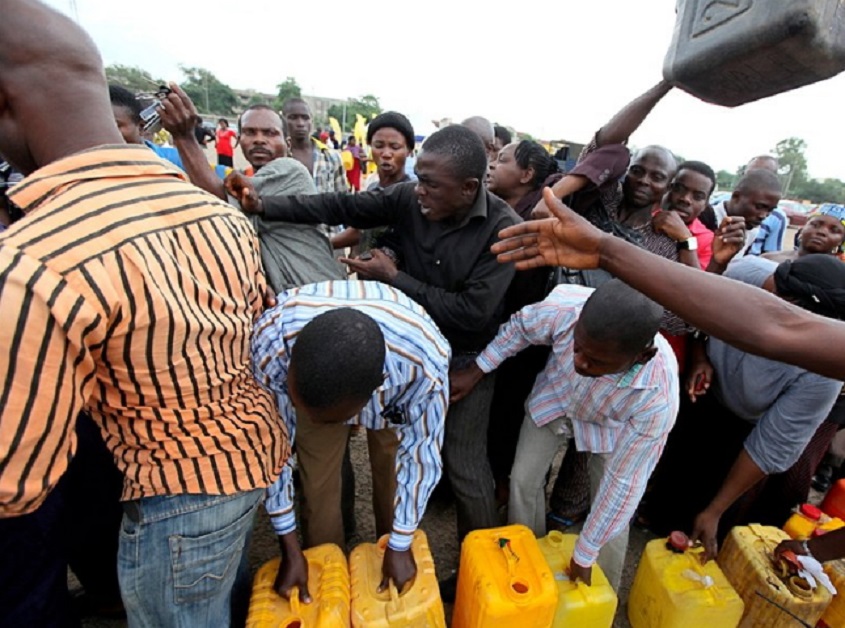
Fuel Scarcity: Oil Marketers Owe N26.7b—NNPC

Published

on

oil marketers

By Dipo Olowookere

Oil marketers in Nigeria under the aegis of Depot and Petroleum Products Marketers Association (DAPPMA) have been accused of owing Federal Government the sum of N26.7 billion.

This claim was made by the Nigerian National Petroleum Corporation (NNPC), which noted that despite this indebtedness, it has not still stopped supply Premium Motor Spirit (PMS) otherwise known as petrol, to the oil marketers.

NNPC, while reacting to a statement issued by DAPPMA on Monday, where it claimed that depots of its members were empty because there was no fuel supplied to them, disclosed that despite the concession by the government giving access to DAPPMA to obtain forex at an official rate of N305 per Dollar for PMS import, their members have not been able to do so, leaving NNPC as the sole supplier of PMS to the Nigerian market.

The state-owned oil firm described the association’s statement as “very unfortunate.”

“NNPC wishes to affirm that it has supplied appreciable volume to DAPPMA, Major Marketers Association of Nigeria (MOMAN) and Independent Petroleum Marketers of Nigeria (IPMAN) to rid the challenges currently being experienced in the supply and distribution of petroleum products in the country,” NNPC said.

“NNPC regrets that DAPPMA which members had taken receipts of products from Petroleum Products Marketing Company (PPMC), a subsidiary of NNPC and owe the company to the tune of N26.7 billion as at December 21, 2017, has the audacity to indict NNPC unjustifiably.

“The statement by DAPPMA that the current hiccups in the supply of products was due to the inability of the Direct Sales Direct Purchase (DSDP) partners of NNPC to deliver on their business obligations is unfounded and self-indicting as many of DAPPMA members patronize the same DSDP international counterparts as the corporation,” the statement disclosed.

“NNPC assures the public that despite the increase it effected in the supply of PMS in the December 2017, it has nonetheless, programmed to supply 1.2 billion litres of the white products in January 2018, translating to about 40million litres of PMS supply per day. Ordinarily, Nigeria consumes about 700 trucks (about 27million – 30million) litres per day.

“Despite the current challenges, Nigerians are reassured that there is no plan to increase PMS pump price above N145/litre and that NNPC will continue to maintain ex–depot price of N133.28/litre which guarantees the pump price not exceeding the N145 per litre capped by the government.

“All stakeholders are implored to support the efforts of government to bring a speedy end to the current fuel distribution challenges being experienced in parts of the country as this is not the time to play the blame game,” the statement said.


Dipo Olowookere is a journalist based in Nigeria that has passion for reporting business news stories. At his leisure time, he watches football and supports 3SC of Ibadan. Mr Olowookere can be reached via [email protected]

Economy

NGX Market Cap Surpasses N110trn as FY 2025 Earnings Impress Investors

Published

on

creative economy capital market

By Dipo Olowookere

Investors at the Nigerian Exchange (NGX) Limited have continued to show excitement for the full-year earnings of companies on the exchange so far.

On Friday, Customs Street further appreciated by 1.01 per cent as more organization released their financial statements for the 2025 fiscal year.

During the session, traders continued their selective trading strategy, with the energy sector going up by 2.47 per cent at the close of business despite profit-taking in the banking counter, which saw its index down by 0.11 per cent.

Yesterday, the insurance space grew by 2.16 per cent, the industrial goods segment expanded by 1.70 per cent, and the consumer goods industry jumped by 0.42 per cent.

Consequently, the All-Share Index (ASI) increased by 1,722.13 points to 171,727.49 points from 170,005.36 points, and the market capitalisation soared by N1.106 trillion to N110.235 trillion from the N109.129 trillion it ended on Thursday.

Business Post reports that there were 59 appreciating stocks and 19 depreciating stocks on Friday, representing a positive market breadth index and strong investor sentiment.

The trio of Omatek, Deap Capital, and NAHCO gained 10.00 per cent each to sell for N2.64, N6.82, and N136.40 apiece, as Zichis and Austin Laz appreciated by 9.98 per cent each to close at N6.72 and N5.40, respectively.

Conversely, The Initiates depreciated by 9.74 per cent to N19.45, DAAR Communications slumped by 7.32 per cent to N1.90, United Capital crashed by 6.55 per cent to N18.55, Coronation Insurance lost 5.71 per cent to quote at N3.30, and First Holdco shrank by 5.53 per cent to N47.00.

The activity chart showed an improvement in the activity level, with the trading volume, value, and number of deals up by 33.77 per cent, 93.27 per cent, and 10.63 per cent, respectively.

This was because traders transacted 953.8 million shares worth N43.1 billion in 51,005 deals compared with the 713.0 million shares valued at N22.3 billion traded in 46,104 deals a day earlier.

Fidelity Bank was the most active with 92.4 million units sold for N1.8 billion, Chams transacted 69.2 million units valued at N310.9 million, Deap Capital exchanged 59.1 million units worth N382.7 million, Access Holdings traded 57.2 million units valued at N1.3 billion, and Tantalizers transacted 48.6 million units worth N228.2 million.

Continue Reading

Economy

Naira Retreats to N1,366.19/$1 After 13 Kobo Loss at Official Market

Published

on

naira street value

By Adedapo Adesanya

The value of the Naira contracted against the United States Dollar on Friday by 13 Kobo or 0.01 per cent to N1,366.19/$1 in the Nigerian Autonomous Foreign Exchange Market (NAFEX) from the previous day’s value of N1,366.06/$1.

According to data from the Central Bank of Nigeria (CBN), the Nigerian currency also depreciated against the Pound Sterling in the same market window yesterday by N2.37 to N1,857.75/£1 from the N1,855.38/£1 it was traded on Thursday, and further depleted against the Euro by 57 Kobo to close at N1,612.52/€1 versus the preceding session’s N1,611.95/€1.

In the same vein, the exchange rate for international transactions on the GTBank Naira card showed that the Naira lost N8 on the greenback yesterday to N1,383/$1 from the previous day’s N1,375/$1 and at the black market, the Nigerian currency maintained stability against the Dollar at N1,450/$1.

FX analysts anticipate this trend to persist, primarily influenced by increasing external reserves, renewed inflows of foreign portfolio investments, and a reduction in speculative demand.

In the short term, stability in the FX market is expected to continue, supported by policy interventions and improving market confidence.

Nigeria’s foreign reserves experienced an upward trajectory, increasing by $632.38 million within the week to $46.91 billion from $46.27 billion in the previous week.

The Dollar appreciation this week appears to be largely technical, serving as a correction to the substantial losses experienced from mid- to late January.

Meanwhile, the cryptocurrency market slightly appreciated, with Bitcoin (BTC) climbing near $68,000, up nearly 5 per cent since hitting $60,000 late on Thursday after investor confidence in crypto’s utility as a store of value, inflation hedge, and digital currency faltered.

The sell-off extended beyond crypto, with silver plunging 15 per cent and gold sliding more than 2 per cent. US stocks also fell.

The latest recoup saw the price of BTC up by 4.7 per cent to $67,978.96, as Ethereum (ETH) appreciated by 6.3 per cent to $2,021.10, and Ripple (XRP) surged by 9.5 per cent to $1.42.

In addition, Solana (SOL) grew by 7.3 per cent to $85.22, Cardano (ADA) added 6.1 per cent to trade at $0.2683, Dogecoin (DOGE) expanded by 5.4 per cent to $0.0958, Litecoin (LTC) rose by 5.2 per cent to $53.50, and Binance Coin (BNB) jumped by 2.3 per cent to $637.79, while the US Dollar Tether (USDT) and the US Dollar Coin (USDC) traded flat at $1.00 each.

Continue Reading

Economy

Oil Prices Climb on Worries of Possible Iran-US Conflict

Published

on

Crude Oil Prices

By Adedapo Adesanya

Oil prices settled higher on Friday as traders worried that this week’s talks between the US and Iran had failed to reduce the risk of a military conflict between the two countries.

Brent crude futures traded at $68.05 a barrel after going up by 50 cents or 0.74 per cent, and the US West Texas Intermediate (WTI) crude futures finished at $63.55 a barrel due to the addition of 26 cents or 0.41 per cent.

Iran and the US held negotiations in Muscat, the capital of Oman, on Friday to overcome sharp differences over Iran’s nuclear programme.

It was reported that the talks had ended with Iran’s foreign minister saying negotiators will return to their capitals for consultations and the talks will continue.

Regardless, the meeting kept investors anxious about geopolitical risk, as Iran wanted to stick to nuclear issues while the US wanted to discuss Iran’s ballistic missiles and support for armed groups in the region.

Any escalation of tension between the two nations could disrupt oil flows, since about a fifth of the world’s total consumption passes through the Strait of Hormuz between Oman and Iran.

Saudi Arabia, the United Arab Emirates, Kuwait and Iraq export most of their crude via the strait, as does Iran, which is a member of the Organisation of the Petroleum Exporting Countries (OPEC).

According to Reuters, Iran objected to the presence of any US Central Command (CENTCOM) or other regional military officials, saying that would jeopardise the process.

The current confrontation was sparked by more than two weeks of unrest in Iran that saw authorities launch a deadly crackdown that killed thousands of civilians and shocked the world. As reports of the deaths trickled out of Iran, US President Donald Trump threatened to strike Iran if any of the tens of thousands of protesters arrested were executed.

Meanwhile, Kazakhstan’s planned oil exports could fall by as much as 35 per cent this month via its main route through Russia, as the country’s top oil company, Tengiz oilfield, slowly recovers from fires at power facilities in January.

ING analysts have pointed out Iran’s neighbour, Iraq, and a disagreement with the US as another bullish factor for oil prices. It seems Iraqi politicians favour Mr Nouri al-Maliki as the country’s next Prime Minister, but the US thinks Mr al-Maliki is too close to Iran. President Trump has already threatened the oil producer with consequences if he emerges as PM.

Continue Reading

Trending