Connect with us

Economy

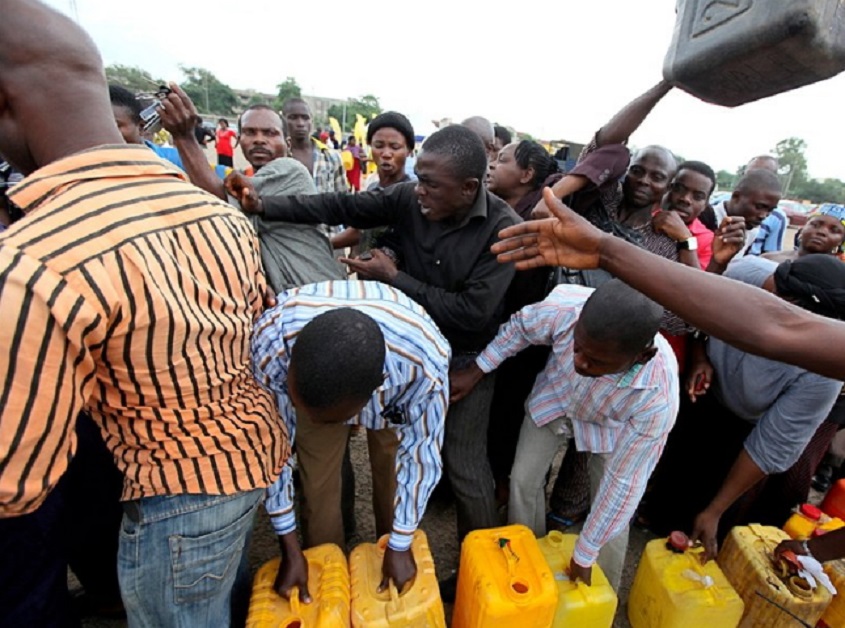
Fuel Scarcity: Oil Marketers Owe N26.7b—NNPC

Published

on

oil marketers

By Dipo Olowookere

Oil marketers in Nigeria under the aegis of Depot and Petroleum Products Marketers Association (DAPPMA) have been accused of owing Federal Government the sum of N26.7 billion.

This claim was made by the Nigerian National Petroleum Corporation (NNPC), which noted that despite this indebtedness, it has not still stopped supply Premium Motor Spirit (PMS) otherwise known as petrol, to the oil marketers.

NNPC, while reacting to a statement issued by DAPPMA on Monday, where it claimed that depots of its members were empty because there was no fuel supplied to them, disclosed that despite the concession by the government giving access to DAPPMA to obtain forex at an official rate of N305 per Dollar for PMS import, their members have not been able to do so, leaving NNPC as the sole supplier of PMS to the Nigerian market.

The state-owned oil firm described the association’s statement as “very unfortunate.”

“NNPC wishes to affirm that it has supplied appreciable volume to DAPPMA, Major Marketers Association of Nigeria (MOMAN) and Independent Petroleum Marketers of Nigeria (IPMAN) to rid the challenges currently being experienced in the supply and distribution of petroleum products in the country,” NNPC said.

“NNPC regrets that DAPPMA which members had taken receipts of products from Petroleum Products Marketing Company (PPMC), a subsidiary of NNPC and owe the company to the tune of N26.7 billion as at December 21, 2017, has the audacity to indict NNPC unjustifiably.

“The statement by DAPPMA that the current hiccups in the supply of products was due to the inability of the Direct Sales Direct Purchase (DSDP) partners of NNPC to deliver on their business obligations is unfounded and self-indicting as many of DAPPMA members patronize the same DSDP international counterparts as the corporation,” the statement disclosed.

“NNPC assures the public that despite the increase it effected in the supply of PMS in the December 2017, it has nonetheless, programmed to supply 1.2 billion litres of the white products in January 2018, translating to about 40million litres of PMS supply per day. Ordinarily, Nigeria consumes about 700 trucks (about 27million – 30million) litres per day.

“Despite the current challenges, Nigerians are reassured that there is no plan to increase PMS pump price above N145/litre and that NNPC will continue to maintain ex–depot price of N133.28/litre which guarantees the pump price not exceeding the N145 per litre capped by the government.

“All stakeholders are implored to support the efforts of government to bring a speedy end to the current fuel distribution challenges being experienced in parts of the country as this is not the time to play the blame game,” the statement said.


Dipo Olowookere is a journalist based in Nigeria that has passion for reporting business news stories. At his leisure time, he watches football and supports 3SC of Ibadan. Mr Olowookere can be reached via [email protected]

Economy

Nigeria’s Oil Exploration Declines 41.7% as Rig Counts Falls to 12 in April

Published

on

rig count

By Adedapo Adesanya

Nigeria’s oil exploration and drilling activities declined by 41.7 per cent in April 2026, following reduced upstream operations and investment activities.

According to the May 2026 Monthly Oil Market Report (MOMR) of the Organisation of the Petroleum Exporting Countries (OPEC), Nigeria’s rig count, a major indicator of upstream oil and gas activities, dropped to 12 in April 2026 from 17 recorded in March 2026.

The decline came amid persistent upstream investment and operational challenges, according to the latest monthly report released by OPEC.

Earlier data contained in the May 2026 edition of the MOMR also showed that Nigeria’s average rig count declined to 13 in 2025 from 15 recorded in 2024, indicating reduced exploration and drilling activities in the upstream petroleum sector.

The report showed that Nigeria’s rig count fell by five rigs month-on-month, from 17 rigs in March 2026 to 12 rigs in April 2026.

Rig count is widely regarded in the petroleum industry as a key indicator of exploration, field development and investment activities.

The decline comes despite ongoing efforts by the Nigerian government and industry operators to raise crude oil production, boost reserves and attract fresh upstream investments under the Petroleum Industry Act (PIA)

Nigeria’s performance contrasted with the broader African trend, where total rig count increased marginally from 42 in March 2026 to 48 in April 2026.

However, Nigeria accounted for a significant share of the continent’s decline in operational rigs during the period.

Within OPEC, Nigeria remained behind major producers such as Saudi Arabia, which recorded 265 rigs in April 2026, the United Arab Emirates with 66 rigs, and Iraq with 19 rigs.

The development also comes at a time when Nigeria is struggling to meet its crude oil production quota allocated by OPEC consistently.

Continue Reading

Economy

Nigeria’s Central Bank Holds Rate at 26.50% Despite Heightened Disruptions

Published

on

CBN MPC meeting May 20

By Adedapo Adesanya

The Monetary Policy Committee (MPC) of the Central Bank of Nigeria (CBN) has retained the headline interest rate, the Monetary Policy Rate (MPR), at 26.50 per cent.

This was disclosed by the Governor of Nigeria’s central bank, Mr Yemi Cardoso, on Wednesday, after the conclusion of the MPC meeting. He noted that the decision was hinged on Nigeria being largely insulated from external shocks relating to developments in the Middle East.

He also acknowledged that inflation and exchange rate stability were put into consideration during the two-day meeting.

The committee reduced the benchmark interest rate by 50 basis points from 27.0 per cent to 26.5 per cent at its 304th MPC gathering in February.

Nigeria’s inflation rose to 15.69 per cent in April 2026, affected by the fallout from the Iran war, which continued to impact the global economy. Noting that year-on-year, the figures show a moderation rather than worry.

The headline inflation rate for April on a month-on-month basis was 2.13 per cent, while the food inflation rate in the review month was 16.06 per cent on a year-on-year basis.

Mr Cardoso noted that the Cash Reserve Ratio (CRR) was also retained at 45 per cent for commercial Banks, 16 per cent for Merchant Banks, and 75 per cent for non-TSA public sector deposits.

He added that the Standing Facilities Corridor was also held flat at +50 / -450 basis points around the MPR.

Continue Reading

Economy

World Bank’s MIGA Targets $6.4bn Annual Guarantees for Africa

Published

on

World Bank Blacklists

By Adedapo Adesanya

The Multilateral Investment Guarantee Agency (MIGA), a World Bank financer, is ramping up efforts to unlock private capital for Africa, with plans to more than double its annual guarantee issuance on the continent to $6.4 billion over the next three and a half years.

The move is expected to catalyse as much as $23 billion in private sector investment across key sectors, including energy infrastructure, food security, trade finance, digital connectivity and sovereign debt restructuring.

The expansion underscores a growing shift among development finance institutions toward deploying guarantees as a primary tool for de-risking investments in frontier markets and attracting private capital flows into economies often viewed as high-risk.

MIGA’s Managing Director, Mr Tsutomu Yamamoto, said the scaled-up programme would play a critical role in mobilising investment, creating jobs and strengthening economic resilience across African countries.

He noted that the agency’s instruments, ranging from political risk insurance to credit enhancement, debt swaps and portfolio guarantees, are designed to reduce investor exposure and improve project bankability.

The guarantee push will continue to focus on strategic sectors such as power grids, local banking systems, agriculture and food supply chains, as well as digital infrastructure, all of which are seen as foundational to long-term economic growth across the continent.

Although the agency did not disclose specific projects in its pipeline, it said the expansion reflects rising demand for risk-sharing mechanisms in emerging markets, particularly as governments grapple with tight fiscal conditions and limited access to affordable financing.

The development follows a broader restructuring within the World Bank Group nearly two years ago, which consolidated guarantee operations to scale up private sector investment mobilisation globally.

MIGA has already played a role in pioneering debt swap transactions in the Ivory Coast and Angola, while also supporting food security initiatives in Kenya and backing more than 100 energy projects across emerging markets. Its guarantees have further underpinned lending operations in countries such as Ghana and Zambia, helping to stabilise financial systems and sustain credit flows.

The agency’s latest push reflects a wider evolution in development finance strategy, where guarantees are increasingly used to stretch limited public funds and crowd in private investors. By lowering perceived risks, these instruments make large-scale infrastructure and development projects more attractive to commercial financiers who would otherwise stay on the sidelines.

This shift is gaining urgency as many advanced economies scale back aid budgets while simultaneously seeking stronger economic ties and resource access in Africa.

In response, multilateral lenders are leaning more heavily on innovative financial tools like guarantees to bridge funding gaps and sustain development momentum.

MIGA’s broader ambition is to help lift the World Bank Group’s global guarantee issuance to $20 billion annually by 2030, positioning guarantees as a central pillar in financing sustainable development across emerging markets.

Continue Reading

Trending