Connect with us

Economy

Economy: Investors Panic as CBN ‘Suspends’ MPC Meeting

Published

on

MPC Meeting

By Modupe Gbadeyanka

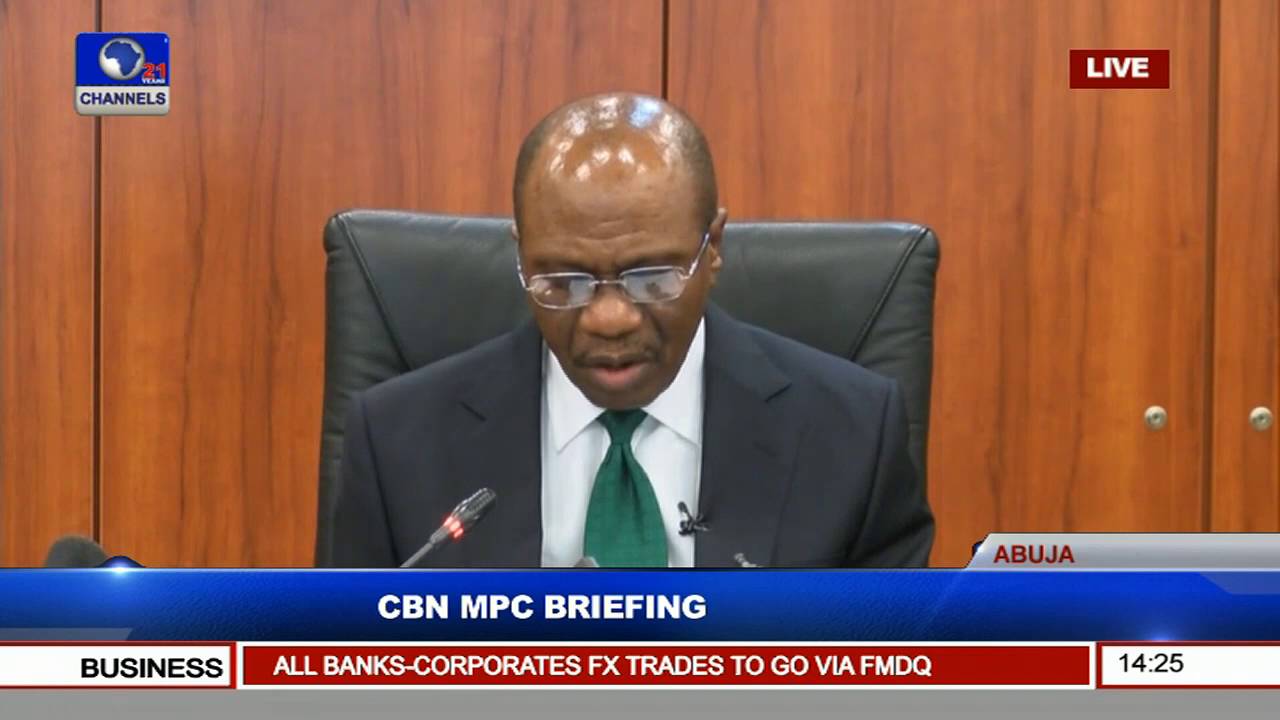
With just two weeks left to the first meeting of the Monetary Policy Committee (MPC) meeting this year, it is not certain if the meeting will hold.

This is because the committee lacks the quorum to seat and the Senate, which is to screen and confirm nominees to fill the vacant positions, has refused to carry out this duty because of a face-0ff with the executive arm of government.

The MPC meeting is organised by the Central Bank of Nigeria (CBN) and it uses it to formulate monetary policies and set interest rates.

The committee comprises the CBN Governor, who acts as the chairman; the four deputy governors of the apex bank; two members of the board of directors of the chief lender; three members appointed by the President; and two members appointed by the Governor.

At the moment, eight positions on the 12-member committee are vacant, making it impossible for the committee to form a quorum.

With the crisis on ground, investors are already getting worried where this could lead the nation’s economy to.

Business Post gathered that investors and observers want the Senate and Presidency to quickly resolve the issue so as not to put the recovering economy into another crisis.

“It is a bad signal to investors. If the meeting fails to hold later this month, be rest assured that it would have a negative effect on the economy because it would surely bring panic amongst us,” an investor, Mr Sunday Akinremi, told Business Post on Monday.

The Senate is expected to resume from its recess on Tuesday, January 16, 2018, while the MPC meeting is scheduled to hold a week after.

According to a report by ThisDay, a Senator, who spoke on the condition of anonymity on Sunday, maintained that the position of the upper legislative chamber remained unchanged until the impasse regarding the nomination and non-confirmation of the acting chairman of the Economic and Financial Crimes Commission Crimes Commission (EFCC), Mr Ibrahim Magu, was resolved.

The lawmaker also said the Senate had resolved to seek legal interpretation of a comment made by Vice-President Yemi Osinbajo that the position of the EFCC chairman does not require the confirmation of the Senate, as it was not specified in the constitution.

As a result of Mr Osinbajo’s remark, the Senate had resolved to suspend the confirmation process for all nominees of the president not specifically mentioned in the 1999 Constitution, but are provided for in the establishment Acts of several agencies of the federal government such as the CBN, FIRS, NCC, and others.

The source explained: “What we are saying is that there is a need to test this in court. Since the vice-president, who is a lawyer, can pronounce that Magu does not need Senate confirmation and that his nomination should not have been sent to us in the first instance, then we queried why that of the MPC members were sent to the Senate.

“After all, the appointment of MPC members is also not contained in the constitution. So why was it sent to us? If we decline confirmation, would the executive not still interpret it the way they have chosen to interpret the issue with Mr Magu?

“Just like the EFCC chairmanship, the members of the MPC are not mentioned in our constitution.”

However, the lawmaker pointed out that the Senate has been confirming nominees of the president specifically mentioned in the constitution such as officials of the Independent National Electoral Commission (INEC).

When contacted, the spokesman of the Senate, Mr Sabi Aliyu Abdullahi, could not be reached for his reaction, as his mobile phones were switched off.

In a recent interview, he had told THISDAY that the resolution of the Senate was still in place until the impasse regarding Mr Magu was resolved.

The President had in October nominated Mrs Aisha Ahmad as deputy governor of the CBN to replace Mrs Sarah Alade, who retired from the Bank last June.

He also nominated Professor Adeola Festus Adenikinju, Dr Aliyu Rafindadi Sanusi, Dr Robert Chikwendu Asogwa and Dr Asheikh Maidugu as members of the MPC to fill the positions of four others whose tenure expired at the end of last year.

Similarly, the president had nominated five non-executive directors for the CBN, who have also not been confirmed by the Senate.

Meanwhile, Mr Suleiman Barau, another deputy governor of the central bank, who is also a member of the committee, retired last month.

The president is yet to name a replacement for him.

The delay in confirming the MPC nominees has led to uncertainty over the January meeting of the committee, which has operational independence in setting interest rates as well as formulating monetary policies for the country.

Speaking on the issue Sunday, a senior CBN official who pleaded to remain anonymous, said the matter was beyond the CBN.

She explained: “The CBN is not in a position to push for the confirmation of the nominees.  It is something between the presidency and the Senate.

“We would have loved to get the confirmation so that our MPC and even the Board of Governors would be up and running.”

When asked about the likely implication of not holding the meeting, the CBN official said: “The implications are very clear. Apart from being a national disgrace, it would be an international embarrassment that the CBN cannot hold its MPC because of the lack of quorum. I don’t think it has ever happened to any country.”


Modupe Gbadeyanka is a fast-rising journalist with Business Post Nigeria. Her passion for journalism is amazing. She is willing to learn more with a view to becoming one of the best pen-pushers in Nigeria. Her role models are the duo of CNN's Richard Quest and Christiane Amanpour.

Click to comment

Leave a Reply

Your email address will not be published. Required fields are marked *

Economy

Nigeria’s Gross Foreign Reserves Hit 17-Year High of $51.04bn

Published

on

Reserves

By Aduragbemi Omiyale

The gross foreign reserves of Nigeria reached a 17-year high of $51.04 billion, data from the Central Bank of Nigeria (CBN) shows.

Business Post gathered from the apex bank’s website that this new feat was achieved on Thursday, June 18, 2026.

A day earlier, which was Wednesday, June 17, 2026, the amount in the country’s external reserves stood at $50.96 billion, indicating accretion of 0.16 per cent.

This latest development is expected to strengthen the value of the Nigerian Naira in the foreign exchange (FX) market.

It was observed that since the beginning of this month, the amount in the forex reserves has been building up gradually after an initial scare.

It is believed that inflows from crude oil sales have been boosting the reserves, though prices are expected to trend downward as a result of the ceasefire deals between the United States and Iran on Friday.

The price of crude oil has cooled to around $80 per barrel. It should further moderate to its level before February 28, 2026, when the bombardment of Iran started, which led to the death of the country’s 86-year-old Supreme Leader, Ayatollah Ali Khamenei.

Continue Reading

Economy

DBN, EIB Seal €200m Financial Partnership for Nigerian MSMEs

Published

on

€200m Financial Partnership

By Aduragbemi Omiyale

A €200 million financial partnership to support the development of small-scale investments of Nigerian enterprises contributing to the country’s green and digital economy has been signed by the Development Bank of Nigeria (DBN) and the development arm of the European Investment Bank (EIB) Group, EIB Global.

The funds would be disbursed to Micro, Small, and Medium Enterprises (MSMEs) in Nigeria, with a focus on agriculture, renewable energy, digitalisation and innovation.

The collaboration aligns with EIB Global’s strategy to support sustainable, inclusive, and resilient economic growth in Nigeria under the Global Gateway Initiative.

The investment programme will boost private sector development in Nigeria and support entrepreneurs and job creation by easing access to suitable finance for MSMEs and Midcaps.

It will also strengthen Nigeria’s green transition by expanding financing opportunities for companies in the renewable energy and agribusiness sectors.

In agriculture, it will help improve productivity, develop local supply chains, and strengthen food security for a country that hosts the largest population in Africa.

On the energy side, improved financing for renewable energy businesses will support clean energy access, reduce carbon emissions, and help build climate resilience in underserved communities.

“This partnership with DBN will strengthen the competitiveness of Nigeria’s private sector, especially for SMEs in the green and digital sectors.

“In supporting green projects and women entrepreneurs, we are also fostering inclusive growth and climate action.

“This is a powerful example of EIB’s real impact on the ground,” EIB Vice-President, Mr Ambroise Fayolle, said at a signature ceremony on Thursday, June 18, 2026, at the Lagos office of the DBN.

Also commenting, the chief executive of DBN, Mr Tony Okpanachi, described the investment as a significant milestone in efforts to drive Nigeria’s economic growth and sustainability.

“The €200 million investment from EIB Global is a significant milestone in our mission to drive Nigeria’s economic growth and sustainability. By supporting local financial institutions and MSMEs in key sectors like agriculture, renewable energy, digitalisation, and innovation, we’re empowering entrepreneurs and fostering a culture of sustainable innovation,” he stated.

Continue Reading

Economy

Nigeria’s Crude Oil Output Can Hit 1.9mbpd—Eyesan

Published

on

crude oil output

By Adedapo Adesanya

Nigeria has the potential to produce 1.9 million barrels of crude oil per day, having hit a peak production of 1.86 million barrels per day in May, according to the chief executive of the Nigerian Upstream Petroleum Regulatory Commission (NUPRC), Mrs Oritsemeyiwa Eyesan.

The NUPRC chief said this on Wednesday during a meeting with the chairman of the Nigeria Revenue Service, Mr Zacch Adedeji, at the NRS headquarters in Abuja.

In a statement signed by the agency’s Head of Media and Corporate Communications, Mr Eniola Akinkuotu, it was disclosed that the country’s oil industry has continued to record production growth, noting that crude output reached a peak of 1.86 million barrels per day in May, placing the industry on a stronger recovery path.

The meeting also focused on strengthening collaboration between the two agencies to promote transparency, accountability and efficiency in the collection of oil and gas revenues.

Speaking during the engagement, Mrs Eyesan commended the leadership of the NRS for reforms that culminated in the enactment of the NRS Act and described the transition of revenue collection responsibilities as smooth.

Mrs Eyesan said the process had been seamless. The CCE also highlighted the Commission’s efforts in creating an enabling environment for operators in the oil and gas industry.

“We are here to enable them, enable their businesses, ensure that they survive and succeed. And we want to grow the pie because when you grow the pie, everybody benefits,” she said.

She also disclosed that recent gains in crude production demonstrate that industry reforms and collaborative efforts by stakeholders are beginning to yield positive results.

“We are back to production. We are ramping up now, and we want to continue working. We still recognise the constraints. Infrastructure and asset integrity are major constraints, but we will work on these. Even human capacity in the industry—we see that because we want to grow, we must also grow that capacity to meet the demands,” she said.

The NUPRC boss also pointed out that one of the key targets upon assuming office was the digitisation of NUPRC’s operations, a goal she said has largely been achieved.

Continue Reading

Trending