Connect with us

Economy

Buhari Approves Tax Hike on Alcoholic Drinks, Cigarettes

Published

on

By Dipo Olowookere

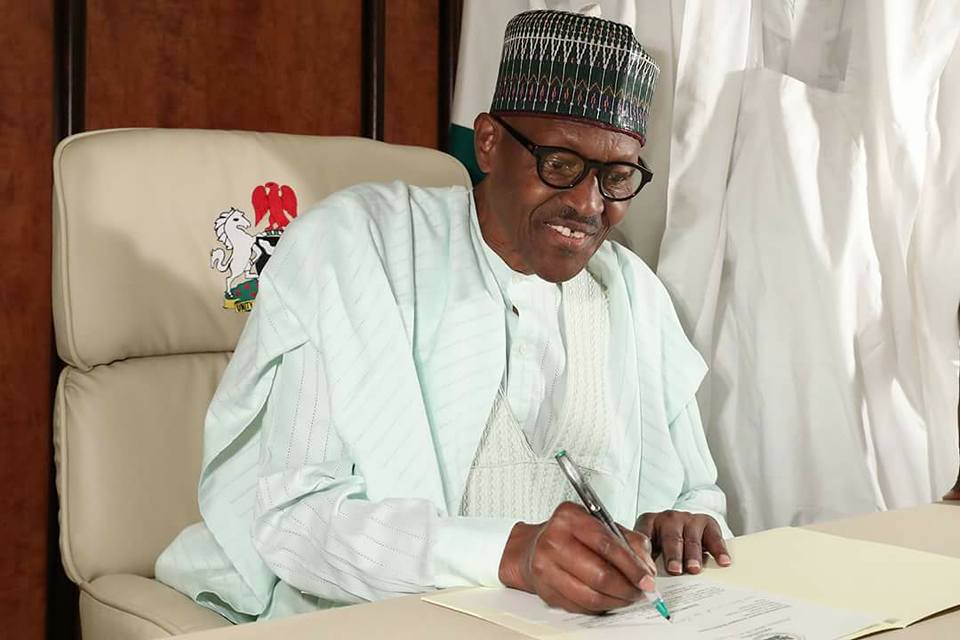
President Muhammadu Buhari has approved the upward review of excise duty rates on alcoholic beverages and tobacco.

It was gathered that the President has also granted a grace period of 90 days to all manufacturers before the commencement of the new excise duty regime.

This information was confirmed in a statement issued on Sunday in Abuja and it takes effect from Monday, June 4, 2018.

A statement signed by Oluyinka Akintunde, Special Adviser on Media and Communication to Minister of Finance, Mrs Kemi Adeosun, explained that the new excise duty rates were spread over a three-year period from 2018 to 2020 in order to moderate the impact on prices of the products.

However, there is no increase in excise duty of other locally excisable products.

It was explained that the new excise duty regimes followed all-inclusive stakeholder engagements by the Tariff Technical Committee of the Ministry of Finance with key industry stakeholders.

According to the Minister, the upward review of the excise duty rates for alcoholic beverages and tobacco was to achieve a dual benefit of raising the Federal Government’s fiscal revenues and reducing the health hazards associated with tobacco-related diseases and alcohol abuse.

The TCC recommended the slight adjustment in the excise duty charges after cautious considerations of the government’s Fiscal Policy Measures for 2018 and the reports of the World Bank and the International Monetary Fund Technical Assistance Mission on Nigeria’s Fiscal Policy

The effect of the excise duty rates adjustment on trade and investment was also assessed by the Federal Ministry of Trade and Investment and it adopted the recommendations of the TTC, the statement explained.

Furthermore, peer country comparisons were also carried out showing Nigeria as being behind the curve in the review of excise duty rates on alcoholic beverages and tobacco.

Following the President’s approval, the new excise duty rate on tobacco was now a combination of the existing ad-valorem base rate and specific rate while the ad-valorem rate was replaced with a specific rate for alcoholic beverages.

For Alcoholic Beverages, the current ad-valorem rate will be replaced with specific rates and spread over three years to moderate the impact on prices. This will curb the discretion in the Unit Cost Analysis (UCA) for determining the ad-valorem rate & prevent revenue leakages.

For Tobacco, government said it will maintain the current ad-valorem rate of 20 percent and introduce additional specific rates with the implementation to be spread over a three-year period to also reasonably reduce the impact on prices.

Under the newly approved excise duty rates for tobacco in addition to the 20 percent ad-valorem rate, each stick of cigarette will attract a N1 specific rate per stick (N20 per pack of 20 sticks) in 2018 with N2 specific rate per stick (N40 per pack of 20 sticks) in 2019 and N2.90k specific rate per stick (N58 per pack of 20 sticks) in 2020.

Nigeria’s cumulative specific excise duty rate for tobacco was 23.2 percent of the price of the most sold brand, as against 38.14 percent in Algeria, 36.52 percent in South Africa and 30 percent in Gambia.

The new specific excise duty rate for alcoholic beverages cuts across Beer & Stout, Wines and Spirits for the three years 2018 to 2020.

Under the new regime, Beer & Stout would attract N0.30k per centiliter (Cl) in 2018 and N0.35k per Cl each in 2019 and 2020.

Wines would attract N1.25k per Cl in 2018 and N1.50k per Cl each in 2019 and 2020, while N1.50k per Cl was approved for Spirits in 2018, N1.75k per Cl in 2019 and N2.00k per Cl in 2020.

The Minister added that the new excise duty regimes are in line with the Economic Community of West African States (ECOWAS) directive on the harmonisation of member-states’ legislations on excise duties.

It would be recalled that the ECOWAS Council of Ministers had at its 62nd and 79th Ordinary Sessions in Abuja in May 2009 and December 2017, respectively, issued directives on the harmonisation of the ECOWAS Member States’ Legislations on Excise Duties.

The directives seek to harmonise member-states’ legislations on excise duties of non-oil products and also stipulate the scope of application, rate of taxation, taxable event and amount.


Dipo Olowookere is a journalist based in Nigeria that has passion for reporting business news stories. At his leisure time, he watches football and supports 3SC of Ibadan. Mr Olowookere can be reached via [email protected]

1 Comment

Leave a Reply

Your email address will not be published. Required fields are marked *

Economy

Finance Ministry Orders NAICOM to Suspend Nigeria Re, NICON Recapitalisation Fees

Published

on

NAICOM

By Adedapo Adesanya

The Federal Ministry of Finance has directed the National Insurance Commission (NAICOM) to suspend enforcement of disputed recapitalisation fees and a directive requiring NICON Insurance Limited and the Nigeria Reinsurance Corporation to transfer their entire fresh capital into an escrow account with the Central Bank of Nigeria (CBN).

The ministry also demanded a detailed response and legal justification from NAICOM over assessments of N305 million against NICON and N375 million against Nigeria Re as part of the ongoing insurance industry recapitalisation exercise.

The directive was contained in a letter dated August 6, 2026, signed by the Permanent Secretary, Finance, Mr Raymond Omachi, on behalf of the Minister of Finance and Coordinating Minister of the Economy, Mr Taiwo Oyedele.

The letter followed a July 27 petition by NICON and Nigeria Re over the implementation of the Nigerian Insurance Industry Reform Act, 2025. The companies challenged NAICOM’s demand for a one per cent capital injection fee, alongside processing and verification charges under the commission’s Minimum Capital Requirement Guidelines.

They also disputed a directive requiring existing insurance companies to transfer their entire recapitalisation funds into a CBN escrow account, arguing that Section 16(3) of NIIRA 2025 provides for a statutory deposit of only 10 per cent.

According to the Finance Ministry, NICON and Nigeria Re had injected N20 billion and N30 billion respectively into Mudaraba Term Deposit accounts with Lotus Bank, exceeding their adjusted capital requirements of N16 billion and N28 billion.

The companies also deposited N2.5 billion and N3.5 billion respectively with the CBN as statutory deposits and paid initial fees of N80 million and N75 million.

The ministry said the companies therefore considered themselves compliant with the July 31, 2026 recapitalisation deadline.

“Pending the determination of the petition, the Commission should suspend the enforcement of the contested processing fees, 1 per cent capital injection fee demands, and full-capital escrow transfer directives against NICON Insurance Limited and Nigeria Reinsurance Corporation,” the letter stated.

The ministry consequently asked NAICOM to explain the basis and legal justification for the disputed charges and escrow requirement.

The intervention comes amid the Federal Government’s efforts to strengthen the capital base of insurance companies and reinsurers, improve their capacity to underwrite larger risks and enhance the sector’s contribution to economic development.

The dispute, however, has raised questions over the extent of NAICOM’s authority to impose additional fees and require existing insurers to place their entire recapitalisation funds in escrow.

The Finance Ministry’s letter did not disclose whether NAICOM had responded to the issues raised. It also referenced an alleged N500 million demand and an additional N180 million capitalisation charge in its subject, although the substantive section specifically put the disputed assessments at N305 million for NICON and N375 million for Nigeria Re.

For now, enforcement of the contested fees and full-capital escrow directive against the two state-owned insurers has been suspended pending NAICOM’s response and legal clarification.

Continue Reading

Economy

NASD Exchange Sheds 0.32% 11 Plc Leads Losers’ Chart

Published

on

NASD Exchange bullish

By Adedapo Adesanya

Four price decliners overpowered the two price gainers recorded at the NASD Over-the-Counter (OTC) Securities Exchange on Monday, August 10, weakening it by 0.32 per cent at the close of transactions.

The advancers were led by Food Concepts Plc, which chalked up 25 Kobo to sell at N2.75 per unit versus the previous price of N2.50 per unit, and Mass Telecoms Innovation Plc appreciated by 3 Kobo to 35 Kobo per share from 32 Kobo per share.

However, 11 Plc lost N24.75 to close at N222.75 per unit versus N247.50 per unit, FrieslandCampina Wamco Nigeria Plc declined by N3.09 to N145.00 per share from N148.09 per share, Industrial and General Insurance (IGI) Plc went down by 5 Kobo to 50 Kobo per unit from 55 Kobo per unit, and Geo-Fluids Plc slid by 1 Kobo to N2.27 per share from N2.28 per share.

As a result, the market capitalisation contracted by N8.94 billion to N2.798 trillion from the previous session’s N2.807 trillion, and the NASD Security Index (NSI) retreated by 14.9 points to 4,663.18 points from 4,678.08 points.

The trading data showed that the volume of securities exchanged by investors rose by 108.9 per cent to 1.1 million units from 535,7560 units, and the value of securities jumped by 69.5 per cent to N10.2 million from N6.0 million, while the number of deals executed receded by 2.8 per cent to 35 deals from 36 deals.

Great Nigeria Insurance (GNI) Plc closed the trading session as the most traded stock by value on a year-to-date basis, with 3.4 billion units exchanged for N8.4 billion, followed by Infrastructure Credit Guarantee (Infracredit) Plc with 2.3 billion units valued at N6.5 billion, and Central Securities Clearing System (CSCS) Plc with 77.0 million units transacted for N5.5 billion.

GNI Plc also ended the day as the most traded stock by volume on a year-to-date basis, with 3.4 billion units worth N8.4 billion, followed by Infracredit Plc with 2.3 billion units sold for N6.5 billion, and Resourcery Plc with 1.1 billion units traded for N415.7 million.

Continue Reading

Economy

Naira Gains N5.55, Sells N1,360/$1 at Official Market

Published

on

naira official market

By Adedapo Adesanya

The Naira opened the week on a positive note, appreciating against the US Dollar by N5.55 or 0.41 per cent in the Nigerian Autonomous Foreign Exchange Market (NAFEM) on Monday, August 10, to N1,360.14/$1 from N1,365.69/$1.

The domestic currency also improved its exchange rate against the Pound Sterling in the official market during the session by 67 Kobo to sell at N1,838.50/£1 compared with the preceding session’s N1,839.17/£1, and gained N4.64 against the Euro to quote at N1,571.09/€1, in contrast to last Friday’s N1,575.73/€1.

However, the Naira maintained stability against the Dollar in the black market and the GTBank forex counter on Monday at N1,400/$1 and N1,371/$1, respectively.

Data from the Central Bank of Nigeria (CBN) showed that interbank FX turnover fell by 46 per cent yesterday to $213.845 million from the $393.477 million recorded at the close of trading on Friday.

The decline came despite a sharp increase in the volume of foreign exchange transactions executed during the session, indicating weaker participation by high-ticket FX customers and other major market participants.

The lower turnover suggests reduced demand for FX among large-scale buyers, even as market makers continued to facilitate transactions through the NAFEM window, with the number of FX traded rising to 182 from 102.

In the cryptocurrency market, traders and investors took profit as broader markets’ focus shifted to rising bond yields, higher oil prices and upcoming US inflation data.

Cardano (ADA) depreciated by 5.2 per cent to $0.1873, Ethereum (ETH) slipped by 2.6 per cent to $1,873.43, Ripple (XRP) slumped by 2.3 per cent to $1.01, Bitcoin (BTC) fell by 1.8 per cent to $63,949.22, Solana (SOL) crashed by 1.3 per cent to $75.81, and Binance Coin (BNB) tumbled by 0.6 per cent to $599.49.

But TRON (TRX) gained 0.5 per cent to trade at $0.3314, and Dogecoin (DOGE) grew by 0.2 per cent to $0.0700, while the US Dollar Tether (USDT) and the US Dollar Coin (USDC) traded flat at $1.00 apiece.

Continue Reading