Economy
$2.5b Currency Swap: CBN Appoints Four Lenders as Settlement Banks
By Dipo Olowookere
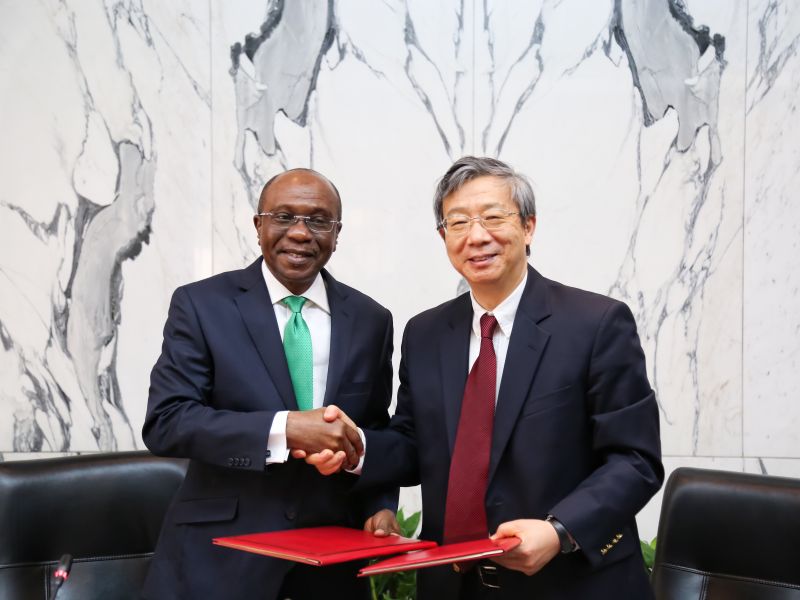
Four banks have been appointed by the Central Bank of Nigeria (CBN) as settlement banks for the $2.5 billion currency swap deal signed between Nigeria and China last Friday in Beijing.
According to a report by ThisDay, the four financial institutions appointed by the apex bank are First Bank of Nigeria Limited, Stanbic IBTC, Standard Chartered Bank (SCB) and Zenith Bank Plc.
Last Friday, the CBN, on behalf of Nigeria, sealed the much-awaited $2.5 billion bilateral currency swap agreement with the People’s Bank of China (PBoC).
The settlement banks are expected to handle the trade obligations that would enable an importer in Nigeria, after filling the required documentation, to easily exchange the Naira for the Renminbi (RMB) instead of resorting to third currencies such as the US Dollar, while the reverse will be the case for importers in China that trade with Nigerian businesses.
Quoting a source at the CBN privy to the deal, ThisDay said while two of the banks will begin work immediately, the two others will have to upgrade their statuses in China.
Standard Chartered Bank and Stanbic IBTC already have operational offices in China, while Zenith Bank and First Bank have representative offices in Beijing.
“While SCB already has a presence in China through its Standard Chartered Bank (China) Limited, Stanbic has been trading in the country through its affiliate, the Investment and Commercial Bank China (ICBC).
“However, FBN and Zenith Bank were also appointed because they already have representative offices in China.
“So, while SCB and Stanbic can start immediately, it would take FBN and Zenith Bank some time to join the settlement arrangement because they would have to convert their representative offices to operational offices.
“This whole swap agreement would kick off likely before June because we have to operationalise the settlement arrangement with the relevant institutions,” the source quoted in the report said.
It was gathered that these banks, to be responsible for settling the trade transactions between importers and exporters from both countries, will likely take off just before next month.
The source explained further that the currency swap by the two central bank governors was partly facilitated by the improving economic environment in Nigeria.
“As you know, negotiations have been on-going for two years, so yes to some extent, the improvement in foreign reserves and government revenues, drop in the inflation rate, and the uptick in economic activities, played a role in getting the swap with the PCoB.
“But this was not the only reason factored into the negotiations, as there were other bilateral reasons which I am not at liberty to disclose,” she said.
When asked about the impact on the country’s external reserves, the source pointed out that China is Nigeria’s largest trading partner, accounting for about 35 percent of trade.
However, the National Bureau of Statistics’ (NBS) Fourth Quarter (Q4) 2017 Foreign Trade Statistics put China’s trade with Nigeria at 22 percent, making it a major trading partner. The total value of trade in Q4 2017 was put at N465.13 billion.
According to the CBN source, the currency swap will play a role in reserves management as pressure from Nigerian importers seeking to source dollars will now dissipate.
“Of course, this will help in terms of management of our reserves. What this means is that pressure on Nigerian importers seeking to source dollars to import goods from China will completely dissipate,” she explained.
Yesterday, the CBN, through its spokesman, Mr Isaac Okorafor, said in a statement on Thursday that among other benefits, the agreement is expected to provide Naira liquidity to Chinese businesses and provide RMB liquidity to Nigerian businesses respectively, thereby improving the speed, convenience and volume of transactions between the two countries.
Also, the currency swap is aimed at providing adequate local currency liquidity to Nigerian and Chinese industrialists and other businesses thereby reducing the difficulties encountered in the search for third currencies.
Furthermore, the deal will make it easier for most Nigerian manufacturers, especially small and medium enterprises (SMEs) and cottage industries in manufacturing and export businesses to import raw materials, spare -parts and simple machinery to undertake their businesses by taking advantage of available RMB liquidity from Nigerian banks without being exposed to the difficulties of seeking other scare foreign currencies.
The deal, which is purely an exchange of currencies, will also make it easier for Chinese manufacturers seeking to buy raw materials from Nigeria to obtain enough Naira from banks in China to pay for their imports from Nigeria.
The CBN said this will protect Nigerian business people from the harsh effects of third currency fluctuations.
Economy
Coronation Sees February 2026 Inflation Cooling to 14.12%
By Aduragbemi Omiyale
Analysts at Coronation Research are projecting the inflation rate for February 2026 to moderate by 0.98 per cent to 14.12 per cent from the 15.10 per cent recorded in the preceding month.
The National Bureau of Statistics (NBS) is expected to release the inflation numbers today, Monday, March 16, 2026.
In a note released over the weekend, Coronation Research disclosed that the fall in the average prices of goods and services for last month would be impacted by a decline in the prices of food items.
“Our projection is supported by favourable base effects, easing food price pressures, and slight appreciation of the Naira,” a part of the report sighted by Business Post read.
The organisation revealed that the ongoing government interventions in the agricultural sector to improve food supply conditions are beginning to ease pressures within the food component of the consumer basket.
It further stated that “appreciation of the Naira to N1,363.40/1$ from N1,386.55/1$ in January is expected to reduce the cost of imported food items.”
However, it stressed that the ongoing US/Israel-Iran war was capable of reversing the deflationary trends because of the rising global energy prices.
“Also, the $200 million financing approved by the African Development Bank (AfDB) Group to scale up priority agricultural investments is expected to be disbursed in March, but its impact is likely to materialise in the medium to long term, with limited immediate effects on food supply and prices,” it said.
Coronation Research also disclosed that the recent energy market developments could keep core inflation sticky in the near term, as average Bonny Light crude oil prices rose to $72.33 per barrel in February 2026 from $68.04 per barrel in January.
Economy
SERAP Calls for Investigation into NNPC’s N5.9bn Rebranding
By Adedapo Adesanya
The Socio-Economic Rights and Accountability Project (SERAP) has called on President Bola Tinubu to order an investigation into the alleged N5.9 billion rebranding cost of the old Nigerian National Petroleum Corporation into the Nigerian National Petroleum Company (NNPC) Limited.
In a Sunday statement, SERAP urged Mr Tinubu to direct the Attorney General of the Federation and Minister of Justice, Mr Lateef Fagbemi, alongside anti-corruption agencies, to look into the matter.
The group further urged the President to direct the panel to identify and invite officials who authorised the payment and contractors who handled the project for questioning.
“We’ve urged President Bola Tinubu to urgently direct the Attorney General of the Federation and Minister of Justice, Mr Lateef Fagbemi, SAN, and appropriate anti-corruption agencies to promptly investigate the alleged expenditure of about ₦5.9 billion reportedly spent on the rebranding of the Nigerian National Petroleum Corporation (NNPC) to the Nigerian National Petroleum Company Limited (NNPCL).
“We also urged him to direct the Economic and Financial Crimes Commission (EFCC) and the Independent Corrupt Practices and Other Related Offences Commission (ICPC) to identify the officials who approved and paid the amount, and the contractor(s) who collected the money, and to invite them for questioning,” the organisation stated.
SERAP further alleged that the NNPC reportedly paid N2.9 billion for incorporation expenses from petroleum product proceeds, while the National Petroleum Investment Management Services (NAPIMS) also charged N2.9 billion against crude oil revenue for the same purpose.
The group argued that the total cost was valued at about N5.9 billion, which was spent by the NNPCL for the rebranding.
“There ought to be full transparency and accountability regarding the reported ₦5.9 billion spent on rebranding NNPC to NNPCL.”
SERAP emphasised that Nigerians have the right to know who approved the expenditure, who received the money, and whether due process was followed.
“Any investigation into the rebranding project should determine whether the N5.9 billion represents value for money, lawful spending of public funds, and compliance with transparency and accountability requirements,” the statement concluded.
Business Post reports that NNPC became a limited liability company on July 1, 2022, under the Companies and Allied Matters Act (CAMA) in line with the implementation of the Petroleum Industry Act (PIA), which was signed into law on August 16, 2021, by late President Muhammadu Buhari.
Economy
NASD Market Falls 1.18% to Extend Losing Streak
By Adedapo Adesanya
The NASD Over-the-Counter (OTC) Securities Exchange extended its stay in the south for the fourth consecutive session after it shed 1.18 per cent on Friday, March 13.
The unlisted securities market recorded a loss despite closing without a price decliner, and ending with two price gainers led by Geo Fluids Plc, which gained 1o Kobo to sell at N3.10 per share compared with the previous day’s N3.00 per share. Industrial and General Insurance (IGI) Plc appreciated during the session by 2 Kobo to trade at 54 Kobo per unit versus Thursday’s closing price of 52 Kobo per unit.
When the market closed for the day, the market capitalisation lost N29.83 billion to close at N2.489 trillion compared with the N2.519 trillion it finished a day earlier, and the NASD Unlisted Security Index (NSI) crashed by 49.84 points to 4,160.46 points from 4,210.31 points.
Market activity improved yesterday, as the volume of transactions rose 179.5 per cent to 10.4 million units from 3.7 million units, but the value of trades declined by 68.4 per cent to N29.9 million from N95.0 million, while the number of deals weakened by 11.5 per cent to 46 deals from 52 deals.
Central Securities Clearing Systems (CSCS) Plc remained the most active stock by value on a year-to-date basis with 38.4 million units worth N2.4 billion, Okitipupa Plc followed with 6.4 million units traded at N1.1 billion, and FrieslandCampina Wamco Nigeria Plc transacted 6.3 million units for N584.3 million.
Resourcery Plc ended the trading session as the most traded stock by volume on a year-to-date basis with 1.1 billion units valued at N415.6 million, trailed by Geo-Fluids Plc with 130.8 million units valued at N504.5 million, and CSCS Plc with 38.4 million units worth N2.4 billion.
-
Feature/OPED6 years agoDavos was Different this year
-
Travel/Tourism10 years ago
Lagos Seals Western Lodge Hotel In Ikorodu
-
Showbiz3 years agoEstranged Lover Releases Videos of Empress Njamah Bathing
-
Banking8 years agoSort Codes of GTBank Branches in Nigeria
-
Economy3 years agoSubsidy Removal: CNG at N130 Per Litre Cheaper Than Petrol—IPMAN
-
Banking3 years agoSort Codes of UBA Branches in Nigeria
-
Banking3 years agoFirst Bank Announces Planned Downtime
-
Sports3 years agoHighest Paid Nigerian Footballer – How Much Do Nigerian Footballers Earn