Connect with us

Economy

$2.5b Currency Swap: CBN Appoints Four Lenders as Settlement Banks

Published

on

By Dipo Olowookere

Four banks have been appointed by the Central Bank of Nigeria (CBN) as settlement banks for the $2.5 billion currency swap deal signed between Nigeria and China last Friday in Beijing.

According to a report by ThisDay, the four financial institutions appointed by the apex bank are First Bank of Nigeria Limited, Stanbic IBTC, Standard Chartered Bank (SCB) and Zenith Bank Plc.

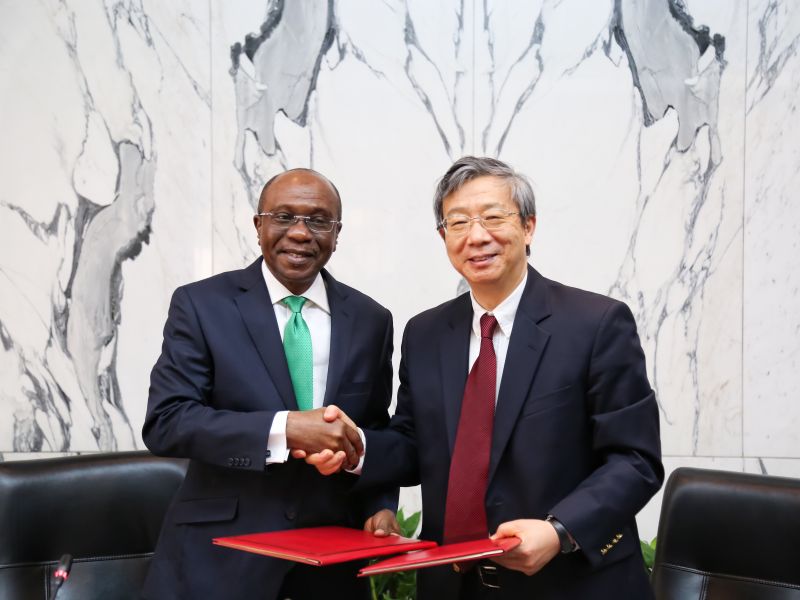
Last Friday, the CBN, on behalf of Nigeria, sealed the much-awaited $2.5 billion bilateral currency swap agreement with the People’s Bank of China (PBoC).

The settlement banks are expected to handle the trade obligations that would enable an importer in Nigeria, after filling the required documentation, to easily exchange the Naira for the Renminbi (RMB) instead of resorting to third currencies such as the US Dollar, while the reverse will be the case for importers in China that trade with Nigerian businesses.

Quoting a source at the CBN privy to the deal, ThisDay said while two of the banks will begin work immediately, the two others will have to upgrade their statuses in China.

Standard Chartered Bank and Stanbic IBTC already have operational offices in China, while Zenith Bank and First Bank have representative offices in Beijing.

“While SCB already has a presence in China through its Standard Chartered Bank (China) Limited, Stanbic has been trading in the country through its affiliate, the Investment and Commercial Bank China (ICBC).

“However, FBN and Zenith Bank were also appointed because they already have representative offices in China.

“So, while SCB and Stanbic can start immediately, it would take FBN and Zenith Bank some time to join the settlement arrangement because they would have to convert their representative offices to operational offices.

“This whole swap agreement would kick off likely before June because we have to operationalise the settlement arrangement with the relevant institutions,” the source quoted in the report said.

It was gathered that these banks, to be responsible for settling the trade transactions between importers and exporters from both countries, will likely take off just before next month.

The source explained further that the currency swap by the two central bank governors was partly facilitated by the improving economic environment in Nigeria.

“As you know, negotiations have been on-going for two years, so yes to some extent, the improvement in foreign reserves and government revenues, drop in the inflation rate, and the uptick in economic activities, played a role in getting the swap with the PCoB.

“But this was not the only reason factored into the negotiations, as there were other bilateral reasons which I am not at liberty to disclose,” she said.

When asked about the impact on the country’s external reserves, the source pointed out that China is Nigeria’s largest trading partner, accounting for about 35 percent of trade.

However, the National Bureau of Statistics’ (NBS) Fourth Quarter (Q4) 2017 Foreign Trade Statistics put China’s trade with Nigeria at 22 percent, making it a major trading partner. The total value of trade in Q4 2017 was put at N465.13 billion.

According to the CBN source, the currency swap will play a role in reserves management as pressure from Nigerian importers seeking to source dollars will now dissipate.

“Of course, this will help in terms of management of our reserves. What this means is that pressure on Nigerian importers seeking to source dollars to import goods from China will completely dissipate,” she explained.

Yesterday, the CBN, through its spokesman, Mr Isaac Okorafor, said in a statement on Thursday that among other benefits, the agreement is expected to provide Naira liquidity to Chinese businesses and provide RMB liquidity to Nigerian businesses respectively, thereby improving the speed, convenience and volume of transactions between the two countries.

Also, the currency swap is aimed at providing adequate local currency liquidity to Nigerian and Chinese industrialists and other businesses thereby reducing the difficulties encountered in the search for third currencies.

Furthermore, the deal will make it easier for most Nigerian manufacturers, especially small and medium enterprises (SMEs) and cottage industries in manufacturing and export businesses to import raw materials, spare -parts and simple machinery to undertake their businesses by taking advantage of available RMB liquidity from Nigerian banks without being exposed to the difficulties of seeking other scare foreign currencies.

The deal, which is purely an exchange of currencies, will also make it easier for Chinese manufacturers seeking to buy raw materials from Nigeria to obtain enough Naira from banks in China to pay for their imports from Nigeria.

The CBN said this will protect Nigerian business people from the harsh effects of third currency fluctuations.


Dipo Olowookere is a journalist based in Nigeria that has passion for reporting business news stories. At his leisure time, he watches football and supports 3SC of Ibadan. Mr Olowookere can be reached via [email protected]

Economy

Nigerian Equity Market Surpasses N145trn After 1.30% Expansion

Published

on

Nigerian equity market

By Dipo Olowookere

The Nigerian equity market showed no signs of slowing down, as it further appreciated by 1.30 per cent on Friday on the back of sustained buying pressure.

Unlike the preceding sessions, investor sentiment was bullish yesterday after the Nigerian Exchange (NGX) Limited ended with 43 price gainers and 26 price losers, implying a positive market breadth index, the first this week.

UPDC gained 10.00 per cent to close at N4.40, Academy Press also appreciated by 10.00 per cent to quote at N7.70, Haldane McCall improved by 9.97 per cent to N3.97, Zichis soared by 9.94 per cent to N15.60, and Wema Bank added 9.84 per cent to settle at N31.25.

Conversely, Meyer lost 9.92 per cent to sell for N16.80, Trans-Nationwide Express also crashed by 9.92 per cent to end at N7.90, C&I Leasing slipped by 8.53 per cent to N5.90, Omatek dipped by 7.34 per cent to N2.02, and eTranzact decreased by 5.28 per cent to N17.05.

When the bourse closed its doors to business, the All-Share Index (ASI) rose by 2,884.81 points to 225,722.49 points from 222,837.68 points, and the market capitalisation grew by N1.858 trillion to N145.335 trillion from N143.477 trillion.

A look at the activity chart showed that market participants transacted 627.6 million shares worth N44.5 billion in 55,232 deals during the trading day compared with the 667.9 million shares valued at N38.1 billion traded in 53,062 deals a day earlier.

This indicated that the volume of transactions went down by 6.03 per cent, the value of trades went up by 16.80 per cent, and the number of deals jumped by 4.09 per cent.

Access Holdings closed the session as investors’ toast, with a turnover of 75.6 million units worth N2.4 billion. UBA transacted 43.1 million units valued at N2.3 billion, Wema Bank exchanged 41.5 million units for N1.3 billion, Zenith Bank traded 38.4 million units valued at N5.2 billion, and Universal Insurance sold 29.5 million units for N35.9 million.

Continue Reading

Economy

Oyedele Eyes Fiscal Discipline, Investor-friendly Environment, Fair Taxation

Published

on

taiwo oyedele wale edun

By Aduragbemi Omiyale

Mr Taiwo Oyedele has set some goals he intends to achieve as Nigeria’s Minister of Finance and Coordinating Minister of the Economy.

While taking over from his predecessor, Mr Wale Edun, on Thursday, the tax expert assured that he has no plans to overturn some of the reforms already put in place by the former occupier of the seat.

In a message on Friday, he emphasised that, “Our immediate task is to consolidate these gains, deepen ongoing reforms, and ensure they translate into tangible benefits for all Nigerians.”

He promised to ensure fiscal discipline by embracing transparent and prudent management of public resources, while also harmonising revenue administration, broadening the tax base, reducing the burden on the vulnerable population, and supporting economic growth.

Mr Oyedele further said his other strategic priorities include creating a predictable and investor-friendly environment anchored on policy coherence, consistency, and clarity; and aligning efforts across all tiers and institutions to maximise policy impact.

He also said efforts would be made to deepen collaboration with the private sector and other key stakeholders for data-driven policy design, co-implementation, and feedback for continuous improvement.

According to him, “Good policy design alone is not enough; success will be defined by execution. We are committed to disciplined implementation, accountability, and measurable results.”

“I look forward to working with colleagues across government, the private sector, and all Nigerians as we move from reform to result, accelerate growth and build a more stable, inclusive, and prosperous economy,” he stated.

Continue Reading

Economy

NASD Bourse Edges Up 0.23% as NSI Nears 3,970 Points

Published

on

NASD OTC Bourse

By Adedapo Adesanya

The NASD Over-the-Counter (OTC) Securities Exchange further appreciated by 0.23 per cent on Thursday, April 23, with the Unlisted Security Index (NSI) adding 8.99 points to close at 3,969.96 points against the previous day’s 3,968 points.

The rise in the share price of Central Securities Clearing System (CSCS) Plc by N2.86 to N69.34 per unit from N66.48 per unit raised the market capitalisation of the NASD bourse by N5.38 billion to N2.380 trillion from N2.375 trillion.

Yesterday, there were two price losers, led by Food Concepts Plc, which lost 29 Kobo to sell at N2.65 per share versus N2.94 per share, while UBN Property Plc dipped by 22 Kobo to N2.03 per unit from N2.25 per unit.

During the session, the volume of securities traded declined by 97.9 per cent to 451,522 units from 21.5 million units on Wednesday, the value of securities depreciated by 52.32 per cent to N23.6 million from N49.5 million, and the number of deals depreciated by 3.6 per cent to 27 deals from 28 deals.

At the close of business, Great Nigeria Insurance (GNI) Plc remained the most active stock by value on a year-to-date basis with 3.4 billion units valued at N8.4 billion, followed by CSCS Plc with 59.5 million units exchanged for N4.0 billion, and Okitipupa Plc with 27.8 million units traded for N1.9 billion.

GNI Plc also closed the day as the most traded stock by volume on a year-to-date basis with 3.4 billion units worth N8.4 billion, trailed by Resourcery Plc with 1.1 billion units transacted for N415.7 million, and Infrastructure Guarantee Credit Plc with 400 million units sold for N1.2 billion.

Continue Reading

Trending