Connect with us

Economy

US Stocks Open on Disappointing Earnings, Trade Concerns

Published

on

US Stocks report

By Investors Hub

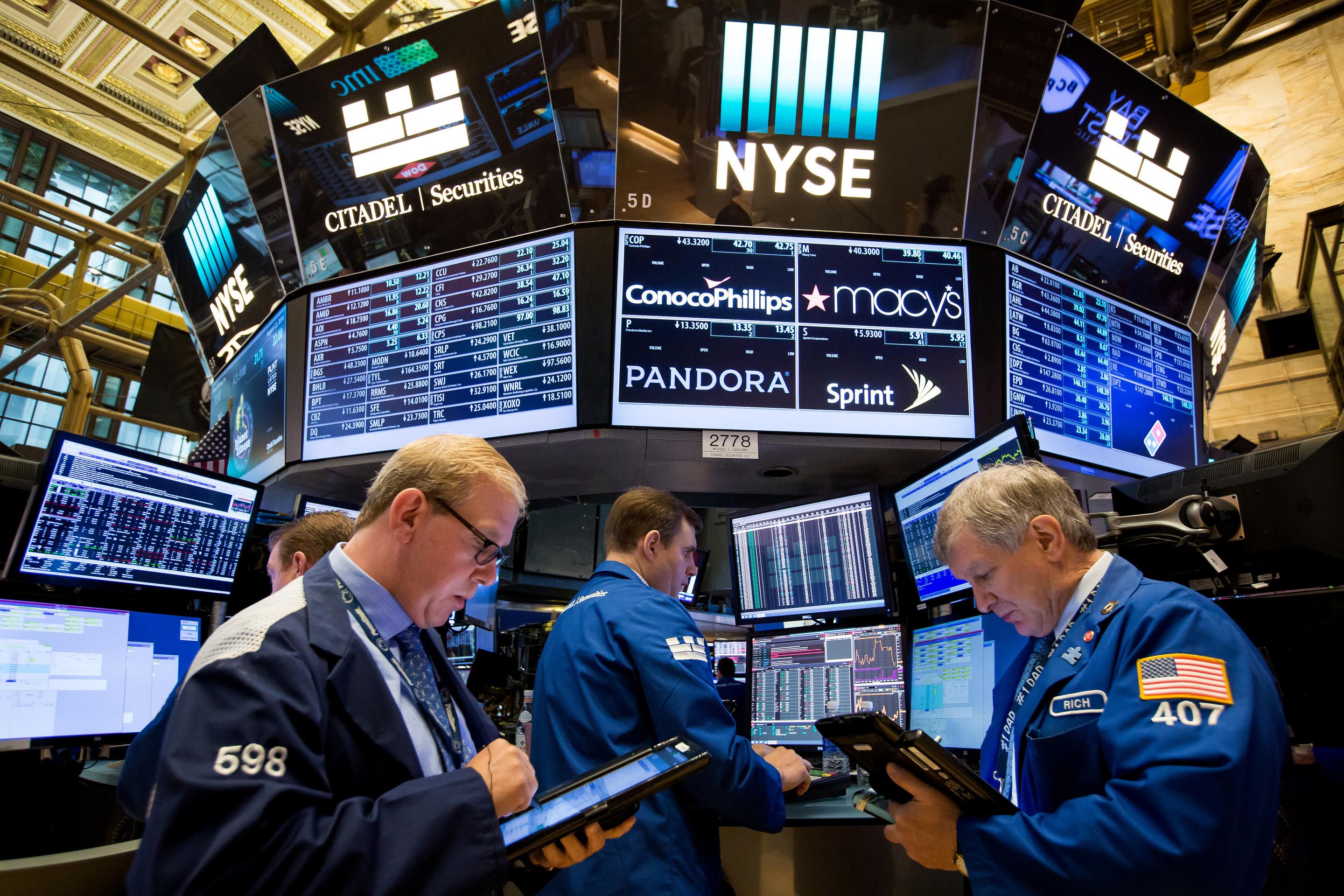
The major U.S. index futures are pointing to a lower opening on Wednesday, with stocks likely to see further downside following the weakness seen in the previous session.

Disappointing earnings news from Target (TGT) may weigh on the markets, as the discount retailer is moving significantly lower in pre-market trading.

Traders may also continue to react to comments from President Donald Trump expressing some dissatisfaction with trade talks with China.

?Our Trade Deal with China is moving along nicely, but in the end we will probably have to use a different structure in that this will be too hard to get done and to verify results after completion,? Trump said in a post on Twitter.

U.S. stocks fell on Tuesday, unable to sustain positive momentum from the previous session despite overtures from China.

China will cut the import tariffs it charges on cars to 15 percent, which will give a boost to foreign automakers in the world’s largest market, especially for U.S. automakers.

The Chinese Finance Ministry said Tuesday that it would cut import duties on passenger vehicles from 25 percent to 15 percent, starting July 1st.

Still, U.S. President Donald Trump says he’s “not really” pleased with China’s trade talks so far.

The Dow Jones Industrial Average closed 178.88 points, or 0.7 percent lower at 24,834.65. The S&P 500 Index fell 8.54 points, or 0.3 percent to 2,724.46 and the Nasdaq Composite edged down 15.58 points or 0.2 percent to 7,378.46.

Kohl’s (KSS) announced the company now expects its adjusted fiscal 2018 earnings to be $5.05 to $5.50 per share, compared to its prior guidance of $4.95 to $5.45. Shares tumbled 7 percent.

J.C. Penney (JCP) shares also moved sharply lower after the abrupt resignation of the company’s CEO Marvin Ellison.

Meanwhile, Micron (MU) shares jumped 7.4 percent after a deal with Intel. The chipmaker raised quarterly guidance Monday.

Adobe (ADBE) will buy e-commerce platform Magento in $1.68 billion deal. Adobe shares were up fractionally.


Modupe Gbadeyanka is a fast-rising journalist with Business Post Nigeria. Her passion for journalism is amazing. She is willing to learn more with a view to becoming one of the best pen-pushers in Nigeria. Her role models are the duo of CNN's Richard Quest and Christiane Amanpour.

Economy

Naira Rallies to N1,358/$1 at Official Market, N1,450/$1 at Parallel Market

Published

on

Naira parallel market

By Adedapo Adesanya

The Naira rallied at the different segments of the foreign exchange (FX) market on Wednesday as supply continues to outweigh demand, giving it an edge against the United States Dollar.

In the parallel market, the Nigerian Naira improved its value on the greenback yesterday by N5 to quote at N1,450/$1 compared with the previous day’s N1,455/$1, and at the GTBank FX desk, it gained N3 to trade at N1,383/$1, in contrast to Tuesday’s exchange rate of N1,386/$1.

In the the Nigerian Autonomous Foreign Exchange Market (NAFEX), which is also the official market, the Naira firmed up against the Dollar at midweek by N14.63 or 1.1 per cent to settle at N1,358.28/$1 versus the preceding session’s N1,372.91/$1.

Against the Pound Sterling, the domestic currency appreciated on Wednesday by N14.16 to N1,863.43/£1 from the previous day’s N1,877.59/£1, and gained N13.73 on the Euro to end at N1,606.03/€1 versus the N1,619.76/€1 it was exchanged a day earlier.

The strengthening of the Naira value has been driven by the injection of forex into the financial markets by foreign investors seeking attractive investments in the emerging markets, helping to boost Nigeria’s external reserves, which provide the Central Bank of Nigeria (CBN) with the capacity to support the local currency.

As of February 4, 2026, the reserves reached $46.59 billion.

The local currency has been able to find a solid path despite no indications of any intervention from the apex bank in recent week, strengthening the case of price discovery.

Policy moves by the CBN is also offering a backbone for the FX market as it considers some strategic reforms through a policy known as the Single Regulatory Window.

In its 2025 Fintech Report, the central bank said this scheme will significantly reduce time-to-market for new digital financial products by streamlining licensing and supervisory processes across multiple agencies.

Meanwhile, the cryptocurrency market was in red amid a broad sell-off in global technology stocks, with reports showing that liquidity was notably thin, amplifying price moves and contributing to forced liquidations. The decline followed a sharp sell-off in global technology stocks overnight, where concerns over the pace of artificial intelligence adoption and rising capital spending by major firms weighed heavily on valuations.

Bitcoin (BTC) lost 7.9 per cent to sell at $70,534.94, Ripple (XRP) declined by 11.2 per cent to $1.42, Binance Coin (BNB) slumped by 9.4 per cent to $689.70, Ethereum (ETH) crashed by 8.9 per cent to $2,072.46, and Solana (SOL) dipped by 8.7 per cent to $89.86.

In addition, Dogecoin (DOGE) depreciated by 6.9 per cent to $0.1008, Cardano (ADA) slipped by 6.8 per cent to $0.2792, Litecoin (LTC) dropped 5.1 per cent to trade at $57.56, and US Dollar Tether (USDT) went down by 0.1 per cent to $0.9980, while the US Dollar Coin (USDC) closed flat at $1.00.

Continue Reading

Economy

Selective Buying in Bellwether Stocks Further Raises NGX by 1.28%

Published

on

domestic investors NGX

By Dipo Olowookere

The decision of investors to cherry-pick stocks with sound fundamentals across categories further lifted the Nigerian Exchange (NGX) Limited by 1.28 per cent on Wednesday.

This selective buying of equities was inspired by the earnings season, as companies that have already released their 2025 financial statements have impressed market participants.

However, the insurance sector experienced profit-taking yesterday, causing its index to go down by 0.84 per cent at the close of business.

But this loss was offset by the 2.33 per cent growth achieved by the banking index, with the other remaining sectors also closing in green. The energy industry appreciated by 1.52 per cent, the industrial goods landscape expanded by 1.20 per cent, and the consumer goods counter improved by 1.09 per cent.

As a result, the All-Share Index (ASI) went up by 2,128.61 points to 168,030.18 points from 165,901.57 points and the market capitalization rose by N1.366 trillion to N107.861 trillion from the previous day’s N106.495 trillion.

Yesterday, 53 equities ended on the advancers’ chart and 26 equities finished on the laggards’ table, indicating a positive market breadth index and strong investor sentiment.

DAAR Communications led the gainers’ group after it surged by 10.00 per cent to sell for N1.87, Berger Paints appreciated by 10.00 per cent to N66.00, Fortis Global Insurance advanced by 10.00 per cent to 22 Kobo, RT Briscoe also jumped by 10.00 per cent to N10.45, and First Holdco improved by 9.92 per cent to N48.75.

Conversely, Red Star Express led the losers’ gang after it went down by 9.97 per cent to N17.15, Deap Capital also fell by 9.97 per cent to N6.86, Union Homes REIT slipped by 9.95 per cent to N69.25, McNichols dipped by 9.93 per cent to N6.53, and eTranzact lost 9.89 per cent to trade at N16.85.

At the midweek’s session, traders transacted 694.8 million shares worth N20.6 billion in 42,095 deals compared with the 736.4 million shares valued at N24.7 billion traded in 46,026 deals a day earlier, showing a shortfall in the trading volume, value, and number of deals by 5.65 per cent, 16.60 per cent, and 8.54 per cent, respectively.

Chams ended the day as the busiest stock after trading 57.4 million units worth N256.3 million, Universal Insurance transacted 56.2 million units valued at N88.8 million, First Holdco exchanged 35.3 million units for N1.7 billion, Deap Capital traded 26.8 million units valued at N187.0 million, and Wema Bank sold 26.7 million units worth N674.6 million.

Continue Reading

Economy

Oil Prices Climb 3% on US-Iran Talk Jitters

Published

on

Oil Prices fall

By Adedapo Adesanya

Oil prices surged about 3 per cent on Wednesday after it was reported that planned talks between the United States and Iran on Friday could collapse.

Brent futures grew by $2.13 or 3.16 per cent to $69.46 a barrel, while the US West Texas Intermediate (WTI) futures gained $1.93 or 3.05 per cent to trade at $65.14 per barrel.

The US and Iran had agreed to meet on Friday in Istanbul, with other Middle Eastern countries participating as observers.

However, the Iranians said on Tuesday that they wanted to move the talks to Oman and hold them in a bilateral format, to ensure that they focused only on nuclear issues and not other matters like missiles that are priorities for the US and countries in the region.

US officials were at first open to the request to change the location but then rejected it.

Later, the talks scheduled for Friday were back on, after several Middle Eastern leaders urgently lobbied the Trump administration on Wednesday afternoon not to follow through on threats to walk away.

The talks will be held in Muscat, the capital of Oman, on Friday.

The tensions between the US and Iran and heightened fears of potential disruption to oil flows through the Strait of Hormuz, where 20 per cent of the world’s oil supply passes through.

Members of the Organisation of the Petroleum Exporting Countries (OPEC) such as Saudi Arabia, Iran, the United Arab Emirates, Kuwait and Iraq export most of their crude via the strait.

Recall that the US military on Tuesday shot down an Iranian drone that aggressively approached a US aircraft carrier in the Arabian Sea. Separately, a group of Iranian gunboats approached a US-flagged tanker north of Oman.

The US Energy Information Administration (EIA) said on Wednesday that US crude stocks fell last week as a winter storm gripped large swaths of the country.

US crude oil inventories fell by 3.5 million barrels to 420.3 million barrels last week, as oil output slid to the lowest level since November 2024, the EIA said.

The EIA’s data release follows figures by the American Petroleum Institute (API) that were released a day earlier, which suggested that crude oil inventories fell by a colossal 11.1 million barrels.

Continue Reading

Trending