

General
Sahara Group Reaffirms Commitment to Youth Empowerment

By Modupe Gbadeyanka
There’s just something about the word space. Everyone craves it. Young people guard and sometimes, deify it. Individuals, businesses, and nations would give anything to safeguard it. And when you add the word safe before it, a whole new meaning is formed. Perhaps one of the greatest challenges of today’s world is ensuring safe spaces. This is the focus of the 2018 International Youth Day Celebration.
Increasingly, we are witnessing young people engage more actively in issues that affect their future and wellbeing. For example, around the world, the #NotTooYoungToRun movement has gained momentum and even in countries where the voices of young people were hardly ever heard or given any importance, we are witnessing a new wave of recognition for the role of young people. In Nigeria, a bill reducing the age for holding or contesting for political office was recently passed. Now, young people can be voted into critical offices in the country which was hitherto impossible due to constitutional constraints. Today, there is a wave of young people contesting for various key offices ahead of the forthcoming elections in 2019.
While this is a big win for young people all around the world, such a win was only made possible because an enabling environment to have such conversations freely was created. These conversations are propelled by sundry sustainable development interventions and the social media. Youths now have a voice of their own, leading to an unprecedented wave of young leaders since the dawn of the 21st century.
Energy Giant, Sahara Group reiterates the need for the global collaboration towards providing opportunities and safe spaces for young people to pursue their aspirations. “As a leading international energy and infrastructure conglomerate, we are passionate about promoting youth empowerment, especially at our locations in over 38 countries across Africa, Middle East, Europe and Asia. We call it giving wings to aspirations,” says Bethel Obioma, the company’s head of corporate communications.
The Sahara workforce comprises 65 percent youth population, a unique collection of vibrant young men and women of who add incalculable value to the energy giant’s continuing growth. These young experts churn out innovative ideas from the sanctuary of the safe spaces that the organization provides – a work environment that celebrates diversity with zero tolerance for all manner of discrimination.
Recently, Sahara signed on Zuriel Oduwole, a 16-year-old girl education advocate as its ambassador. Working with Zuriel as Sahara’s Girl Child Education Ambassador, the partnership is expected to amplify the message of gender equality and access to quality education to world leaders as well as other stakeholders.
Apparently excited about the project, Oluseyi Ojurongbe, Manager Sahara Foundation says, “It is a good day for African girls where most of the projects will be executed and even a better day for girls all around the world. After all, one empowered girl is a huge leap towards the emergence of a better world.”
Of key significance, in terms of our contribution to the empowerment of young people and the creation of safe spaces for them, is our virtual extrapreneurship hub. This platform goes beyond providing a safe space for young people to interact and develop by also providing and connecting them to opportunities that help them grow, create impact, and reach their aspirations.
Offline, Sahara collaborates with various stakeholders to provide safe spaces to nurture the dreams of young people. A case in point is the renovation and state of the art upgrade of the industrial kitchen at the Lagos State Vocational Centre in Surulere where over six hundred young people in the Surulere community annually acquire food-making skills in an atmosphere that promotes learning and engenders creativity. This results in improved income generating capacity for the beneficiaries in line with goal 8 of the SDGs – Decent Work and Economic Growth.
Similar interventions have been implemented in countries across Africa including Zambia, Tanzania, Ghana and Cote d’Ivoire.
In partnership with Enactus Nigeria, Sahara encourages innovations among undergraduates who design brilliant and transformative sustainable solutions to address the Sustainable Development Goals. Sahara Foundation has supported the Enactus Nigeria National Competition where these innovations from students of different institutions around the Nigeria and showcase. Recently, the partnership was reloaded to support some of the innovators to create marketable and scalable products out of their solutions.
In 2016, Sahara launched the Grooming Film Extrapreneurs initiative aimed at promoting a hub of enterprise that connects budding filmmakers with stakeholders that can help hone their skills to enhance productivity, excellence, and sustainability. In its first year, three finalists were granted an internship with Kunle Afolayan, one of Africa’s ace movie directors as well as sponsored for furthering skills development at the London Film School.
The second edition of the initiative had over one hundred girls (15 to 20 years old) from three West African Countries – Ghana, Cote d’Ivoire and Nigeria – acquire basic film-making and editing training from one of the world’s youngest film-makers, Zuriel Oduwole. These interventions not only empower the beneficiaries for self-reliance and improved economic capacity, it also helps girls/women who are the major beneficiaries attain an increased sense of self-worth, self-belief, and confidence to take on big goals.
Sahara’s commitment to the development of young people has led to interventions in line with goal four of the Sustainable Development Goals (SDGs) – Quality Education. From the rehabilitation of seven classrooms and an upgrade of the Technical Workshop at the Manhean Senior Secondary School in Ghana to the upgrade of the library at Pugu Secondary School in Tanzania, Sahara Group remains committed to the improvement of education for young people across Africa. In addition, in the past four years, over 100 full scholarships covering tuition, uniforms, books, and feeding during schooling hours have been given to secondary school students in Nigeria who would otherwise have been unable to get an education.
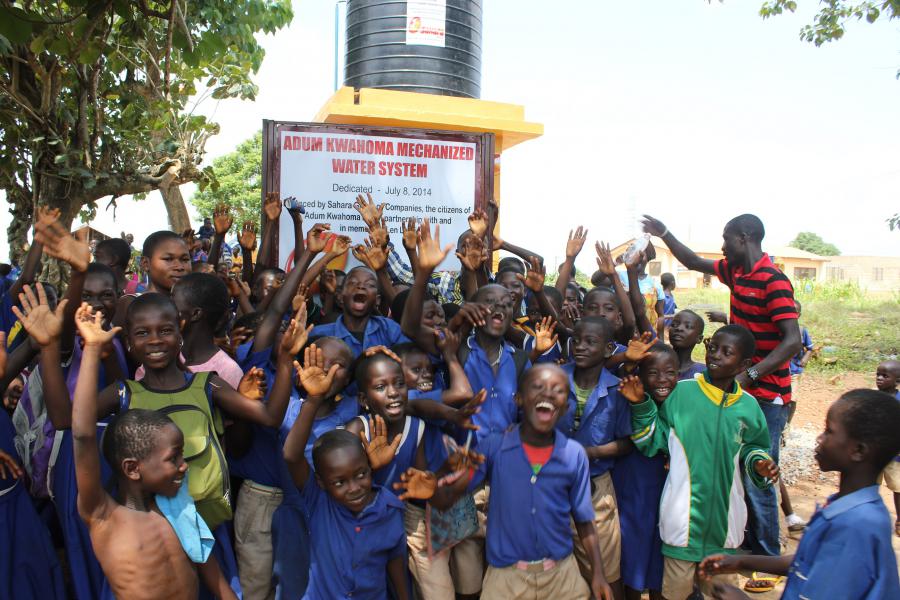
David Ekugum one of Sahara Foundation’s young program officers explains that Sahara’s interventions have also enhanced access to water and sanitary facilities in schools and communities, resulting in the wellbeing of students. Over the years, Sahara Foundation has implemented numerous Water Sanitation and Hygiene (WASH) programmes in schools and communities across Africa. This includes over fifty borehole projects in Ghana, Cote d’Ivoire, and Nigeria; toilet constructions in schools where they were either dilapidated or none existent including schools in Ghana, Nigeria and Tanzania. These interventions have resulted in improved school attendance but particularly improved safety for the students who prior to such interventions had to use bushes as their toilet. ” In our experience, girls have been the biggest beneficiaries of our SWASH (School Water Sanitation and Hygiene) Projects as open/bush defecation/urination put them at more risk than boys. The toilets constructed provide safe spaces of hygiene for these students,” says David who is passionate about the SDG for all mantra.
As the world celebrates the International Youth Day 2018, Sahara Group reaffirms its commitment to giving wings to young people’s aspirations by creating an enabling environment and safe spaces for them to express their talent and enterprise.


