Connect with us

Economy

CBN Sustains Pressure on System Liquidity with N25b OMO Sale

Published

on

By Dipo Olowookere

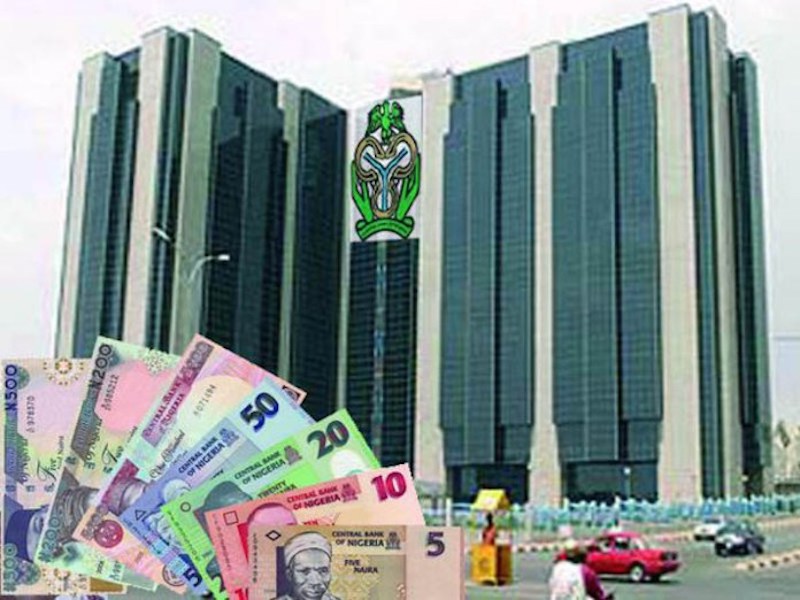
The Central Bank of Nigeria (CBN) yesterday continued with its usual mopping up of excess liquidity from the financial system with the offering of treasury bills to investors via Open Market Operations (OMO).

However, the exercise was marred with low turnout as investors continued to undersubscribe to the OMO auction by the apex bank.

This is largely due to the fact that the central bank has failed to push the stop rates upward to attract market players, who want better return.

Of the N150 billion worth of the debt instruments offered for sale on Tuesday by the CBN, subscriptions valued at N24.6 billion were received and eventually allotted.

Business Post reports that N20 billion worth of the 100-day bills were auctioned yesterday with N6 billion offers received and sold to investors at 11.90 percent.

Also, N30 billion of the 205-day bills were offered to market players with subscriptions worth N1.06 billion received and allotted at 13.50 percent, while N50 billion worth of the 310-day bills were auctioned with offers worth N17.54 billion received and sold at 15.00 percent.

Generally, the T-bills market was bearish with the average yields closing higher by 0.05 percent as selloffs on the short end of the curve outpaced slight demand around some mid tenors.

“We expect the market to remain slightly bearish as the CBN maintains pressure on system liquidity via its continued OMO auctions,” Zedcrest Research noted.

Meanwhile, rates in the money market moderated by 0.20 percent on Tuesday with the Open Buy Back (OBB) and Overnight (OVN) rates closing at 19.33 percent and 21.95 percent.

This was as system liquidity opened the day at about N43 billion positive, whilst market players were able to access the CBN’s SLF window to fund their obligations.

With the OMO sale of N25 billion during the trading day, system liquidity was estimated at N18 billion positive.

The rates are expected to remain elevated today with the CBN expected to conduct another round of OMO interventions due to the N472 billion in OMO maturities expected on tomorrow (Thursday).


Dipo Olowookere is a journalist based in Nigeria that has passion for reporting business news stories. At his leisure time, he watches football and supports 3SC of Ibadan. Mr Olowookere can be reached via [email protected]

Click to comment

Leave a Reply

Your email address will not be published. Required fields are marked *

Economy

Brent Nears $80 on Fresh Doubt About US-Iran Ceasefire

Published

on

Brent crude futures

By Adedapo Adesanya

Oil prices ​rose on Thursday after American Vice President JD Vance warned Israel against further attacks on Iran-backed Hezbollah in Lebanon, raising ‌doubts about the durability of the US-Iran ceasefire agreement.

Brent crude futures settled at $79.85 a barrel after chalking up 30 cents or ​0.38 per cent, while the US West Texas Intermediate (WTI) crude futures gained 19 cents or 0.25 per cent to finish at $76.60 a barrel.

US Vice President JD Vance on Thursday issued an extraordinary rebuke to Israeli critics of the Iran deal, warning them not to alienate their “only powerful ally” left in the world.

The deal gives negotiators 60 days to reach an agreement on the status of Iran’s nuclear ​programme and set up a $300 billion reconstruction fund for Iran and other financial incentives.

Mr Vance told members of Israeli Prime Minister Benjamin Netanyahu’s cabinet to “wake up and smell the reality,” amid growing tensions between Netanyahu and US President Donald Trump.

Market analysts noted that the statements about Israel may have put things back on edge, as the two countries jointly launched the war on Iran on February 28.

Ultimately, oil markets will be focused on what happens in the Strait ​of Hormuz, through which 20 per cent of the world’s oil flowed before the start of the war.

Analysts expect a gradual recovery in flows through the Strait of Hormuz, while industry experts have cautioned that prices may not plummet as demand recovers and inventories are refilled.

Investment bank Goldman Sachs expects Gulf exports to normalise to pre-war levels by the end of July, with crude production recovering by October. The bank estimates ​that a normalisation in exports to ​pre-war levels might be achieved ⁠with a 13 million barrel-per-day increase in Hormuz flows from current levels to around 70 per cent of pre-war levels.

Markets will be watching closely in the coming week to see exactly how much oil begins to flow, especially Iranian oil, which will no longer be sanctioned thanks to the latest ceasefire agreement.

China, the world’s second-largest oil consumer, is forecast to consume 753 million metric tons of petrol in 2026, down 4.9 per cent from 2025 amid a pivot to new energy and high oil prices.

Continue Reading

Economy

FG Releases Transition Guidelines for Tax Acts 2025

Published

on

Tax Acts 2025

By Modupe Gbadeyanka

The transition guidelines on the Tax Acts 2025 to provide direction to taxpayers, tax practitioners, revenue authorities and other stakeholders on how to address various issues arising from the old regime to the new framework have been released by the federal government.

The framework was issued on Thursday via a statement signed by the Director of Press Relations in the Federal Ministry of Finance, Efe Ovuakporie.

The guidelines set out the process for transition from the repealed tax laws to the new tax framework effective January 1, 2026.

Under the guidelines, the Tax Acts 2025, comprising the Nigeria Revenue Service (Establishment) Act, the Nigeria Tax Act, the Nigeria Tax Administration Act, and the Joint Revenue Board (Establishment) Act, apply from the respective commencement dates as enacted in each law. In particular, January 1, 2026, for the Nigeria Tax Act, 2025.

Tax liabilities, assessments, audits, investigations, disputes and enforcement actions relating to periods before that date will be treated under the repealed tax laws, the notice stated.

Tax returns relating to accounting periods ending before January 1, 2026, will be filed under the previous tax laws, while returns relating to accounting periods ending from January 1, 2026, onward will be administered under the new tax framework.

The document also covers the treatment of income taxes, transaction taxes, development levies, tax incentives, exemptions, record-keeping obligations and transactions that span both the old and new tax regimes.

Existing tax incentives and exemptions granted under the repealed laws will remain in place until their expiration dates. New applications and pending requests, however, will be considered under the provisions of the Tax Acts 2025.

The Minister of Finance and Coordinating Minister of the Economy, Mr Taiwo Oyedele, described the Tax Acts 2025 as a significant milestone in Nigeria’s tax reform programme, noting that the Guidelines set out how existing obligations, ongoing matters and future transactions will be treated under the new regime.

According to the Minister, the guidelines are anchored on three key principles – clarity, fairness and administrative certainty, adding that they are intended to promote uniform implementation and support effective administration across the Nigeria Revenue Service, State Internal Revenue Services, the FCT Internal Revenue Service, Local Government Revenue Committees, tax practitioners and taxpayers nationwide.

Continue Reading

Economy

Federal, State, LG Councils Share N2.3trn FAAC Allocation

Published

on

faac allocation

By Adedapo Adesanya

The Federation Account Allocation Committee (FAAC) has shared a total of N2.300 trillion among the federal government, state governments, and Local Government Councils from the revenue generated in May 2026.

The amount is slightly higher than the N2.257 trillion distributed last month, according to a statement issued by the Head of Information at the Federal Ministry of Finance, Mrs Efe Ovuakporie.

The FAAC allocation was confirmed at its June 2026 meeting following consideration of revenue receipts for the month of May.

The total distributable revenue of N2.300 trillion comprised N1.611 trillion from statutory revenue and N688.785 billion from Value Added Tax (VAT).

From the distributable amount, the federal government received N818.680 billion, while state governments got N759.141 billion. Local Government Councils were given N534.277 billion, and oil-producing states received N188.132 billion as 13 per cent derivation revenue.

The gross statutory revenue for the month stood at N2.652 trillion, representing an increase of N273.623 billion compared to the N2.378 trillion recorded in April 2026.

FAAC reported significant increases in collections from Companies Income Tax (CIT), Capital Gains Tax (CGT), Stamp Duties, Petroleum Profit Tax (PPT), Hydrocarbon Tax (HT), and oil royalties during the period under review.

However, collections from Import Duty, Value Added Tax (VAT), Excise Duty, and Common External Tariff (CET) levies recorded declines compared to the previous month.

Gross VAT revenue for May 2026 stood at N743.668 billion, lower than the N806.617 billion collected in April 2026.

The committee noted that despite the decline in VAT collections, overall revenue performance for the month was strengthened by improved receipts from petroleum-related taxes and Companies Income Tax.

Continue Reading

Trending