Economy
Robi, YABX Partner for Cheaper Smartphones in Bangladesh
By Modupe Gbadeyanka
A deal to facilitate financing for smartphones for customers of leading digital services provider in Bangladesh, Robi, has been entered into with YABX, a fintech company incubated by Comviva.
Within one year of launching 4.5G service, Robi has created the largest 4.5G network in Bangladesh and YABX, on the other hand, provides the technology to underwrite smartphone financing for customers in the emerging markets.
In doing so, the company builds customer profiles from tens of thousands of data points, using data from the mobile network. This, in turn, enables the customers to purchase their first smartphone. Therefore, it is believed that this partnership will make a significant difference in promoting digital lifestyle in the country.
In addition to this, YABX’s state-of-the-art device impairment technology enables financial institutions to launch EMI plans while Yabx manages the complete customer journey through digital channels which includes acquisition, disbursals, collections etc.
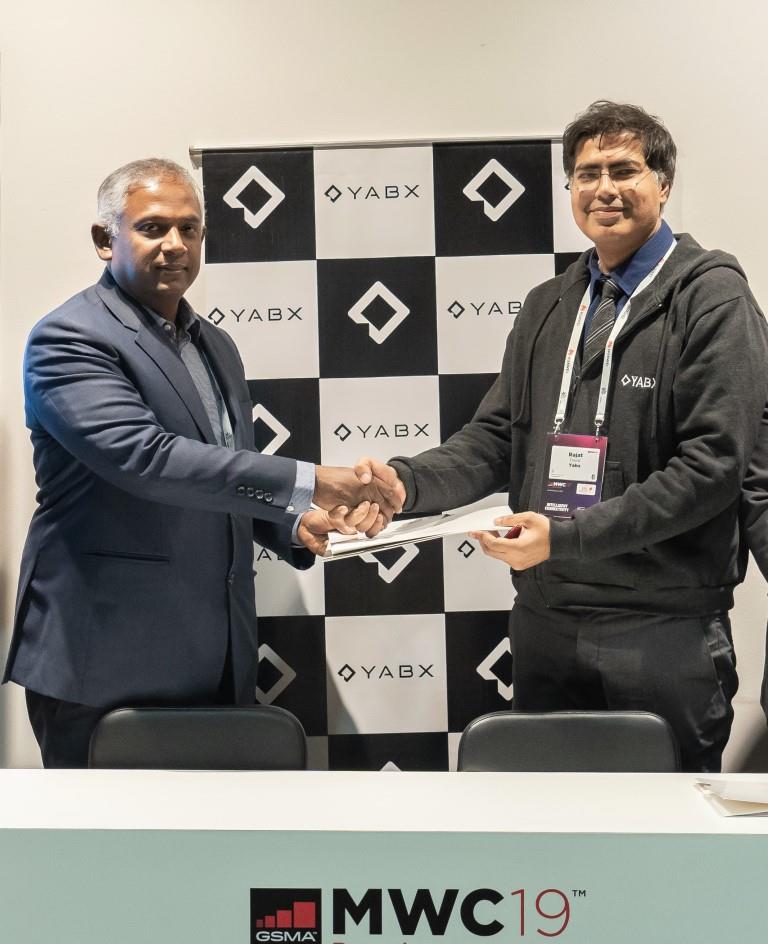
It was gathered that at the Mobile World Congress 2019, in Barcelona, Robi’s Managing Director and CEO, Mahtab Uddin Ahmed and YABX’s Founder and Chief Executive Officer, Rajat Dayal, signed a Memorandum of Understanding (MoU) for both firms.
Witnessing the ceremony were Robi’s Chief Digital Services Officer, Shihab Ahmad, Chief Technology and Digital Services Officer, Medhat El-Husseiny, Executive Vice President, Digital Services, Ahmed Armaan Siddiqui, Executive Vice President, Technology Operations, Sarker Sohel Ahmed, Vice President, IoT & Product Innovation, Md. Showkat Kader Chowdhury, Vice President, Public Affairs, Raz Sharif Shah Jamal and Comviva’s Vice President for Global Market Units, Remus Teodorescu and Chief Marketing Officer, Suryadeep Verma.
Commenting on the partnership, Mahtab Uddin Ahmed, Managing Director and Chief Executive Officer, Robi Axiata Limited said, “Average smartphone price, as percentage of Gross National Income (GNI) per capita for Bangladesh, is one of the highest in the region. This is a key challenge to smartphone penetration, which currently is one of the lowest in the region.
“We are confident that through this partnership with YABX, the high entry-cost barrier will be eliminated, which will help in driving smartphone adoption and reduce inequality in Bangladesh as per SDG goal. Moreover, this will add another feather to the Big Data analytics and Fin-tech initiatives of Robi.”
On his part, Rajat Dayal, Founder and Chief Executive Officer, YABX said, “Our collaboration with Robi is a part of the company’s long-term strategy to enable digital micro-loans services in Bangladesh.
“Our partnership would facilitate the vision of affordable and convenient handset financing in Bangladesh.
“The main economic and social objectives of our partnership is to help the population of Bangladesh gain instant access to smartphones in an affordable and convenient manner, thus enhancing financial inclusion through digital inclusion.”
Economy
SEC Fixes 5 pm T+1 Settlement Deadline for Equities, Commodities
By Aduragbemi Omiyale
As part of the implementation of the T+1 settlement cycle in the Nigerian capital market, the Securities and Exchange Commission (SEC) has fixed 5:00 pm on the first business day after a transaction (T+1) as the settlement deadline for equities and commodities traded and settled through the Central Securities Clearing System (CSCS).
In a circular on Wednesday to capital market operators and other market participants, the capital market regulator noted that all transactions in the affected securities must be fully paid by 5:00 pm T+1 to ensure compliance with the standard Delivery versus Payment (DvP) settlement procedure.
It warned that where a broker/dealer’s trading account is not adequately funded to meet its settlement obligation within the prescribed period, the default would be managed in line with the CSCS Default Management Procedure and the applicable transaction settlement guidelines of the relevant exchange.
The commission also clarified that foreign portfolio investors are not required to prefund their accounts for trades in the Nigerian capital market.
However, it said capital market operators facilitating transactions on behalf of foreign portfolio investors must establish and maintain appropriate controls and processes to ensure timely funding and completion of settlements within the prescribed timeframe.
The clarification follows earlier SEC circulars on the implementation of the T+2 settlement cycle for equities transactions, issued on June 3, 2025, and the transition to the T+1 settlement cycle, issued on May 15, 2026.
The T+1 cycle means that eligible securities transactions are settled one business day after the trade date, reducing the period between execution and final settlement.
The SEC said the transition represents a significant milestone in its efforts to build a more efficient, resilient and internationally aligned trading and post-trade environment, adding that the shorter settlement cycle would improve settlement efficiency, reduce counterparty risk, enhance liquidity and strengthen the competitiveness of the Nigerian capital market.
According to the agency, the reforms would ultimately improve the attractiveness of the Nigerian market to both domestic and international investors.
Economy
Oil Prices Rise as Hormuz, Bab el-Mandeb Attacks Fuel Supply Fears
By Adedapo Adesanya
Oil prices slightly rose on Wednesday as attacks on ships in the Middle East continued and talks to end the Iran war hit an impasse.
Brent futures gained 7 cents to trade at $88.98 a barrel, while the US West Texas Intermediate (WTI) crude increased by 7 cents to $83.27 per barrel.
The US and Yemen’s Iran-aligned Houthis reported separate attacks on shipping in the Strait of Hormuz and the Bab el-Mandeb Strait on Tuesday, two crucial export routes for Middle Eastern oil and gas in addition to the Suez Canal.
Reuters reported that there continued to be no discussions between Iran and the US to extend their ceasefire because, from Iran’s perspective, the deal had no start date and so there was nothing to extend.
Shipping data showed the number of vessels transiting the Strait of Hormuz fell to a one-week low of eight on Tuesday. Before the war, 125 to 140 vessels passed through the crucial waterway each day.
The US military, meanwhile, said an American Navy MH-60 helicopter fired two Hellfire missiles to disable the steering gear of a Panama-flagged cargo ship.
The ship ignored repeated warnings to stop violating a naval blockade on Iranian ports, the US Central Command said.
Forecasters including the Organisation of the Petroleum Exporting Countries (OPEC) and the International Energy Administration (IEA) revised down their oil demand outlooks as US-Iran talks stall.
OPEC lowered its world oil demand growth forecast for 2026 to 580,000 barrels per day, it said in its monthly oil market report.
The International Energy Agency cut its 2026 demand projections and now expects a 1.6 million barrels per day contraction this year. However, the Paris-based agency is also predicting a 4.3 million barrels per day drop in supply this year, and an overall 2026 deficit of around 1.27 million barrels per day.
According to the IEA, Middle East oil flows briefly returned to pre-war levels in early July, with loadings reaching 20 million bpd, before falling to 12 million bpd later in the month. Middle East production remained 8.3 million barrels per day below pre-war levels in July.
The IEA cited the Hormuz shutdown, the US blockade of Iranian exports, attacks in the Bab el-Mandeb Strait and reduced Kazakh CPC Blend exports among the forces keeping global supply below demand.
Economy
For Third Straight Month, Nigeria Meets OPEC Quota in July
By Aduragbemi Omiyale
Nigeria slightly surpassed its quota set by the Organisation of the Petroleum Exporting Countries (OPEC) in July 2026.
In the month under review, the country produced about 1.57 million barrels of crude oil per day.
It was the third consecutive month Africa’s largest oil-producing nation was meeting its monthly quota, set to stabilise the price of the commodity on the global market by the oil cartel.
Data released by the Nigerian Upstream Petroleum Regulatory Commission (NUPRC) on Wednesday showed that the 1.5 million barrels per day ceiling for Nigeria was surpassed last month.
The agency disclosed in a statement today that the country produced 1.505mbpd of crude oil and 0.17mbpd of condensate, bringing the combined daily production to 1.67mbpd.
In the month under review, the daily peak production of crude oil and condensate was 1.78mbpd, while the lowest daily production was 1.57mbpd.
Although Nigeria met its OPEC quota in the month of July, the statistics show that on a month-on-month basis, production fell by 4 per cent.
This was attributed to the decline in production due to operational challenges experienced at the Erha and Akpo fields, which impacted crude oil output during the period under review.
These disruptions constrained production volumes and contributed significantly to the overall reduction in national crude oil output.
Despite the challenges, production operations across most other producing assets remained relatively stable, with operators implementing measures aimed at maintaining production efficiency and minimising the impact of operational constraints, NUPRC stated.