Connect with us

Banking

Anxiety as Access Bank, Diamond Bank Hold EGMs Tuesday

Published

on

By Modupe Gbadeyanka

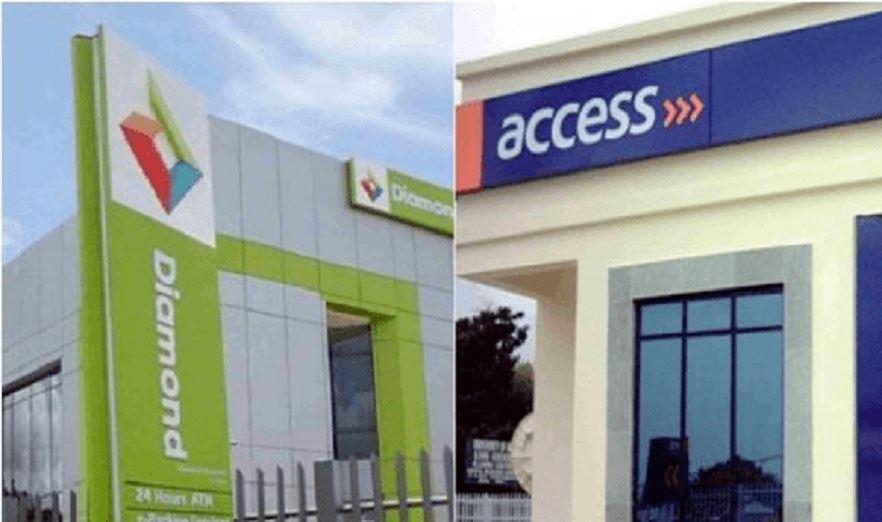
Tomorrow, Tuesday, March 5, 2019, shareholders of Access Bank and Diamond Bank will gather at two separate venues to deliberate on the proposed merger between both financial institutions.

While shareholders of Access Bank will meet at the Balmoral Convention Centre, Federal Palace Hotel, Victoria Island, Lagos, those of Diamond Bank will converge few kilometres away at Grand Banquet Hall, Civic Centre, Victoria Island, Lagos.

The main purpose of the Extraordinary General Meetings (EGMs) is to give their respective boards the authority to make the banks a corporate entity.

Business Post reports that Diamond Bank will first hold its EGM tomorrow by 10am, while Access Bank fixed its for 1:00pm.

Information gathered by our correspondent has it that both lenders have put finishing touches to the preparations and are ready to convince the shareholders to approve the merger.

“I can tell you that we are ready for Tuesday’s meeting. We are very confident that our shareholders will approve this merger with Access Bank,” a source at Diamond Bank, who is privy with the preparations, informed Business Post at the weekend.

It is important to note that tomorrow’s meetings were ordered by Justice O Oguntoyinbo of a Federal High Court sitting in Lagos.

The judge held that Chairman of the board of Access Bank, Mrs Mosun Belo-Olusoga, Mrs Ajoritsedere Awosika, who is a director of the company or any other director appointed in their stead by the shareholders present at the meeting will act as Chairman of the said meeting, while for the Diamond Bank meeting, Chairman of the board, Mr Dele Babade; or Mr Chris Ubosi, who is a director of the lender, or any other director appointed in their stead by shareholders present at the meeting will take charge.

At the Access Bank meeting, shareholders will vote to consider if “the Scheme as contained in the Scheme Document dated the 24th, day of January, 2019, a printed copy of which has been submitted to the meeting and, for purposes of identification, endorsed by the Chairman, be and is hereby approved; and that the Directors be and are hereby authorised to consent to any modification of the Scheme that the Securities and Exchange Commission (SEC), Central Bank of Nigeria (CBN) and or the Court shall deem fit to impose and approve.”

“That the Directors be and are hereby authorised to accept the transfer of all the assets, liabilities and undertakings including real properties and intellectual property rights of Diamond Bank Plc upon the terms and subject to the conditions set out in the Scheme Document, without any further act or deed.”

“That as consideration for the transfer of all the assets, liabilities and undertakings including real properties and intellectual property rights of Diamond Bank Plc, the Directors be and are hereby authorised to; allot the Scheme Shares to Diamond Bank Shareholders upon the terms and subject to the conditions set out in the Scheme Document, without any further act or deed; and pay the sum of N1.00 (One Naira) per share for each issued and paid-up Diamond Bank ordinary share held at the date of the Court-Ordered Meeting.

“That the Solicitors of the Company be and are hereby directed to seek orders of the Court sanctioning the Scheme and the foregoing resolutions, as well as such other incidental, consequential or supplemental orders as are necessary or required to give full effect to the Scheme.

“That the Directors be and are hereby authorised to take such actions as may be necessary to give effect to the Scheme including but not limited to the listing of the Scheme Shares on the Nigerian Stock Exchange.”

For Diamond Bank shareholders, they will vote, “That the Scheme as contained in the Scheme Document dated the 24th, day of January, 2019, a printed copy of which has been submitted to the meeting and, for purposes of identification, endorsed by the Chairman, be and is hereby approved; and that the Directors be and are hereby authorised to consent to any modification of the Scheme that the Securities and Exchange Commission (SEC), Central Bank of Nigeria (CBN) and or the Court shall deem fit to impose and approve.

“That the transfer of all the assets, liabilities and undertakings including real properties and intellectual property rights of the company to Access Bank Plc, upon the terms and subject to the conditions set out in the Scheme Document, be and is hereby approved without any further act or deed.

“That all legal proceedings claims, litigation matters pending or contemplated by or against the company be continued by or against Access Bank Plc after the Scheme is sanctioned by the court.

“That in consideration of the (2) above, all shareholders of the company shall, after the Scheme is sanctioned by the court, be allotted two ordinary shares of 50 kobo each in Access Bank Plc ‘(credited as fully paid)’ in exchange for every 7 ordinary shares of the company of 50 kobo each (the share consideration); and be paid N1 for every share held in the company (the cash consideration) withi 10 business days of the court sanction of the scheme.

“That the entire share capital of the company be cancelled and the company be dissolved without winding up.

“That the solicitors of the company be and are hereby directed to seek orders of the court sanctioning the scheme and the foregoing resolutions, as well as such other incidental, consequential or supplemental orders as are necessary or required to give full effect to the scheme.

“That the directors of the company be and are hereby authorised to take such other actions and steps as may be necessary or required to give full effect to the scheme.”

Earlier this year, Business Post reported that Access Bank was considering changing its corporate identity after the ‘marriage’ with Diamond Bank, which should be officially consummated before the end of June 2019.

Speaking at a customer forum in Lagos, CEO of Diamond Bank, Mr Uzoma Dozie while responding to a question on whether the enlarged bank will have a new name, had said, “I believe that the name will be Access Bank, but the identity will be the one that is recognised by both Access Bank and Diamond Bank.

“So, it will be……just as we have come here today to inform you of what we are doing and get your feedback, we are also going to have a customer forum to help us decide what is the best identity that when people see, they will say this is Diamond Bank, this is Access Bank.”

His counterpart at Access Bank, Mr Herbert Wigwe, had explained further that, “Let me just add to that point, if you go to global banks like Barclays Bank and HSBC that have gone through mergers and acquisitions, you can keep an identity, but you can also make sure you reflect the identity of the different institutions and what they do.

“So, the retail will look like what you see in Diamond Bank so you don’t lose your connection; that is how it happens.

“If you look at the corporate logo and how things will come out, you will not see that you’ve not lost anything.

“Same thing for Access Bank customers, because you know we were also at the corporate end. We also have to be mindful of these customers as well.

“So, we have to do something that will sit nice for Access Bank customers and also sit nice for the retail business of Diamond Bank.”

Some experts have said the merger between both lenders could help in saving over N150 billion as direct result of economies of large scale which will translate to returns on equity to shareholders.

They emphasised that the synergy will yield over N62 billion savings on the revenue side, adding that N40.9 billion would come from extended product offering while N8.4 billion from expanded digital channels.

They also hope that N6.7 billion is going to be saved from the extension of market share in corporate and retail banking markets, and another N6.2 billion to be dug from treasury sales.

That is not all the good side to what could be eked out from the merger. On the expenditure side, the managers believe that savings of N88.1 billion would be made; and from procurement and facility management a whopping N40.5 billion or about half of the savings is expected to come while N21 billion will accrue from cost of funds reduction through lower deposit pricing.

More savings of N12.6 billion from IT integration; N13.5 billion from branch consolidation; and another N500 million to be squeezed from support functions integration, bringing envisaged total integration savings to about N150.1 billion.

The merger managers were of the opinion that going forward the savings would improve investor’s equity returns as the merger would allow for both economies of scale and of scope as fixed costs would be shared over a much larger depositor and borrower base.

It was also stressed that those who would benefit more from the merger scheme are customers of the enlarged bank who stand the chance of achieving a lot more through the combination of Access Bank and Diamond Bank.


Modupe Gbadeyanka is a fast-rising journalist with Business Post Nigeria. Her passion for journalism is amazing. She is willing to learn more with a view to becoming one of the best pen-pushers in Nigeria. Her role models are the duo of CNN's Richard Quest and Christiane Amanpour.

Click to comment

Leave a Reply

Your email address will not be published. Required fields are marked *

Banking

Ecobank Floats $450m Nature Bond for Sustainable Agric Businesses, Others

Published

on

Ecobank Back2School loans

By Aduragbemi Omiyale

The world’s first ICMA commercial bank-issued Nature Bond has been launched by Ecobank Group to mobilise global capital for the protection of Africa’s natural ecosystems.

The debt instrument, up to $450 million, will be tradable on the London Stock Exchange (LSE), creating a new route for international and African capital to ​protect Africa’s biodiversity.

The bond will ​support African farmers, sustainable agriculture businesses and water systems,​ protecting some of the planet’s most important ecosystems.

Africa is home to some of the world’s most important natural capital, including arable land, tropical forests, freshwater systems and biodiversity across hundreds of millions of hectares. But, until now, private nature capital has not flowed to Africa at the scale the continent’s ecological significance warrants​ in global ecological resilience. Despite hosting 25 per cent of global biodiversity, Africa receives less than 3 per cent of nature finance​.

Ecobank’s Nature Bond​ is a direct response to this gap. It​ will support smallholder farmers adopting sustainable agricultural practices, agri-processors with verified deforestation-free supply chains, and water infrastructure protecting freshwater ecosystems relied upon by millions of people.

Unlike many conservation-focused financing vehicles, Ecobank’s Nature Bond channels capital directly through Africa’s real economy — financing businesses and communities whose day-to-day activities shape environmental outcomes at scale.

The investments will be made in 24 markets, with significant deployment in biodiversity-priority countries such as Côte d’Ivoire, Burkina Faso and Ghana. Importantly, 81 per cent of the eligible lending pool is allocated to countries where agricultural land-use change is the primary driver of biodiversity loss, helping direct capital to the areas where it can have the greatest environmental impact.

The framework also incorporates independent monitoring and verification mechanisms, including deforestation screening and supply chain traceability requirements, helping ensure that financed activities deliver measurable nature-positive outcomes. Every eligible loan carries seven independently verified sustainability conditions.

A Nature Bond, under the ICMA secondary designation,​ requires proceeds to actively contribute to nature-positive outcomes, including transforming economic activities to reduce the drivers of nature loss at scale.

The Nature Bond was designed to reach those that conservation-focused instruments were not designed to serve – farmers, agri-processors and water operators whose daily activities collectively determine ecosystem outcomes.

While green bonds typically finance a broad range of environmental objectives, the Nature Bond designation focuses the use of proceeds specifically on nature-related outcomes, including biodiversity, sustainable agriculture, land use and water infrastructure.

“This transaction is a defining moment for African sustainable finance. Investors did not just support this bond. They demanded more of it, allowing us to increase the size and tighten pricing.

“We are not a bank that simply labels bonds. We have spent four years building the systems, governance and accountability needed to make nature finance credible and scalable in Africa.

“This bond is ultimately about the farmers, cooperatives and communities whose livelihoods depend on healthy ecosystems,” the chief executive of Ecobank Group, Mr Jeremy Awori, stated.

On her part, the Head of Sustainability and ESRM at Ecobank Transnational Incorporated, Ms Rachael Antwi, said, “Nature finance will only scale in Africa if it is practical, measurable and connected to the real economy. This bond is designed to do that by linking international capital to eligible lending for sustainable agriculture and water infrastructure across 24 countries. It reflects the systems and standards Ecobank has built to ensure nature finance supports both environmental resilience and the communities whose livelihoods depend on healthy ecosystems.”

Business Post gathered that the $450 million bond was priced following strong investor demand, with the final orderbook exceeding $1.36 billion, almost 400 per cent of the original target size. The strength of demand enabled Ecobank to increase the transaction by $100 million and tighten pricing by 50 basis points.

The transaction attracted support from both international and African investors, demonstrating Ecobank’s unique ability to mobilise capital across global and African markets.

Continue Reading

Banking

Abbey Mortgage Bank Gets Green Light to Switch to Commercial Banking

Published

on

Abbey Mortgage Bank

By Adedapo Adesanya

One of Nigeria’s real estate lenders, Abbey Mortgage Bank Plc, has secured approval from the Central Bank of Nigeria (CBN) to convert into a regional commercial bank, marking a shift from its current status as a primary mortgage institution.

The development was disclosed in a regulatory filing, signalling a strategic change that will see the bank expand into broader commercial banking activities beyond housing finance.

The conversion is expected to take effect later this year, subject to the completion of regulatory and operational requirements, including system upgrades and restructuring.

The move comes amid ongoing changes in Nigeria’s banking sector, where institutions are seeking to strengthen capital bases and diversify operations in response to evolving regulatory and market conditions.

At its recent Annual General Meeting (AGM), its board gave approval to raise N100 billion in additional capital aimed at helping the company achieve its next growth phase.

Shareholders authorised the lender to raise the funds through various funding instruments, including shares, bonds, commercial papers, loans, and other securities, subject to regulatory approvals.

The directors were also allowed to raise fresh equity capital of up to N65.547 billion by way of private placement of 26,562,647,265 ordinary shares of 50 Kobo each at N2.43 per share, subject to regulatory approvals.

In addition, shareholders approved the increase in the company’s issued share capital from N5,076,923,077 divided into 10,153,846,154 of 50 Kobo each to N18,358,246,709.50 by the creation of up to 26,562,647,265 ordinary shares of 50 Kobo each, such new shares to rank pari passu in all respects with the existing ordinary shares in the capital of the bank.

Continue Reading

Banking

CBN Scraps Form A for Domiciliary Account Remittances

Published

on

CBN Form A Form M Form Q

By Adedapo Adesanya

In a significant easing of foreign exchange (FX) procedures, the Central Bank of Nigeria (CBN) has exempted domiciliary account holders from obtaining Form A before making eligible foreign remittances.

The provision is contained in the newly issued Forex Manual (4th Edition), which took effect on June 1, 2026. Under the new framework, customers using funds already held in their domiciliary accounts can make remittances without processing Form A.

The change is expected to shorten processing times for legitimate foreign transfers and reduce paperwork for banks and customers.

Form A remains relevant for certain transactions involving the purchase of foreign exchange through the official market.

The broader manual introduces new measures covering imports, exports, travel allowances, trade finance, and foreign remittances as the CBN seeks to improve transparency and efficiency in the forex market.

The apex bank said the reforms are intended to strengthen market discipline, improve data accuracy, and support confidence in Nigeria’s foreign exchange framework.

Under the revised framework, all import transactions must be backed by a valid Form ‘M’, with strict timelines imposed for the submission of shipping and exchange control documents.

Importers are required to ensure that all documentation is genuine, verifiable, and routed through authorised banking channels, as part of efforts to eliminate trade-based money laundering and illicit capital flows.

The apex bank also standardised the exchange rate for import duty payments, directing that duties be calculated using the prevailing Nigerian Foreign Exchange Market (NFEM) rate published daily by the CBN.

In a move to limit capital flight, the manual caps advance payments for imports at 30 per cent of transaction value and places a ceiling on interest rates for trade-related credit at 0.5 per cent above the Secured Overnight Financing Rate (SOFR), with a maximum tenor of 180 days.

On the export side, the CBN has made it mandatory for all exporters to process Form NXP, regardless of the value of goods.

Export proceeds must be repatriated within 180 days for non-oil exports and 90 days for oil and gas shipments, reinforcing efforts to boost foreign exchange inflows.

The guidelines also introduce stricter inspection requirements, mandating pre-shipment verification and the issuance of Clean Certificates of Inspection before goods can be exported.

Exporters are further required to pay the Nigerian Export Supervision Scheme (NESS) levy, set at 0.5 per cent for non-oil exports and 0.12 per cent for oil and gas exports.

In addition, the manual strengthens oversight of insurance-related forex transactions, restricting foreign currency-denominated policies for residents and requiring regulatory clearance for certain offshore payments.

Continue Reading

Trending