Economy
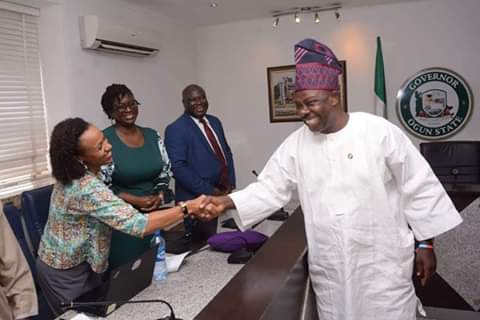
$350m Loan: Ogun, World Bank Finalise Economic Transformation Programme
The Ogun State government and the World Bank have concluded the design and plans for the Ogun State Economic Transformation Programme (OGSTEP), which will grant up to $350 million long term concessionary loan to the state.
The Bank’s final mission to the State on 29th & 30th April was to dot the Is and cross the Ts. The Task Team Leader for the bank, Mr. Kofi Nouve, while presenting the progress report to Governor Ibikunle Amosun, at his Oke Mosan, Abeokuta office, reiterated that the major aim of the programme is to help Ogun State put in place necessary reforms to accelerate private sector participation to inclusively grow its economy and thus enable critical social investments that will help uplift the welfare of the populace.
“At our internal decision meeting in early April, the team received final approval to proceed with this final design mission”, he said, adding that all the core areas for the programme have been confirmed during their visit.
In support of Ogun State’s development objectives, the project has three core areas of implementation, which are, creation of enabling business environment, strategic technical and vocational skills and development as well as agricultural value chain development. These will all rest on a pillar of strengthened governance capabilities as areas such as statistics, procurement, monitoring & evaluation and planning are bolstered through the program.
Nouve, who disclosed that the project has design process has been on for about two years, assured that in the next one month, the project would be submitted to the World Bank’s Board in Washington for final approval. Once obtained, this would enable the release of the funds and the commencement of implementation of this landmark program.
Mr Amosun, in his reaction, said his administration would do all that was possible to ensure that the state gets this much needed support from the Bank, noting that the incoming administration already has a ready made support to enhance delivery and good governance.
He also emphasised that the lengthy and painstaking process that the State had been through in designing and developing this landmark program, likely to be the first of its kind in Nigeria, has already significantly improved the workings of Government, positioning the state to realise its vast potential.
Mr Abbas, representing the Federal Ministry of Finance on the Mission also gave assurances to Governor Amosun that it was on hand play its part and do all that was necessary to prepare and conduct negotiations with the World Bank as the final step before the project documents are submitted to the World Bank Board.
Mr Amosun observed that the bank’s support will also help to create a system-driven environment that is critical for its progress, urging the team to fast track the process for final approval.
Economy
FX Liquidity Crunch Sinks Naira to N1,363/$1 at NAFEX, N1,370/$1 at Black Market
By Adedapo Adesanya
The Naira performed poorly against the United States Dollar in the different segments of the foreign exchange (FX) market on February 27, closing the week without a gain.
In the black market, the domestic currency weakened against the Dollar yesterday by N5 to close at N1,370/$1 compared with Thursday’s closing price of N1,365/$1, and at the GT Bank forex desk, it lost N2 to sell N1,369/$1 versus the N1,367/$1 it was sold a day earlier.
Yesterday, the Nigerian Naira lost N3.75 or 0.26 per cent against the greenback at the Nigerian Autonomous Foreign Exchange Market (NAFEX) to trade at N1,363.39/$1 compared with the previous day’s N1,359.82/$1.
Also, the Naira depreciated against the Euro at the official market during the session by N2.33 to quote at N1,609.22/€1 versus N1,606.89/€1, and appreciated against the Pound Sterling by N6.74 to settle at N1,836.49/£1 compared with the preceding session’s N1,843.23/£1.
The Naira’s latest depreciation occurred as FX demand continued to outpace available supply, intensifying pressure in the market.
In response to the negative momentum, the Central Bank of Nigeria (CBN) intervened by selling Dollars to banks and other authorised dealers in an effort to stabilise the local currency. The move came barely a week after the apex bank had purchased about $190 million from the foreign exchange market to temper the Naira’s rally.
Specifically, the CBN injected $200 million into the official market between Tuesday and Wednesday through an intervention call. However, the liquidity support proved insufficient to reverse the currency’s downward trend.
Meanwhile, the cryptocurrency market declined on Friday, with Solana (SOL) down by 10.4 per cent to $78.60, as Dogecoin (DOGE) decreased by 9.5 per cent to $0.0982.
Further, Cardano (ADA) slumped 8.9 per cent to $0.2647, Ethereum (ETH) slipped by 8.6 per cent to $1,859.10, Ripple (XRP) shrank by 8.2 per cent to $1.30, Litecoin (LTC) lost 1.4 per cent to close at $52.39, Bitcoin (BTC) slid 5.9 per cent to $63,686.39, and Binance Coin (BNB) went down by 4.9 per cent to $596.64, while the US Dollar Tether (USDT) and the US Dollar Coin (USDC) traded flat at $1.00 apiece.
Economy
Oil Prices Climb on Geopolitical Anxiety
By Adedapo Adesanya
Oil prices rose about 2 per cent on Friday, with traders bracing for supply disruptions as nuclear talks between the United States and Iran were without an agreement.
Brent crude futures settled at $72.48 a barrel after chalking up $1.73 or 2.45 per cent, while US West Texas Intermediate crude futures finished at $67.02 a barrel, up $1.81 or 2.78 per cent.
The two sides agreed to extend indirect negotiations into next week, but traders grew sceptical that an agreement between US President Donald Trump’s administration and Iran was possible.
The US and Iran held indirect talks in Geneva on Thursday after Mr Trump ordered a military buildup in the region.
Oil prices gained during the talks, on media reports indicating that discussions had stalled over U.S. insistence on zero enrichment of uranium by Iran. However, prices eased after the mediator from Oman said the two sides had made progress.
They plan to resume negotiations with technical-level discussions scheduled next week in Vienna, Omani Foreign Minister Sayyid Badr Albusaidi said on X.
Market analysts noted that geopolitical risk premiums of $8 to $10 a barrel have been built into oil prices on fears that a conflict will disrupt Middle East supply through the Strait of Hormuz, where about 20 per cent of global oil supply passes.
To cushion the impact from a possible strike, one of the world’s largest oil producers, the United Arab Emirates (UAE), is set to export more of its flagship Murban crude in April, while Saudi Arabia said it would also increase oil production.
Additionally, Saudi Arabia may raise its April crude price to Asia for the first time in five months due to higher demand from India to replace Russian supplies, potentially raising it by about $1 a barrel.
Meanwhile, the Organisation of the Petroleum Exporting Countries and its allies (OPEC+) is likely to consider raising oil output by 137,000 barrels per day for April at its March 1 meeting, after suspending production increases in the first quarter.
The resumption of output increases after a three-month pause would allow Saudi Arabia and the UAE to regain market share at a time when other OPEC+ members, such as Russia and Iran, contend with Western sanctions while Kazakhstan recovers from a series of oil production setbacks.
Eight OPEC+ producers – Saudi Arabia, Russia, the United Arab Emirates, Kazakhstan, Kuwait, Iraq, Algeria and Oman will meet at the meeting on Sunday.
Economy
Nigerian Stocks Further Lose 0.38% as Cautious Trading Persists
By Dipo Olowookere
The absence of a positive trigger left Nigerian stocks 0.38 per cent deeper in the bears’ territory on Friday, as investors embarked on cautious trading.
Two of the five major sectors tracked by Business Post finished in red on the last trading session of this week, with the industrial goods down by 2.44 per cent, and the energy down by 0.26 per cent due to profit-taking.
However, bargain-hunting raised the insurance sector by 1.52 per cent, the banking index increased by 0.79 per cent, and the consumer goods sector expanded by 0.28 per cent.
When the closing gong was struck yesterday, the All-Share Index (ASI) of the Nigerian Exchange (NGX) Limited crashed by 741.04 points to 192,826.77 points from 193,567.81 points, and the market capitalisation lost N476 billion to close at N123.763 trillion compared with the previous day’s N124.239 trillion.
According to data from Customs Street, Mecure gave up 9.97 per cent to trade at N75.85, Meyer depreciated by 9.90 per cent to N18.65, DAAR Communications crumbled by 9.83 per cent to N2.11, Champion Breweries staggered by 6.49 per cent to N18.00, and Dangote Cement crashed by 6.09 per cent to N779.00.
Conversely, Sovereign Trust Insurance gained 9.95 per cent to settle at N2.21, RT Briscoe improved by 9.93 per cent to N12.51, NGX Group expanded by 9.78 per cent to N124.00, Ellah Lakes surged by 9.70 per cent to N13.00, and Omatek chalked up 9.70 per cent to sell for N2.60.
A total of 44 shares finished on the gainers’ chart during the session, while 25 shares ended on the losers’ table, representing a positive market breadth index and strong investor sentiment.
The activity chart showed that 823.8 million stocks valued at N34.8 billion exchanged hands in 63,759 deals during the session versus the 868.5 million stocks worth N31.5 billion traded in 69,310 deals on Thursday.
This indicated that the value of transactions increased by 10.48 per cent, the volume of trades declined by 5.15 per cent, and the number of deals dipped by 8.01 per cent.
The busiest equity on Friday was Fortis Global Insurance, which sold 146.6 million units for N137.3 million, Zenith Bank transacted 79.4 million units valued at N7.1 billion, Japaul exchanged 57.2 million units worth N225.1 million, Jaiz Bank traded 49.5 million units valued at N589.3 million, and Access Holdings exchanged 44.8 million units worth N1.2 billion.
-
Feature/OPED6 years agoDavos was Different this year
-
Travel/Tourism10 years ago
Lagos Seals Western Lodge Hotel In Ikorodu
-
Showbiz3 years agoEstranged Lover Releases Videos of Empress Njamah Bathing
-
Banking8 years agoSort Codes of GTBank Branches in Nigeria
-
Economy3 years agoSubsidy Removal: CNG at N130 Per Litre Cheaper Than Petrol—IPMAN
-
Banking3 years agoSort Codes of UBA Branches in Nigeria
-
Banking3 years agoFirst Bank Announces Planned Downtime
-
Sports3 years agoHighest Paid Nigerian Footballer – How Much Do Nigerian Footballers Earn