General
Rainstorms Destroy Hundreds of Homes in North-East Nigeria
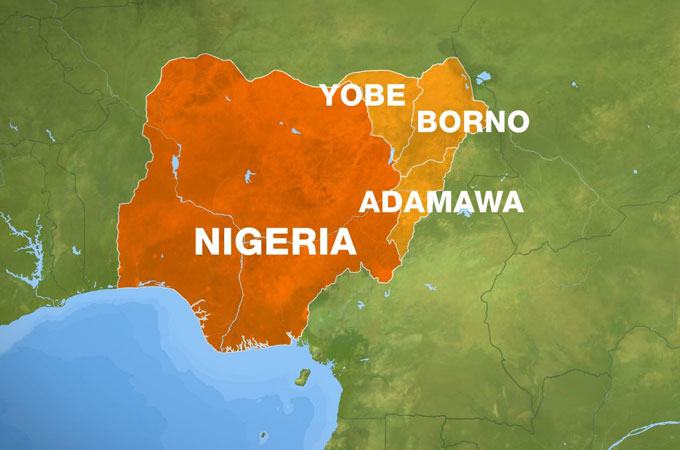
Zaynab stands next to the remnants of her home she used to share with her six children before it was destroyed by early season rainstorms that brought strong winds and rain to north-east Nigeria.
“I was in the market in the afternoon when the storm came but my six children were inside the house,” said Zaynab as she prepares a meal to break the Ramadan fast. “We lost everything except for a mattress we found across the camp and a few cooking pots.”
As of Friday, May 24, 2019, 395 shelters in camps and camp-like settings in Borno State, including Zaynab’s, have been damaged or destroyed since heavy rains began at the end of April. A total of 41 camps hosting more than 300,000 internally displaced persons (IDPs) have been classified as prone to flooding; some in hard-to-reach areas like Monguno, Konduga, Bama and others.
The International Organization for Migration (IOM) in Nigeria will respond to the needs of displaced populations through a multi-sectoral rainy season emergency response plan. The Organization will prioritize its interventions toward households with children under five, pregnant women, elderly people and single female households.
IOM teams are being deployed to repair or strengthen shelters in case of flooding, sensitize people to flood risks and conduct shelter and infrastructure maintenance. Other small-scale community-driven mitigation measures include waste management in camps and building or repairing drainage canals.
Zaynab hails from a farming family from Guduf Nagadio in Borno State, the epicentre of ongoing conflict between Nigerian forces and non-state armed groups. Her husband was killed by armed men as they tried to escape violence three years ago. Since then, her family has resided in an IDP camp in Borno State, home to nearly 1.5 million IDPs.
Storms earlier this month displaced Zaynab’s family yet again. IOM’s Camp Coordination and Camp Management (CCCM) team have subsequently relocated them and other families to temporary shelters in the nearby town of Gwoza.
Borno State is affected by strong winds, storms and flooding on an annual basis. Yearly rains often ravage shelters where IDPs live, and cause blockage of water circulation pathways and drainage systems.
CCCM teams have constructed water pumps in the affected displacement sites where water ways or drainage systems are non-existent. Sand bags have been used in flood-prone areas to divert water from flowing into shelters or pathways.
“Preventive measures are key,” said Nadia Tithi, IOM Nigeria Shelter Programme Manager. “Urgent needs remain, and this year, we’re reinforcing more than 3,000 emergency shelters before the strongest rains hit,” she added.
Staff are also repairing structures where IDPs live and distributing nearly 4,000 emergency shelter kits throughout Borno and Adamawa States. The kits serve as a contingency measure and in some cases, have already been distributed to affected households.
With seasonal heavy rains come an increased risk of disease outbreak, particularly cholera, in north-east Nigeria. During the last rainy season in late 2018, the area saw nearly 100 cholera-related deaths. As part of the Water, Sanitation and Hygiene (WASH) programme, IOM is conducting intensive door-to-door hygiene promotion and awareness raising campaigns to prevent the spread of cholera in communities.
IOM Nigeria’s rainy season emergency preparedness is supported by the Office of US Foreign Disaster Assistance, the Directorate-General for European Civil Protection and Humanitarian Aid Operations, the Federal Republic of Germany and the Nigerian Humanitarian Fund. This support enables IOM to attend to the most acute needs of displaced populations. IOM is appealing for further funds to ensure a holistic response to the multi-sectoral preparedness needs in north-east Nigeria.
General
Kwara Governor Removes Deputy Chief of Staff, Others in Minor Shake-up
By Aduragbemi Omiyale
The Governor of Kwara State, Mr AbdulRahman AbdulRazaq, has removed his Deputy Chief of Staff and the Principal Private Secretary.
In a statement on Monday by his Deputy Chief Press Secretary, Mr Mashood AbdulRafiu Agboola, it was disclosed that the Governor also removed all Special Advisers, Advisers, Senior Special Assistants, and Special Assistants in the “minor cabinet shake-up.
It was explained that the action was to extend opportunities to more party members and inject fresh energy into the administration.
Mr AbdulRazaq directed them to hand over all government properties in their custody to the Office of the Secretary to the State Government.
He thanked the affected appointees for selfless service to the state and his administration, wishing them well in their future endeavours.
“His Excellency expresses his gratitude to all the appointees for their priceless service to the state. He wishes them the best in their future endeavours,” the statement noted.
General
Xenophobia: FG Evacuates More Nigerians as South Africa Protests Loom
By Adedapo Adesanya
The federal government has announced that another batch of Nigerians will be evacuated from South Africa on Tuesday as part of ongoing efforts to safeguard citizens ahead of planned anti-immigrant protests in the country.
Anti-immigrant groups in South Africa have set a June 30 deadline for immigrants to leave the country, planning widespread demonstrations on that date and threatening a national shutdown if the country’s government does not take significant action on immigration.
According to the spokesperson for the Ministry of Foreign Affairs, Mr Kimiebi Ebienfa, an Air Peace aircraft departed Nigeria on Monday and is expected to return to Lagos on Tuesday morning with another group of Nigerians who opted for voluntary evacuation.
The latest operation comes as anti-immigration groups prepare to stage demonstrations from June 30. The government has continued its evacuation programme for Nigerians who have indicated a willingness to return home.
Providing details of the latest flight, Mr Ebienfa said, “Nigeria will resume the evacuation of our nationals from South Africa today.
“Air Peace aircraft will depart Nigeria today, Monday, June 29, 2026, at 3:00 pm and is expected to arrive in South Africa at approximately 9:00 pm local time.
“The return flight is scheduled to depart South Africa at 12:00 midnight and is expected to arrive at Murtala Mohammed International Airport, Lagos, on Tuesday morning.”
He added that 271 Nigerians are expected to arrive on the evacuation flight.
President Tinubu approved the voluntary evacuation programme earlier this month to enable Nigerians willing to leave South Africa to return home safely.
Earlier in June, the federal government disclosed that five Air Peace evacuation flights had been approved after more than 500 Nigerians were screened for repatriation. The Ministry of Foreign Affairs said the flights were intended to ensure that all registered Nigerians who wished to return would be evacuated safely.
Before the latest operation, 328 Nigerians had already been repatriated in two batches. The first flight, which landed on June 11, brought back 262 returnees, while a second batch of 66 arrived in Lagos on June 25.
The evacuation exercise is being coordinated by the Federal Government in partnership with Air Peace and other relevant agencies.
General
Why Ad Platform Policy Changes Are a Hidden Risk in Every Outsourced Paid Media Relationship
The rules governing digital advertising landscapes are never set in stone. Major platforms like Google, Meta, and TikTok frequently update their privacy frameworks, compliance requirements, and algorithmic bidding logic without giving agencies much time to prepare. When a marketing team decides to delegate its active campaigns to an external production partner, these sudden policy shifts can introduce a major element of vulnerability into the relationship. Integrating a professional white label ppc management structure allows your business to scale production and tap into high-level optimization talent without building a massive internal department. However, if your fulfillment partner is not built to monitor, interpret, and rapidly deploy adjustments in response to changing platform guidelines, your clients risk facing sudden account suspensions or massive spikes in customer acquisition costs.
Decoupling Technical Adaptability from Account Ownership
When an advertising platform changes its rules, the changes need to be made away in the live ad accounts. This is so the ads do not stop working. Sometimes there is a problem when one team thinks another team is taking care of making sure the ads follow the rules. The team that is supposed to make sure everything is working thinks the other team is doing this job. This can cause problems like missing information and ads that do not work. To keep your clients happy, you need a plan that says who is in charge of checking for rule changes, who updates the ad information, and who updates the ad text rules when the advertising platform changes its rules. You need to know who does what so everything runs smoothly. Advertising platforms and ad accounts are important for your clients.
Managing the Financial Fallouts of Compliance Delays
The real-world financial cost of failing to adapt to sudden policy changes can ruin an agency’s reputation and cause high client turnover. If an automated ad platform updates its rules for a specific industry—such as healthcare, real estate, or finance—and your campaign structure fails to adjust within the grace period, entire accounts can be paused overnight. While your backend team works to fix the errors, your client loses valuable inbound leads while their fixed overhead costs remain. Agencies must make sure their fulfillment partners don’t just focus on basic optimization but also maintain a proactive stance toward platform compliance to prevent budget waste and operational downtime.
Maintaining Strategic Alignment Through Platform Shifts
Relying on a partner to manage the daily execution of your paid media means you must remain highly aligned on how macro-level platform changes alter your broader strategy. When networks restrict traditional targeting methods, your backend white label ppc management team must quickly pivot to alternative solutions, such as first-party data loops or contextual targeting systems. If your vendor operates on autopilot without adjusting to these shifts, your campaigns will slowly lose efficiency as the old targeting methods become obsolete. Regular strategy sessions are essential to confirm that your optimization partners are actively adjusting their setups to remain effective beneath the latest network rules.
Building a Resilient Operations Partnership
To do well with ad networks, you need to work together with your partners and be able to change quickly. You also need to be open with each other. Ad agencies can not just set up their paid media. Forget about it. They need to keep an eye on it and make changes when needed. If you work closely with the company that provides your white-label service, you can protect your business from losing money. You should expect this company to tell you about changes to the network rules and to take action. The best partnerships are the ones where people work together all the time and make changes fast. This helps your clients make money consistently from their investments even when the rules of the ad networks change. Modern ad networks are always changing, so you need to be able to change with them to do well. Modern ad networks require a lot of work to navigate successfully.
-
Feature/OPED6 years agoDavos was Different this year
-
Travel/Tourism10 years ago
Lagos Seals Western Lodge Hotel In Ikorodu
-
Showbiz3 years agoEstranged Lover Releases Videos of Empress Njamah Bathing
-
Banking8 years agoSort Codes of GTBank Branches in Nigeria
-
Economy3 years agoSubsidy Removal: CNG at N130 Per Litre Cheaper Than Petrol—IPMAN
-
Banking3 years agoSort Codes of UBA Branches in Nigeria
-
Banking3 years agoFirst Bank Announces Planned Downtime
-
Sports3 years agoHighest Paid Nigerian Footballer – How Much Do Nigerian Footballers Earn