

Banking
Panic as Report Suggests Heritage Bank Nears Total Collapse

By Modupe Gbadeyanka
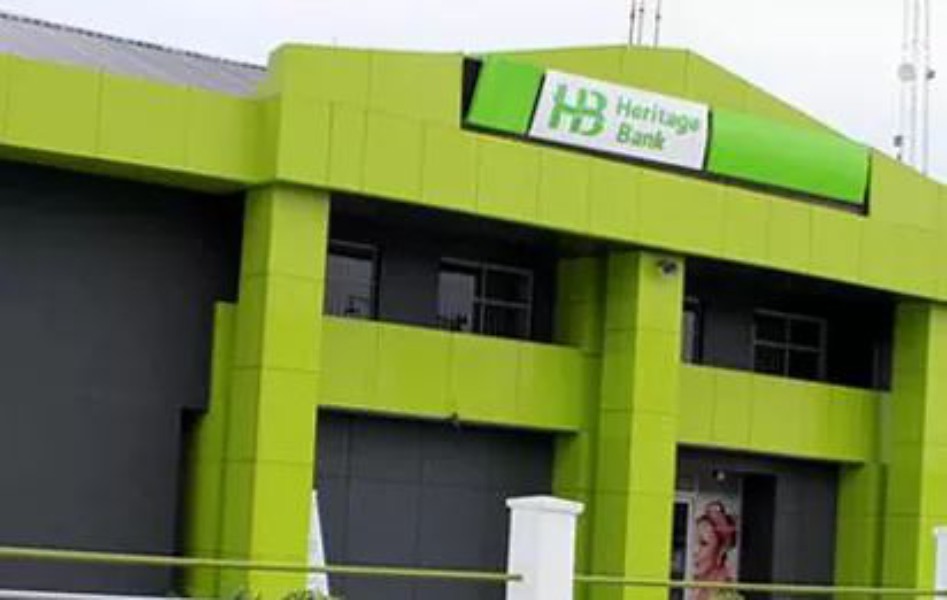
All seems not to be well with Heritage Bank at the moment as a report released by a reputable business news platform, Proshare Nigeria, is suggesting that the bank is a walking corpse.
Already, some customers of the financial institution are contemplating taking their hard-earned funds from the lender to a safer place.
Below is the full report.
Three months ago Proshare had cause to commit resources to investigate and produce an hitherto unpublished Confidential Report on Heritage Banking Company Limited, in direct response to the promptings of the advisory board members who wanted to know the true state of the bank which had another financial institution handling clearing operations for it at some time.
By this time, and curiously; it wasn’t such a big news that some of the bank depositors had experienced recurring challenges with withdrawals and staff exits did little to help matters. Yet, the restraint was important in order to ensure and support financial system stability as well as give the institution an opportunity to execute its resolution strategies without hindrance. After all, the institutional frameworks were in place to protect depositors and the system in general.
The task involved a lot of stakeholder engagements including sources we understood to be in a position to recognize, appreciate and make informed decisions. The revelations offered little comfort from history to, interventions up to the current state. We limited ourselves however to facts, data and evidence and submitted the report.
Further to the completion of this initial review, and in the interest of giving the financial system an opportunity to resolve the bank’s challenges through normal regulatory intervention and management effort at recapitalizing the institution or determination of the banks going concern status through a merger and acquisition (M&A) arrangement; the report remained private.
The burden of a moral hazard however appeared a bigger burden than tolerable or envisaged, especially given the evident ‘sailors survival’ approach that appears to have kicked in as seen through senior management exit, non-improving conditions, non-progressing talks around mergers and acquisitions; and recapitalization plans.
It has become compelling to highlight concerns about the bank formally; with the hope that ‘some intervention’ can happen to alter the trajectory of an inevitability. and remove the spectre of a bank waiting to die that overshadows the institution, unfortunately.
Proshare’s investigation into the bank revealed a few major concerns related to corporate governance and operational stability/sustainability. The primary issues included, but were not limited to the following:
- The acquisition of Enterprise Bank which is turning out to be a major strategic error;
- HBL’s non-performing loans (NPLs) portfolio, which are amongst the most challenged in the industry. Impairment charges in H1 2018 was estimated at N37.5bn but by year end, we extrapolated that the figure should settle around N634.5m;
- The bank posted an operating loss before tax of N38.5bn in H1 2018 and a loss of N4.4bn in the unaudited figures for the month of December 2018;
- The bank’s leverage has been a major sore point for management. The banks debt to equity ratio was -0.17. The negative value reflected negative shareholders fund which could be impaired by as much as $1bn;
- Equity capital has been virtually wiped out by accumulated losses, a legacy issue;
- The bank’s regular recourse to the CBN’s short term borrowing window highlights persistent liquidity resolution issues;
- Corporate governance has been a challenge as a number of the bank’s directors have allegedly been involved in a series of poor performing insider loan transactions, and little known about such resolutions (if any);
- The bank’s 2018 unaudited financial figures shows a dire situation in several operational metrics; and
- The bank has not been engaged in direct cheque clearing for a while, HBL’s instruments have been cleared through a third party first tier bank which got a full CBN guarantee against clearing loses.
IEI’s Pound of Flesh
It is instructive to recall how this sorry pass all began. Records indicated that Heritage Bank was in a difficult place from the start. It’s managing director and chief promoter, Ifie Sekibo, was the former Executive Vice Chairman (EVC) of International Energy Insurance (IEI) Plc from where a sizable amount of the acquisition money for the old SGBN was raised. Sekibo has been in a stretch of back and forth with the Board of his former company on this subject, as the directors of the company insist that Heritage Bank should be considered as part of the assets of the Insurance group; going as far as alleging that Sekibo had invested the insurers money in the bank without the approval of then Board members; or indicating/stating IEI’s consideration in the bank acquisition, if any.
The matter of using IEI resources to acquire the former Societe Generale Bank of Nigeria (SGBN) which was renamed Heritage Banking Company Limited has been the subject of a longstanding Economic and Financial Crime Commission (EFCC) investigation and continues to hound the bank’s CEO till date. Our background work on the matter then, enabled us to sight documentations that lends credence if not validity to the role played by IEI as reflected in presentations made to its board.
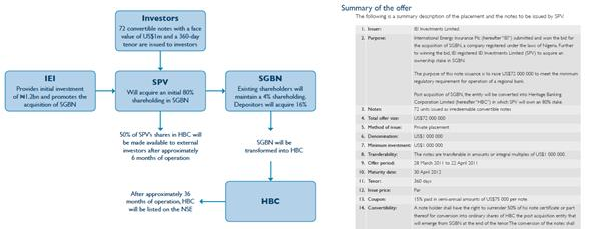
Source: What Happened To The N8bn Raised by IEI Plc in 2007? – Shareholders – Proshare, May 11, 2015
Mr. Sekibo has over the past few years tried to work out an amicable settlement with the IEI Group and directors, but matters are still fluid with necessary concessions being made on both parts. That said, the CEO’s travails still continue as he has had to deal with a few other issues concerning related-party transactions that have crystallized and left the bank’s books in a difficult position.
Weak Governance and Control
Heritage Bank’s problems have most certainly not been about Sekibo, alone. Far from it, the bank’s Board of directors (including former directors) has created a permissive culture that led to this.
Heritage Bank’s erstwhile chairman was also known to have used the banks tills to acquire two electricity distribution licenses’ the underlying cash flow difficulties of the businesses were subsequently and promptly transmitted to the bank, resulting in large repayment defaults. Indeed the loans have become ‘hardcore’ non-performing assets sitting on the bank’s books and creating both liquidity and profitability difficulties.
Managers of the bank, particularly branch managers, were in the past profligate in granting authorized and unauthorized loans to associates. Temporary overdrafts (TODs) routinely skipped repayment dates while structured loans also habitually missed the terms of the loan indenture, resulting into phantom profits and worsening liquidity.
Huge public sector deposits were beauties turned into beasts. The introduction of the Treasury Single Account (TSA) policy by the federal government in 2015 subsequently left the bank’s Asset and Liability Management (ALM) position in tatters.
The TSA policy did four things to undermine the bank’s fiscal stability:
- Sharply reduced the bank’s deposits;
- Significantly raised the banks cost of Funds (CoF);
- Reduced the bank’s ability to give short term loans; and
- Weakened the bank’s already fragile profitability.
Since the bank was already nurtured on a culture of entitlement, finding strategic options to wriggle from, under the weight of government policy and patronage became impossible.
Heritage Bank’s narrow retail base and its poor quality risk assets put inevitable pressure on profitability and liquidity. To compound matters, the bank’s internal control and compliance functions appears to have operated under a cloud of breaches than in the protection of standard corporate governance requirements, as directors willy-nilly violated single obligor limits. The poor internal control and audit process and administration at the bank thus complicated an already combustible bad loan and poor liquidity situation.
Coup de Foudre (Unintended Consequence)
As a way out of its myriad of challenges, the bank fell in love with another entity, committing a tragic error. In a bold but ill-digested move, Heritage Bank decided to acquire the Asset Management Company of Nigeria’s (AMCON’s) legacy deposit money institution, Enterprise Bank, this was the decision that let all the evil spirits out of Pandora’s box. The acquisition of Enterprise Bank was the classic example of a Cobra Effect or a situation where a cure becomes worse than the original disease.
The decision to acquire Enterprise Bank for N56bn in 2014 resulted in unintended consequence. At the time, the bank’s Board rationale in acquiring Enterprise Bank from AMCON was to rapidly expand the retail end of HBL’s operations and reduce its cost to income ratio based on representations that informed their decision. That gambit has proven to be a disaster and a cautionary tale on acquiring distressed banks unfortunately.
The Enterprise Bank wedlock, as consummated, turned into a fiasco as it added a further two hundred (200) branches to the banks operations and cut interest expense while improving net interest income (see chart 1 below). This led to the following outcomes:
- A sudden and significant rise in the bank’s bad debt to asset ratio;
- A leap in the bank’s debt provisioning or loan impairment requirements;
- A major rise in operational costs;
- A rise in the banks cost to income ratio (99% in FY 2018, as against the 53% of a bank like StanbicIBTC). (See chart 2 below);
- Stretching human capacity by lifting managers to their highest levels of administrative and technical (in)competence (The Peter Principle); and
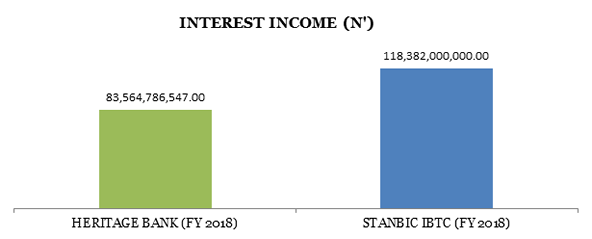
- Low Interest Income (as a result of slowing lending activities, (see chart 3) and high interest expense (as a result of a relatively low retail customer base, (see chart 4).
Chart 1 Net Interest Income FY2018, Heritage Bank and StanbicIBTC Bank
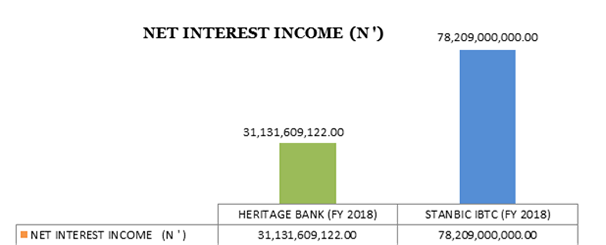
Source: Reported Financials Submitted / Estimated
Chart 2 Operating Expenses/Income FY2018,Heritage Bank and StanbicIBTC Bank
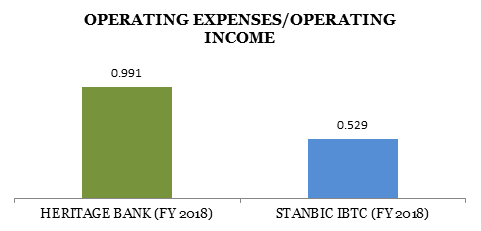
Source: Reported Financials Submitted / Estimated
Chart 3 Interest Income FY2018, Heritage Bank and StanbicIBTC Bank
Source: Reported Financials Submitted / Estimated
Biting into the Heritage Saga – What The Report Says
To understand the nexus between weak corporate governance, hubris, regulatory indulgence and Heritage Bank, the reader can send an email to [email protected] for a copy of the report.
The report is an attempt at a holistic look at the banks realities and lays bare the challenges that occur when individuals and institutions fail to live up to the exacting standards that are required to turn fragile ideas into enduring legacies.
The report was carried out as an intervention guidance to prompt action from the various parties and interested entities; all in the overall interest of the financial system.
To protect the financial system from contagion, the Central Bank of Nigeria (CBN) may need to move into the affairs of Heritage Bank and any of three actions are now plausible:
- Wind up the institution with shareholders losing their money (as things stand today shareholder’s funds have been completely eroded) while depositors resort to the National Deposit Insurance Corporation (NDIC) for part recovery of deposited funds;
- Find fresh investors interested in the institution and intermediate a best effort basis sale of exiting shareholder interest and recapitalization of the institution as a going concern; and
- Liquidation of the institution and the running of the bank under a new franchise as a legacy institution managed by AMCON and available for purchase by third party investors.
The preferred solution would appear to be either the second or third options.
The second option would be of particular preference as it would not involve heavy ‘menu cost’ by way of rebranding but would involve a new ownership – Board of Directors and management staff. The fresh capital inflow would eliminate the need for initial treasury support from public coffers and would likely result in fresh/foreign capital inflows which would be beneficial for the local currency while also protecting domestic employment. This approach would appear plausible given that the CBN recently gave out new licenses to start up banks; premised on their understanding that there exist room for new entrants with fresh ideas and approach.
The CBN would however have to work fast if Heritage Bank is not to be a blight on the Governors no-failure record.
From indicators received, there is a small window to achieve a technical resolution of the Heritage Bank situation, lest it could find itself taking remedial action(s) at a much higher economic cost later than it would now.
Heritage banks weak liquidity, impaired shareholder funds and high loan impairment, according to analysts, needs action not tolerance. The time to act is now!
Source: Proshare Nigeria
NOTE: Only the first two paragraphs of this story were written by Business Post.



