Connect with us

General

Seyi Tinubu Covers July/August Issue of Pleasures Magazine

Published

on

seyi tinubu

The image many have of a meeting of leaders of business and government is of a room filled with people aged 50-70, even 80 years old, discussing the narratives that will shape the world. But the decisions from such meeting will not impact their generation, they will impact young people.

Over 50% of the world’s population is under the age of 27. So, if someone is going to decide to shape the future, the youth, have to be part of that dialogue; a bigger part of this narrative of co-creating the future.

Professor Klaus Schwab, Founder and Executive Chairman of the World Economic Forum, realized this early on and founded the Global Shapers Community to empower young people to play an active role in shaping local, regional and global agendas.

With the largest youth population in history, there is an unprecedented opportunity for young people to take an active role in shaping the future. This generation has inherited enormous global challenges but has the ability to confront the status quo and offer youth-led solutions for change. They are today’s leaders.

The theme of the July / August issue of the Pan-African Entrepreneurial and Luxury magazine, PLEASURES MAGAZINE is “Creating a Shared Future in a Fractured World”, a special edition to celebrate young achievers who are changing our world in no small ways, these two keeps moving the needle especially in the area of entrepreneurship. They are taking more risks than ever before and building phenomenal businesses and taking decisions that are tackling problems and creating lots of jobs in the process. They are real change agents.

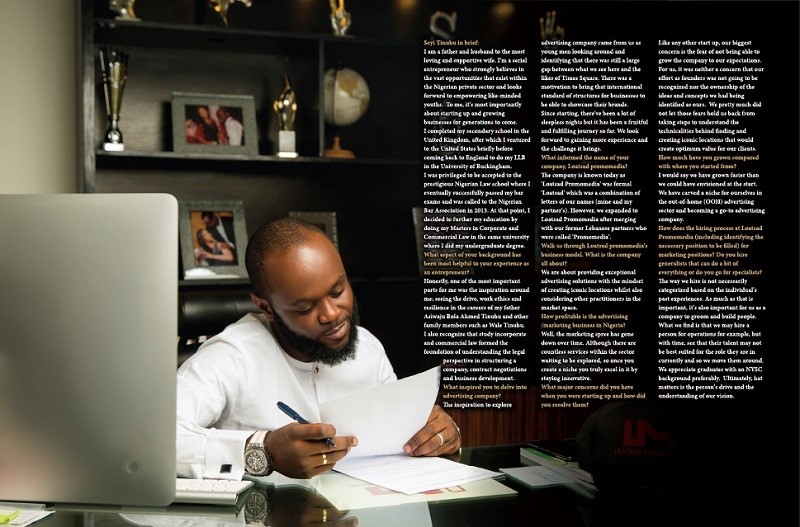
Seyi Tinubu, CEO of advertising giant, Loatsad Promomedia and Noella Tinubu Foundation, a non-profit organization in the interview with Pleasures magazine, highlighted his entrepreneurial journey and the impact of his Noella Tinubu Foundation, an initiative to empower and encourage youths to become change-makers in society by helping them to identify their passion and use that passion to create solutions that empower Nigerian communities and drive greater economic growth.

On the making of Seyi Tinubu

One of the refreshing aspects of the founder of Noella Tinubu Foundation, Seyi Tinubu’s interview with Pleasures Magazine is that he comes across as someone who doesn’t believe in mincing words. Be it the conviction with which he talks about his enterprise and what it has achieved so far, or his refusal to accept the status quo just because of a that’s-the-way-it-has-always-been-done sort of mentality, this Nigerian entrepreneur and the son of one of the leading Nigerian politicians, Asiwaju Bola Ahmed Tinubu seems to be charged up with a vision of a better future for the world at large.

The Noella Tinubu Foundation, founded by Seyi and his wife Layal started out, as a result of the yearnings of people who always ask the couple for support and help in one area or another. So, they both thought it would be best to set up a foundation where they can use a platform to empower people, both entrepreneurs and their startup businesses as well as other areas requiring support to keep their initiatives running. It has since grown into becoming “a global millennial startup movement for social good,” with Seyi and his team essentially developing entrepreneurial pipelines across Africa that transform business minds into change agents for sustainable impact.

“I love innovations and I see the future being tech driven. With that said, the Noella Tinubu Foundation is not limited to creating programs for tech entrepreneurs.” Seyi said in the interview.

With this being the case, PLEASURES MAGAZINE beamed the impact of the foundation and in his response to the question, Seyi said: “We’ve come up with initiatives such as scholarships to deserving students, empowering kids and youths with educational materials, training and skills empowerment, and other outreach programs to orphans, widows and children.”

“The Noella Tinubu Foundation has grown to a full-blown movement which is leading an entire generation to change the world,” he declares. “By 2050, the population in Africa is set to double to two billion with nearly half of that being under 25 years old. I believe that a rise in the younger population alongside entrepreneurship is significant to stir up a job creation wave. Reason why the NoellaTinubu Foundation was set up as a platform to empower and encourage youths to become change makers in society by helping them identify their passion to create solutions that empower Nigerian communities and drive greater economic growth. We give help to various individuals, bodies, groups, etc as a way to increase not just their livelihood, career, business, interests, etc.

We run workshops, training, invest, scale; all for the purpose of changing the trajectory of students on college campuses across Africa. Our aim is to provide a risk-free opportunity, and then back it up with the support required to have change.

We are distinguished in that we are a pipeline creator, the most fundamental piece of the startup funnel. We turn ordinary students into impact entrepreneurs, because we start with people, not ideas.”

As Seyi rightly notes, the NTF has transformed from what it was in its initial days- but it’s a change that has been for the better. “The objective of our foundation is to shortcut the entrepreneurial journey for young people, and get them to realize that you can build a billion-dollar business by creatively thinking about some of our world’s toughest challenges.”

According to him, “We pick an exciting area of impact that can be addressed and then we write a detailed opportunity map, outlining where billion-dollar companies could be generated. By focusing our entire network on one topic, it changes the paradigm of a generation, and exposes market inefficiencies in the current development space, which can be solved through business approaches. This year’s challenge is on rethinking how to harness the power of energy to transform 10 million lives. We used to focus on the bottom of the pyramid, but I have shifted our focus on empowering more people to reach the middle class. Tackling poverty is not enough; we must move the lower third into economic independence.”

Another sector Seyi is making marks is the advertising sector. Although he is trained as a lawyer, his entry into the lucrative advertising industry has rewritten how the industry is run in Nigeria. His company Loatsad Promomedia is the rave of the industry now. With Seyi at the helm, Loatsad Promomedia has provided services for various clients in Telecommunications, Energy, Banking, Food and Beverages, Pharmaceuticals, Media, Real Estate, Education and Government, including Lagos State Advertising Agency (LASAA).

In 2017, his innovative imputes into the industry earned him a prestigious Young Entrepreneur of The Year Award. In recognising and rewarding excellence in Nigeria’s Entrepreneurs, Advertising and Marketing Communications sectors.

Mr Seyi’s giant strides are even more appreciated by many, in his effort to live off the illustrious name of his father. He remains one of the most inventive and energetic minds in Nigerian technology today.

This issue also includes a look at the numerous positive initiatives of Queen Rania Foundation for Education and Development, founded by Queen Rania Al Abdulahi of Jordan. And on the two years crowning achievements of Mohammed bin Salman, crown prince of Saudi Arabia.

Plus, a special profiling of 50 African Women Entrepreneurs to watch out for on the global stage.

And as usual, the magazine is incomplete without your usual light stories and other human interest narratives such as the heart touching grass to grace story of Joana Gyan, Ghana’s queen of Gold export. Read the interesting tourist sites in Africa, these and many more reports combine in making the magazine a collector’s item and reading pleasure for all and sundry.


Modupe Gbadeyanka is a fast-rising journalist with Business Post Nigeria. Her passion for journalism is amazing. She is willing to learn more with a view to becoming one of the best pen-pushers in Nigeria. Her role models are the duo of CNN's Richard Quest and Christiane Amanpour.

Click to comment

Leave a Reply

Your email address will not be published. Required fields are marked *

General

Nigerian Army Arrests 18 Illegal Miners, Recovers N2.47m in Niger State

Published

on

nigerian army

By Adedapo Adesanya

The Nigerian Army has arrested 18 suspected illegal miners at a mining site in Izom, Gurara Local Government Area of Niger State, recovering equipment and N2.47 million in cash from the operation.

The suspects were arrested by troops of the 102 Guard Battalion during a routine operation in the area, where the soldiers reportedly discovered unauthorised mining activities.

Following the arrests, the army handed over the suspects and recovered items to the headquarters of the Nigerian Security and Civil Defence Corps Mining Marshals in Sauka, Abuja, in line with established inter-agency procedures.

The operation is part of intensified efforts by security and regulatory agencies to curb illegal mining, which has been linked to revenue losses, environmental degradation and the unlawful exploitation of Nigeria’s mineral resources.

Reacting to the development, the Commander of the NSCDC Mining Marshals, Assistant Commandant of Corps John Onoja Attah, commended the Nigerian Army for what he described as a strong demonstration of professionalism and commitment to protecting the country’s mineral wealth.

“The Nigerian Army has once again distinguished itself through professionalism, discipline and patriotism. The swift arrest of the suspects and their prompt handover to the Mining Marshals reflect a commendable commitment to the rule of law and the protection of Nigeria’s solid mineral resources,” he said.

Preliminary investigations by the Mining Marshals indicated that the suspects allegedly operated without licences, permits or any affiliation with a registered mining company. Investigators also said they could not produce evidence of valid mineral titles or authorisation from the relevant regulatory authorities.

Items recovered from the mining site included motorcycles, pumping machines, crusher engines, communication devices and cash totalling N2,468,750.

Mr Attah said the Mining Marshals would continue to pursue individuals involved in illegal mining and strengthen intelligence-led operations against activities that undermine the formal mining industry and deprive government of legitimate revenue.

He added that the Corps, under its Commandant-General, Mr Ahmed Audi, remained committed to enforcing the provisions of the Nigerian Minerals and Mining Act and protecting Nigeria’s mineral resources from unlawful exploitation.

The Mining Marshals said the investigation had been concluded and that the 18 suspects were being processed for prosecution under the relevant provisions of the Nigerian Minerals and Mining Act, 2007.

Continue Reading

General

NAPTIP Seals Port Harcourt Maternity Facility Over N13.5m Baby Sale

Published

on

NAPTIP counter-trafficking efforts

By Adedapo Adesanya

The National Agency for the Prohibition of Trafficking in Persons (NAPTIP) has sealed a suspected illegal maternity facility in Port Harcourt, Rivers State, and arrested three people over an alleged N13.5 million baby sale involving a Liberian national residing in Belgium.

The agency said the suspects included the owner of the facility, an alleged facilitator of the baby sale and a member of staff.

According to a statement issued on Thursday by NAPTIP’s Head of Press and Public Relations Unit, Mr Vincent Adekoye, the facility, located in the Elelenwo area of Port Harcourt, was allegedly operating from a residential apartment.

The operation was carried out jointly by NAPTIP operatives from Abuja and Rivers State, in collaboration with officials of the Rivers State Ministry of Health, following intelligence about a suspected child-trafficking syndicate involved in the procurement, sale and unlawful transfer of children.

NAPTIP said preliminary investigations indicated that the Liberian national arrived in Nigeria without evidence of pregnancy but allegedly took custody of three children within about one month.

The agency said intelligence available to it suggested that approximately ₦13.5 million changed hands in connection with the transfer of the three children.

Investigators are now working to establish the identities, whereabouts and welfare of the children, as well as determine their biological and legal parentage.

The investigation will also trace the financial transactions linked to the alleged transfers and establish the roles played by medical personnel and other individuals who may have facilitated the suspected criminal activity.

NAPTIP said the facility was sealed to preserve potential evidence while investigations continue.

The agency said the operation formed part of its nationwide crackdown on fraudulent maternity and healthcare facilities allegedly operating as so-called baby factories.

NAPTIP Director-General, Mrs Binta Bello, expressed concern over the alleged activities of some maternity and health facilities, particularly their suspected involvement in illegal adoption, child sales and trafficking.

She said, “I am particularly disturbed that foreign nationals now come to Nigeria to patronise these suspected criminal elements and procure children like a common object of trade across the border. This is sad and totally unacceptable.

“We have spread our dragnet to fish out all those involved in this case, and they shall be made to face the full wrath of the law,” she said.

She further said the investigation remained active and that anyone found culpable would be prosecuted in accordance with the law.

“I wish to reaffirm that the matter remains under active investigation and that all persons found connected to it will be subjected to due process under the law. The Agency will ensure that anyone found culpable is brought to justice, while the safety and welfare of the affected children remain its foremost priority,” she added.

The NAPTIP chief urged members of the public to remain vigilant and report suspected cases of child trafficking, illegal adoption, baby-selling and other forms of exploitation to the agency through its nearest zonal or state command.

NAPTIP said the latest operation followed an earlier directive by Bello to intensify surveillance of suspected maternity facilities across the country after intelligence suggested that some had become centres for fertility scams, child sales and trafficking.

Continue Reading

General

Afreximbank Now Africa’s Largest Oil, Gas Financier—Wale Tinubu

Published

on

wale tinubu

By Adedapo Adesanya

The chief executive of Oando Plc, Mr Wale Tinubu, says the African Export-Import Bank (Afreximbank) is now the largest financier of oil and gas projects on the African continent.

Mr Tinubu said the bank has committed over $25 billion in Africa’s oil and gas sector while speaking at the Royal African Society’s conference in London on the next 125 years of mining, oil and gas in Africa, according to a social media post on Wednesday.

“Afreximbank is now the largest financier of oil and gas on this continent, with more than twenty-five billion dollars committed,” he wrote on X.

Mr Tinubu said 20 years ago, when Oando wanted to list on the Johannesburg Stock Exchange, “we were told what would be required of us”.

He said the company was directed to adopt International Financial Reporting Standards (IFRS), while the board was also asked to appoint independent directors who could tell the founder “no”.

“Get on a plane and explain ourselves, quarter after quarter, to people who had never set foot in Lagos. It was uncomfortable. It was also the most valuable thing we ever did to ourselves,” he said.

“I returned to that experience in London at the Royal African Society’s (@royafrisoc) discussion on the next 125 years of mining, oil and gas in Africa, where I was asked what African companies need in order to scale.

“The answer begins at home. Much of African enterprise started out fractured; family-held, informally governed, structurally invisible to anyone underwriting a twenty-year risk. Global capital hesitates over what it cannot examine.”

The Oando CEO said governance is more than a compliance exercise, describing it as an instrument that makes a company legible to the world.

“The second half of the answer sits with the world. When European lenders withdrew from African hydrocarbons in pursuit of their own net zero commitments, they did not end demand for African energy,” he said.

“They ended their participation in it. African institutions stepped into that space.”

Mr Tinubu said African firms have done the harder work “of making ourselves investable”, noting that what does not get financed does not get built, and “there is still much to build in Africa for those willing to build it with African companies”.

In Nigeria, the bank has been a major financier of the 650,000 barrels-per-day Dangote Petroleum Refinery, including a $1.35 billion facility in 2025 to refinance construction costs and a further $2.5 billion underwriting commitment in 2026.

The bank has also supported the development of the 200,000 barrels-per-day Lobito Refinery in Angola, the 60,000 barrels-per-day Cabinda Refinery, and the refurbishment of Nigeria’s 210,000 barrels-per-day Port Harcourt Refinery. It has additionally approved financing for the BUA and Azikel refineries in Nigeria and supported Société Ivoirienne de Raffinage in Côte d’Ivoire.

Beyond refining, Afreximbank committed up to $400 million in guarantees and direct lending to Mozambique’s Area 1 LNG project, one of Africa’s largest LNG developments, to support the extraction, processing and liquefaction of offshore gas.

In Angola, the bank helped arrange a $1.75 billion syndicated facility for Sonangol to support the national oil company’s operating and capital expenditure requirements. It has also been mandated to advise on raising capital for Equatorial Guinea’s $4.5 billion EG-27 LNG project, which is expected to produce about 2.4 million tonnes of LNG annually. In the Democratic Republic of Congo, the lender is supporting preparations for a 200MW reservoir-based hydropower project along the Lufira River, designed to provide electricity to mining operations.

Continue Reading