Connect with us

General

Seyi Tinubu Covers July/August Issue of Pleasures Magazine

Published

on

seyi tinubu

The image many have of a meeting of leaders of business and government is of a room filled with people aged 50-70, even 80 years old, discussing the narratives that will shape the world. But the decisions from such meeting will not impact their generation, they will impact young people.

Over 50% of the world’s population is under the age of 27. So, if someone is going to decide to shape the future, the youth, have to be part of that dialogue; a bigger part of this narrative of co-creating the future.

Professor Klaus Schwab, Founder and Executive Chairman of the World Economic Forum, realized this early on and founded the Global Shapers Community to empower young people to play an active role in shaping local, regional and global agendas.

With the largest youth population in history, there is an unprecedented opportunity for young people to take an active role in shaping the future. This generation has inherited enormous global challenges but has the ability to confront the status quo and offer youth-led solutions for change. They are today’s leaders.

The theme of the July / August issue of the Pan-African Entrepreneurial and Luxury magazine, PLEASURES MAGAZINE is “Creating a Shared Future in a Fractured World”, a special edition to celebrate young achievers who are changing our world in no small ways, these two keeps moving the needle especially in the area of entrepreneurship. They are taking more risks than ever before and building phenomenal businesses and taking decisions that are tackling problems and creating lots of jobs in the process. They are real change agents.

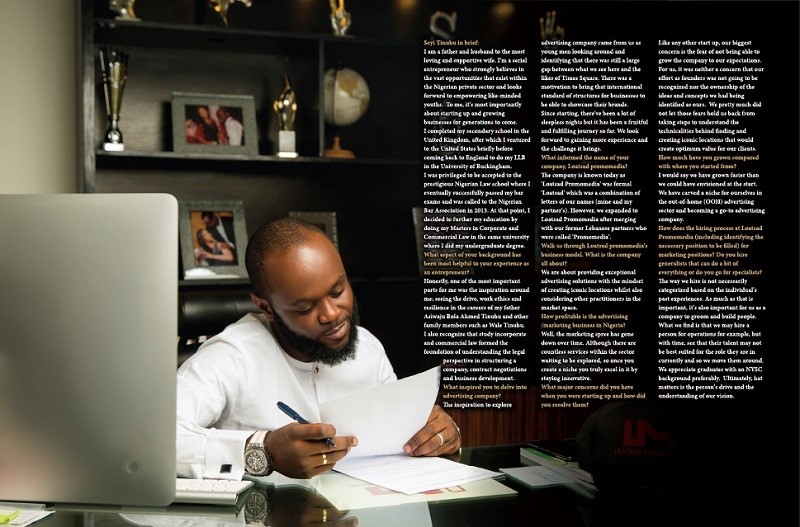
Seyi Tinubu, CEO of advertising giant, Loatsad Promomedia and Noella Tinubu Foundation, a non-profit organization in the interview with Pleasures magazine, highlighted his entrepreneurial journey and the impact of his Noella Tinubu Foundation, an initiative to empower and encourage youths to become change-makers in society by helping them to identify their passion and use that passion to create solutions that empower Nigerian communities and drive greater economic growth.

On the making of Seyi Tinubu

One of the refreshing aspects of the founder of Noella Tinubu Foundation, Seyi Tinubu’s interview with Pleasures Magazine is that he comes across as someone who doesn’t believe in mincing words. Be it the conviction with which he talks about his enterprise and what it has achieved so far, or his refusal to accept the status quo just because of a that’s-the-way-it-has-always-been-done sort of mentality, this Nigerian entrepreneur and the son of one of the leading Nigerian politicians, Asiwaju Bola Ahmed Tinubu seems to be charged up with a vision of a better future for the world at large.

The Noella Tinubu Foundation, founded by Seyi and his wife Layal started out, as a result of the yearnings of people who always ask the couple for support and help in one area or another. So, they both thought it would be best to set up a foundation where they can use a platform to empower people, both entrepreneurs and their startup businesses as well as other areas requiring support to keep their initiatives running. It has since grown into becoming “a global millennial startup movement for social good,” with Seyi and his team essentially developing entrepreneurial pipelines across Africa that transform business minds into change agents for sustainable impact.

“I love innovations and I see the future being tech driven. With that said, the Noella Tinubu Foundation is not limited to creating programs for tech entrepreneurs.” Seyi said in the interview.

With this being the case, PLEASURES MAGAZINE beamed the impact of the foundation and in his response to the question, Seyi said: “We’ve come up with initiatives such as scholarships to deserving students, empowering kids and youths with educational materials, training and skills empowerment, and other outreach programs to orphans, widows and children.”

“The Noella Tinubu Foundation has grown to a full-blown movement which is leading an entire generation to change the world,” he declares. “By 2050, the population in Africa is set to double to two billion with nearly half of that being under 25 years old. I believe that a rise in the younger population alongside entrepreneurship is significant to stir up a job creation wave. Reason why the NoellaTinubu Foundation was set up as a platform to empower and encourage youths to become change makers in society by helping them identify their passion to create solutions that empower Nigerian communities and drive greater economic growth. We give help to various individuals, bodies, groups, etc as a way to increase not just their livelihood, career, business, interests, etc.

We run workshops, training, invest, scale; all for the purpose of changing the trajectory of students on college campuses across Africa. Our aim is to provide a risk-free opportunity, and then back it up with the support required to have change.

We are distinguished in that we are a pipeline creator, the most fundamental piece of the startup funnel. We turn ordinary students into impact entrepreneurs, because we start with people, not ideas.”

As Seyi rightly notes, the NTF has transformed from what it was in its initial days- but it’s a change that has been for the better. “The objective of our foundation is to shortcut the entrepreneurial journey for young people, and get them to realize that you can build a billion-dollar business by creatively thinking about some of our world’s toughest challenges.”

According to him, “We pick an exciting area of impact that can be addressed and then we write a detailed opportunity map, outlining where billion-dollar companies could be generated. By focusing our entire network on one topic, it changes the paradigm of a generation, and exposes market inefficiencies in the current development space, which can be solved through business approaches. This year’s challenge is on rethinking how to harness the power of energy to transform 10 million lives. We used to focus on the bottom of the pyramid, but I have shifted our focus on empowering more people to reach the middle class. Tackling poverty is not enough; we must move the lower third into economic independence.”

Another sector Seyi is making marks is the advertising sector. Although he is trained as a lawyer, his entry into the lucrative advertising industry has rewritten how the industry is run in Nigeria. His company Loatsad Promomedia is the rave of the industry now. With Seyi at the helm, Loatsad Promomedia has provided services for various clients in Telecommunications, Energy, Banking, Food and Beverages, Pharmaceuticals, Media, Real Estate, Education and Government, including Lagos State Advertising Agency (LASAA).

In 2017, his innovative imputes into the industry earned him a prestigious Young Entrepreneur of The Year Award. In recognising and rewarding excellence in Nigeria’s Entrepreneurs, Advertising and Marketing Communications sectors.

Mr Seyi’s giant strides are even more appreciated by many, in his effort to live off the illustrious name of his father. He remains one of the most inventive and energetic minds in Nigerian technology today.

This issue also includes a look at the numerous positive initiatives of Queen Rania Foundation for Education and Development, founded by Queen Rania Al Abdulahi of Jordan. And on the two years crowning achievements of Mohammed bin Salman, crown prince of Saudi Arabia.

Plus, a special profiling of 50 African Women Entrepreneurs to watch out for on the global stage.

And as usual, the magazine is incomplete without your usual light stories and other human interest narratives such as the heart touching grass to grace story of Joana Gyan, Ghana’s queen of Gold export. Read the interesting tourist sites in Africa, these and many more reports combine in making the magazine a collector’s item and reading pleasure for all and sundry.


Modupe Gbadeyanka is a fast-rising journalist with Business Post Nigeria. Her passion for journalism is amazing. She is willing to learn more with a view to becoming one of the best pen-pushers in Nigeria. Her role models are the duo of CNN's Richard Quest and Christiane Amanpour.

Click to comment

Leave a Reply

Your email address will not be published. Required fields are marked *

General

Nigeria Plans to Begin Electricity Generation from Nuclear Sources

Published

on

NIWA NAEC nuclear power plant

By Aduragbemi Omiyale

There are plans for Nigeria to begin to generate electricity from nuclear sources, the chief executive of the Nigeria Atomic Energy Commission (NAEC), Mr Anthony Godwin Ekedegwa, has revealed.

Mr Ekedegwa made this disclosure when he recently visited the acting Managing Director of the National Inland Waterways Authority (NIWA), Mr Umar Yusuf Girei, in Abuja.

He was at NIWA’s office to solicit the support of NIWA in achieving the numerous advantages of using nuclear energy technology in the country.

According to him, the partnership of critical stakeholders in Nigeria will position the country well in developing and maintaining its nuclear power plant.

The NAEC chief said Nigeria intends to begin the generation of electricity from nuclear sources instead of fossil-based power plants and hydro-based power plants, stressing that for Nigeria to develop, there is a need for the country to diversify its energy needs.

In his remarks, Mr Girei assured NAEC of his agency’s readiness to collaborate on the advancement of a nuclear power plant in Nigeria.

He promised the full support of NAEC for the success of a nuclear power plant in the country, saying that as the organisation saddled with the responsibility of regulating and developing Nigeria Inland Waterways, his entity is strategically positioned to play a critical role in the federal government’s quest for sustainable energy through the new technology.

Continue Reading

General

House of Reps Directs IGP Disu to Produce PFIPC DG Adeyemi

Published

on

PFIPC DG Adeyemi

By Adedapo Adesanya

The House of Representatives Ad-hoc Committee probing the Presidential Foreign Intervention Promotion Council (PFIPC) has ordered the Inspector-General of Police (IGP), Mr Olatunji Disu, to ensure the appearance of the agency’s alleged Director-General, Mr Adeniyi Adeyemi, before the panel on July 29, 2026.

Mr Adeyemi was recently arrested after a court directed the police to do so.

The lawmakers’ call came on Monday just as the Accountant General of the Federation, Mr Shamseldeen Ogunjimi, said that his office declined a request by the PFIPC to open a Treasury Single Account (TSA), insisting that due diligence had not been completed.

Mr Ogunjimi, who spoke when he appeared before the House of Representatives ad hoc committee, explained that though the council requested the opening of a TSA account, his office declined the request pending compliance with established due diligence requirements.

The PFIPC controversy began after the self-acclaimed director-general of the disputed agency, Mr Adeyemi, alleged during a presser that the Chief of Staff to the President, Mr Femi Gbajabiamila, demanded 48 per cent from its N27.3 billion take-off grant.

Mr Adeyemi had also alleged that the Chief of Staff received N400 million through a proxy and requested an additional N200 million to facilitate presidential approvals.

However, Mr Gbajabiamila denied the allegations in a statement on oath, maintaining that he had no personal, official or professional relationship with Mr Adeyemi. He also denied demanding or receiving any money, abusing his office or interfering with law enforcement agencies.

The Chief of Staff further denied any involvement in the alleged death of Mr Babatunde Tanimola, whom Mr Adeyemi claimed acted as an intermediary, as well as allegations linking him to an alleged assassination attempt on the defendant or interference with investigations by security agencies.

Following the allegations, President Bola Tinubu directed the ICPC to investigate the matter.

Also, Mr Gbajabiamila instituted a N15 billion defamation suit against the disputed DG at the High Court of the Federal Capital Territory (FCT), Abuja.

In the suit, he sought N10 billion in general damages, N5 billion in aggravated damages, N200 million as the cost of the action, and an order directing Mr Adeyemi to publish a retraction and apology in five national newspapers and across all social media platforms where the alleged defamatory statements were published.

Following the outrage generated by the issue, the House of Representatives inaugurated a 12-member ad hoc committee to investigate the circumstances surrounding the establishment of the disputed agency and the process through which it was included in the 2026 budget.

The committee is also investigating the alleged allocation of N1.3 billion to the agency in the 2026 Appropriation Act.

The committee is chaired by Yusuf Gagdi, who assured Nigerians that the panel would conduct a thorough and impartial investigation.

Last week, the ICPC confirmed that it questioned Mr Gbajabiamila over the disputed PFIPC, but didn’t give further details on its next step.

During her appearance, the Head of the Civil Service of the Federation, Mrs Esther Walson-Jack, said her office did not allocate office space at the Federal Secretariat in Abuja nor deploy staff to the PFIPC.

“The request for deployment of officers was received and noted for consideration. However, there was no deployment of officers by the Office of the Head of the Civil Service of the Federation to the council,” said Mr Walson-Jack.

The Head of Service also noted that “while there is speculation that the council occupied office space in the Federal Secretariat Phase Three,” her office could state categorically that it “did not allocate any office space to the PFIPC”.

Similarly, the Director-General of the Budget Office of the Federation, Mr Tanimu Yakubu, told the committee that no kobo appropriated for the disputed agency was spent.

Mr Yakubu maintained that while the National Assembly approved funds for the council, the statutory conditions required to release, pay, or spend the money were never met.

“The conclusion is firm. Not one kobo of the personnel provision could lawfully have been drawn, and not one kobo was drawn. The overhead provision never matured into a lawful cash release,” Yakubu said.

“The capital provision never matured into procurement or expenditure. The conditions required for spending were not met and were not close to being met. There is therefore no personnel expenditure to recover. The money never moved because the controls held.”

Continue Reading

General

Atiku Queries N5trn Domestic Borrowing Despite Oil Windfall

Published

on

atiku tinubu

By Adedapo Adesanya

Former Vice President and presidential candidate of the African Democratic Congress (ADC), Mr Atiku Abubakar, has criticised President Bola Tinubu’s continued reliance on domestic borrowing, despite the windfall reportedly made when oil prices surged following the US-Iran war.

Mr Abubakar, in a statement issued on Monday by his Senior Special Assistant on Public Communication, Mr Phrank Shaibu, described the federal government’s fiscal approach as inconsistent, lacking transparency and failing to demonstrate prudent financial management.

He questioned the rationale behind accumulating fresh debt despite what he described as a significant revenue boost from high global crude oil prices.

Mr Abubakar claimed that the Mr Tinubu-led administration has raised approximately N5 trillion from the domestic bond market during the first half of 2026, representing nearly 80 per cent of the amount borrowed within the same period in 2025.

This is even as he argued that such borrowing would ordinarily be justified only if government revenues had fallen sharply.

“The exact opposite is the case,” he said.

He noted that the 2026 national budget was based on a crude oil benchmark of $64.84 per barrel, while Brent crude averaged about $92 per barrel between March 1 and July 14. He added that Nigerian crude traditionally sells at a premium above Brent prices.

The former vice president said the difference between the budget benchmark and prevailing market prices translated into substantial additional revenue for the country.

“This naturally raises two unavoidable questions. First, why is a government enjoying such an extraordinary oil windfall borrowing at almost twice last year’s pace as though the nation were in financial distress? Second, where is the money?” he queried.

He estimated that the price differential generated an additional $27.15 per barrel, amounting to roughly $42.7 million in extra daily earnings based on an average production of 1.5 million barrels per day.

Over 135 days, Mr Abubakar said the excess revenue amounted to approximately $5.76 billion, equivalent to about N7.98 trillion.

He recalled that previous administrations maintained formal structures, including the Sovereign Wealth Fund and other fiscal buffers, to manage excess crude earnings and ensure accountability.

The ADC presidential candidate also expressed concern that despite increased oil revenues and the removal of fuel subsidy, many Nigerians continue to experience worsening economic hardship.

He cited recent United Nations findings indicating that nearly 80 per cent of Nigerians are unable to afford a decent daily meal, while infrastructure deficits persist despite government assurances that subsidy savings would be invested in critical sectors such as healthcare, education and road infrastructure.

The former VP said an ADC-led administration would adopt a rules-based fiscal framework to ensure transparency in the management of revenues earned above the budget oil benchmark.

He said surplus earnings would be channelled towards reducing public debt, strengthening fiscal reserves and financing investments in infrastructure, education, healthcare and agriculture.

“Nigerians deserve answers. They deserve accountability. Above all, they deserve a government that manages national wealth in the public interest, not one that presides over unprecedented opacity while asking future generations to repay debts incurred in the midst of plenty,” he said.

Mr Abubakar also argued that the Tinubu administration had recently embraced a power sector strategy he first advocated more than two decades ago.

He said comments by the Minister of Power acknowledging that Nigeria could no longer rely solely on large, centralised power plants amounted to an endorsement of his long-standing position on decentralised electricity generation.

“It should not take a government three years in office to discover what was obvious more than two decades ago,” Atiku said.

He criticised the administration for increasing electricity tariffs before implementing reforms capable of improving power supply.

“A government that thinks before it acts would have fixed the system before asking citizens to pay more. Unfortunately, this administration has done the exact opposite, raising tariffs first and only now beginning to think about the reforms required to justify those increases,” he said.

The politician recalled that while serving under former President Olusegun Obasanjo, he consistently advocated decentralising electricity generation by harnessing multiple energy sources, including hydroelectric power, natural gas and solar energy.

“This has been my position for over two decades. When President Obasanjo established the Power Sector Reform Committee based primarily on gas-fired generation, I was appointed chairman.

“However, because I fundamentally disagreed with the policy direction, I declined to preside over the committee. I believed then, as I do now, that Nigeria’s electricity future lay in a diversified and decentralised energy mix, not an overdependence on a single source.”

“Nigeria does not suffer from a shortage of ideas. It suffers from a shortage of leaders willing to act on the right ideas at the right time.

“It is never too late to embrace the right policy, but Nigerians should never have had to pay the price for a government that spent three years learning what should have guided its actions from day one,” he added.

Continue Reading