Economy
RMAFC to Review Revenue Sharing Formula for FG, States, Local Govts
By Adedapo Adesanya
Chairman of the Revenue Mobilisation Allocation and Fiscal Commission (RMAFC), Mr Elias Mbam, has disclosed that the agency was considering the review of the revenue sharing formula for the three tiers of government; the Federal, States, and Local governments.
Mr Mbam made this disclosure after he received an Award of Excellence from the Nigeria Civil Service Union on Tuesday in Abuja.
He explained that the review of the revenue allocation among the federal, states and local governments of the federation has become necessary due to the current economic realities the country is faced with.
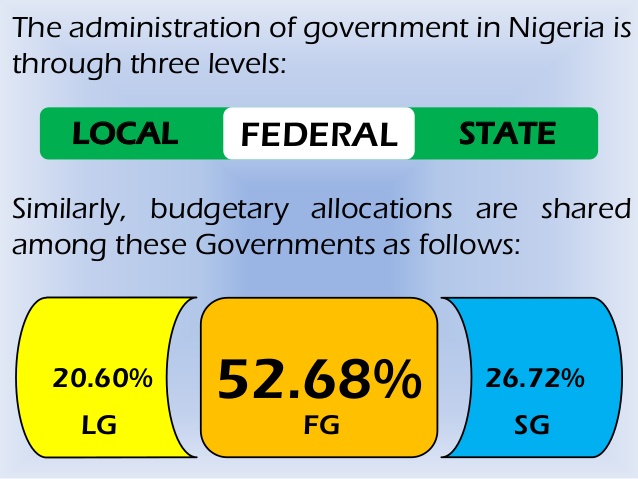
Under the current revenue sharing formula designed during the President Olusegun Obasanjo administration, the federal government takes about 52.68 percent of the total revenue generation by the nation in a month, the 36 state governments including the Federal Capital Territory, Abuja get 26.72 percent and the 774 local governments share 20.60 percent.
Also, the nine oil producing states of the Niger Delta region receive 13 percent revenue as derivation to compensate for ecological damage of oil production in the region.
However, following years of demands for a review of the formula, the RMAFC in 2013 resolved to undertake a review to achieve a balanced development of the country.
To achieve that objective, the commission embarked on a nationwide consultation to the 36 states and also met with notable persons, including traditional rulers on the issue.
In December 2014, the commission came out with a proposed new revenue formula, which was submitted to the government. However, the report was not implemented.
Now, more than five years later, the RMAFC chairman said the commission plans to constitute a standing committee next week to start work once again on the review of the revenue sharing formula.
Mr Mbam said the commission would also pursue the diversification of the nation’s revenue base for a more sustainable growth and economic development.
“My agenda is to expand the sources of revenue for the federation. I will like to expand the cake that we are sharing so that people will get reasonable quantity.
“I intend to do this through diversification in areas outside oil and gas, and that includes solid minerals, agriculture and manufacturing.
“So, we will encourage states and let them know what is available outside oil and gas so they can develop those aspects of the economy to their own benefit,’’ he said.
Economy
NASD OTC Exchange Drops 0.44%
By Adedapo Adesanya
The NASD Over-the-Counter (OTC) Securities Exchange dipped by 0.44 per cent on Tuesday, January 27, with the market capitalisation declining by N9.70 billion to N2.174 trillion from N2.184 trillion, and the NASD Unlisted Security Index (NSI) falling by 16.21 points to 3,634.73 points from 3,650.94 points.
The bourse was under pressure from two securities, which lost weight, overpowering the gains recorded by three securities.
Business Post reports that FrieslandCampina Wamco Nigeria Plc lost N5.70 to sell at N64.00 per share compared with Monday’s price of N69.70 per share and Central Securities Clearing System (CSCS) Plc dropped 17 Kobo to close at N40.50 per unit, in contrast to the preceding day’s N40.67 per unit.
On the flip side, Air Liquide Plc added N1.69 to settle at N18.63 per share versus the previous session’s N16.94 per share, UBN Property Plc appreciated by 20 Kobo to N2.20 per unit from N2.00 per unit, and Industrial and General Insurance (IGI) Plc gained 6 Kobo to trade at 69 Kobo per share versus 63 Kobo per share.
During the session, the volume of securities traded by investors fell further by 80.9 per cent to 1.3 million units from 6.8 million units, the value of securities went down by 57.3 per cent to N57.3 million from N156.7 million, and the total number of deals shrank by 13.6 per cent to 38 deals from 44 deals.
At the close of business, CSCS Plc was the most traded stock by value on a year-to-date basis with 14.4 million units traded for N586.1 million, the second spot was occupied by FrieslandCampina Wamco Nigeria Plc with 1.6 million units worth N107.9 million, and the third spot was taken by MRS Oil Plc with 297,101 units valued at N59.3 million.
CSCS Plc also ended as the most active stock by volume on a year-to-date basis with 14.4 million units valued at N586.1 million, followed by Geo-Fluids Plc with 1.6 million units worth N107.9 million, and Mass Telecom Innovation Plc with 6.4 million units sold for N2.6 million.
Economy
Naira Firms to N1,401/$1 at Official Market as Reforms Bear Fruits
By Adedapo Adesanya
The value of the Nigerian Naira appreciated against the US Dollar in the Nigerian Autonomous Foreign Exchange Market (NAFEX) on Tuesday, January 27 by N17.73 or 1.25 per cent to close at N1,401.22/$1, in contrast to the previous day’s value of N1,418.95/$1.
Also, the domestic currency improved its value against the Euro by N10.09 in the same market window yesterday to trade at N1,672.22/€1 versus the previous session’s N1,682.31/€1, but declined against the Pound Sterling by N4.72 to trade at N1,925.84/£1 compared with Monday’s closing price of N1,921.12/£1.
At the GTBank FX desk, the Naira appreciated against the greenback during the session by N4 to close at N1,426/$1 compared with the previous day’s N1,430/$1 and at the parallel market, it remained unchanged at N1,480/$1.
The Naira continues to align with projections and reforms. Analysts largely expect the local currency to remain within a relatively stable range in the medium term. Many projections suggest the currency will trade between N1,400/$1 and N1,450/$1 this year, supported by improved FX liquidity and ongoing macroeconomic reforms.
Nigeria’s external reserves have continued on a steady upward trajectory, providing additional support for the domestic currency. According to figures published by the CBN on its website, external reserves rose to $46.03 billion as of January 26, 2026, reflecting sustained inflows and improved confidence in the FX market.
Ongoing reforms in the oil sector that have buoyed investments, rising foreign capital inflows, and stronger diaspora remittances are also combining to underpin exchange rate stability and sustain confidence in the FX market.
Meanwhile, the cryptocurrency market rose on Tuesday and the US Dollar remained under pressure ahead of a closely watched Federal Reserve decision on Wednesday.
The weaker Dollar has fueled strong rallies in gold and silver, but crypto has so far lagged that trade.
Ethereum (ETH) gained 2.5 per cent to trade at $3,000.05, Dogecoin (DOGE) increased by 2.4 per cent to $0.1249, Solana (SOL) expanded by 2.3 per cent to $126.84, Binance Coin (BNB) added 2.1 per cent to sell for $900.33, Cardano (ADA) jumped by 1.6 per cent to $0.3568, Ripple (XRP) appreciated by 0.9 per cent to $1.91, Bitcoin (BTC) soared by 0.9 per cent to $89,016.63, and Litecoin (LTC) grew by 0.6 per cent to $69.69, while the US Dollar Tether (USDT) and the US Dollar Coin (USDC) traded flat at $1.00 apiece.
Economy
Crude Oil Jumps 3% as US Winter Storm Affects Output
By Adedapo Adesanya
Crude oil appreciated by 3 per cent on Tuesday as a winter storm in the United States affected crude production and drove US Gulf Coast crude exports to zero over the weekend.
During the session, Brent crude futures went up by $1.98 or 3.02 per cent to $67.57 a barrel and the US West Texas Intermediate (WTI) crude futures grew by $1.76 or 2.9 per cent to trade at $62.39 a barrel.
US oil producers lost up to 2 million barrels per day or roughly 15 per cent of national production over the weekend as a severe winter storm swept across the country, straining energy infrastructure and power grids.
The severe weather has boosted crude futures, with short-term risks rising on fears of supply disruptions.
According to Reuters, the Permian Basin experienced the largest share of that decline at around 1.5 million barrels per day. Production losses eased on Monday, with Permian shut-ins estimated at about 700,000 barrels per day and production set to be fully restored by January 30.
The exports of crude oil and liquefied natural gas from US Gulf Coast ports tumbled to zero on Sunday amid frigid weather. However, this has rebounded in the last days.
Also boosting prices, Kazakhstan’s biggest oilfield, Tengiz, is likely to restore less than half of its normal production by February 7 as it slowly recovers from a fire and power outage.
The slow pace of recovery of Tengiz’s production is keeping the oil market tighter while a weaker US Dollar also lended some support.
However, the CPC, which operates Kazakhstan’s main exporting pipeline, said it returned to full loading capacity at its terminal on the Russian Black Sea coast after maintenance was completed at one of its three mooring points.
On the geopolitical front, the US landed an aircraft carrier and supporting warships in the Middle East, adding to the slim chance of a military action against Iran.
President Donald Trump Trump had repeatedly threatened to intervene if Iran continued to kill protesters, but the countrywide demonstrations have since abated. The US president said he had been told that killings were subsiding and that he believes there is currently no plan for the executions of prisoners.
Meanwhile, the Organisation of the Petroleum Exporting Countries and its allies (OPEC+) is set to keep its pause on oil output increases for March at a meeting on February 1.
-
Feature/OPED6 years agoDavos was Different this year
-
Travel/Tourism9 years ago
Lagos Seals Western Lodge Hotel In Ikorodu
-
Showbiz3 years agoEstranged Lover Releases Videos of Empress Njamah Bathing
-
Banking8 years agoSort Codes of GTBank Branches in Nigeria
-
Economy3 years agoSubsidy Removal: CNG at N130 Per Litre Cheaper Than Petrol—IPMAN
-
Banking3 years agoSort Codes of UBA Branches in Nigeria
-
Banking3 years agoFirst Bank Announces Planned Downtime
-
Sports3 years agoHighest Paid Nigerian Footballer – How Much Do Nigerian Footballers Earn