Economy
RMAFC to Review Revenue Sharing Formula for FG, States, Local Govts
By Adedapo Adesanya
Chairman of the Revenue Mobilisation Allocation and Fiscal Commission (RMAFC), Mr Elias Mbam, has disclosed that the agency was considering the review of the revenue sharing formula for the three tiers of government; the Federal, States, and Local governments.
Mr Mbam made this disclosure after he received an Award of Excellence from the Nigeria Civil Service Union on Tuesday in Abuja.
He explained that the review of the revenue allocation among the federal, states and local governments of the federation has become necessary due to the current economic realities the country is faced with.
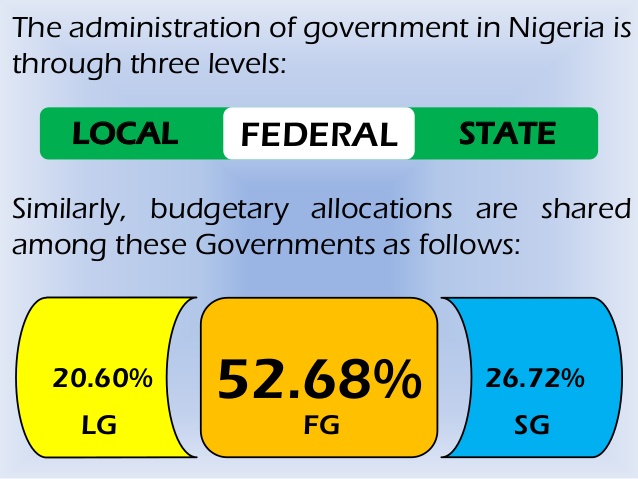
Under the current revenue sharing formula designed during the President Olusegun Obasanjo administration, the federal government takes about 52.68 percent of the total revenue generation by the nation in a month, the 36 state governments including the Federal Capital Territory, Abuja get 26.72 percent and the 774 local governments share 20.60 percent.
Also, the nine oil producing states of the Niger Delta region receive 13 percent revenue as derivation to compensate for ecological damage of oil production in the region.
However, following years of demands for a review of the formula, the RMAFC in 2013 resolved to undertake a review to achieve a balanced development of the country.
To achieve that objective, the commission embarked on a nationwide consultation to the 36 states and also met with notable persons, including traditional rulers on the issue.
In December 2014, the commission came out with a proposed new revenue formula, which was submitted to the government. However, the report was not implemented.
Now, more than five years later, the RMAFC chairman said the commission plans to constitute a standing committee next week to start work once again on the review of the revenue sharing formula.
Mr Mbam said the commission would also pursue the diversification of the nation’s revenue base for a more sustainable growth and economic development.
“My agenda is to expand the sources of revenue for the federation. I will like to expand the cake that we are sharing so that people will get reasonable quantity.
“I intend to do this through diversification in areas outside oil and gas, and that includes solid minerals, agriculture and manufacturing.
“So, we will encourage states and let them know what is available outside oil and gas so they can develop those aspects of the economy to their own benefit,’’ he said.
Economy
NUPRC Targets $50bn Investments from 22 Offshore Projects
By Aduragbemi Omiyale
Between $30 billion and $50 billion in investments are anticipated from 22 major offshore projects by the Nigerian Upstream Petroleum Regulatory Commission (NUPRC) from now till 2030.
Speaking at the Society of Petroleum Engineers’ Nigeria Annual International Conference and Exhibition (NAICE 2026) in Lagos on Wednesday, the chief executive of NUPRC, Mrs Oritsemeyiwa Eyesan, said since 2022, successive licensing rounds have opened access to some of Nigeria’s most prospective oil and gas acreages.
She made reference to the recent 2025 Licensing Round where 31 companies emerged successful bidders for 37 oil and gas blocks after progressing through a robust, data-driven and technology enabled evaluation process.
Mrs Eyesan said the 2026 Licensing Round, which is set to commence soon, is showing greater promise thanks to the transparency that has characterised licensing rounds.
“With preparations already underway for the 2026 Licensing Round, Nigeria is demonstrating that investment certainty is no longer an aspiration; it is becoming an enduring feature of our regulatory framework,” the NUPRC boss stated.
The agency’s chief, who was represented at the event by the Executive Commissioner for Development and Production, Mr Enorense Amadasu, the expected investments are expected to increase production, create jobs and strengthen energy security.
“Since 2024, the NUPRC has approved over $57 billion in Field Development Plan (FDPs) some of which have translated to Final Investment Decisions. Twenty-two major offshore projects are expected between 2026 and 2030 with an estimated investment potential of $30–50 billion.
“Beyond increasing production, these investments will create jobs, expand infrastructure, strengthen energy security and reinforce Nigeria’s position as a leading global upstream investment destination,” she stated.
She noted that besides developing its proven reserves, Nigeria is building a resilient energy future by maintaining a strong pipeline of exploration opportunities that will sustain long-term growth and energy security.
Mrs Eyesan said infrastructure deficit continues to undermine Africa’s promising potential, stating that, Nigeria is, however, addressing this challenge through a series of strategies.
“We are expanding gas gathering systems, processing facilities, pipelines and export infrastructure, while promoting shared facilities, open access, third party access and field tiebacks to reduce costs, speed up project delivery, maximise the use of existing infrastructure and help bring stranded oil and gas resources into production,” the NUPRC boss stated.
Besides these infrastructure strategies, Mrs Eyesan said stronger collaboration among government, security agencies, operators, host communities and private partners; as well as the Host Community Development Trust had led to an improvement in the protection of critical energy assets which had ultimately made Nigeria’s upstream sector more resilient.
Economy
Pathway Advisors Opens N25bn Commercial Paper Offer for Zeenab Foods
By Adedapo Adesanya
Pathway Advisors Limited has launched a N25 billion Series 3 Commercial Paper (CP) issuance for Zeenab Foods Limited, with proceeds expected to strengthen the agro-processing company’s working capital and support its short-term funding needs.
The offer, which is being issued under Zeenab Foods’ N50 billion Commercial Paper Programme, opened for subscription on August 4 and will close on August 10, 2026. Issue and settlement are scheduled for August 11, while the commercial paper will mature on August 10, 2027.
Acting as the lead arranger and issuing house, Pathway Advisors structured the 364-day instrument at a discount rate of 19.69 per cent, translating to an effective yield of 24.50 per cent. The offer has a minimum subscription of N5 million, with additional investments accepted in multiples of N1,000.
Founded in 2011, Zeenab Foods operates across rice milling, the export of processed agricultural commodities, and the supply of food products to international donor organisations, including the United Nations World Food Programme (UN-WFP). The company runs processing facilities in Abuja and Kano, while maintaining export liaison offices in Changsha, Guangzhou and Shanghai in China, as well as Dubai in the United Arab Emirates.
The company has received strong investment-grade ratings from leading credit rating agencies. Agusto & Co. assigned it a short-term rating of A1 and a long-term rating of A-, while DataPro Limited rated it A1 for the short term and A+ for the long term.
According to the transaction details, Zeenab Foods has maintained a strong repayment record under both its previous N20 billion Commercial Paper Programme and the current N50 billion programme. Since 2024, the company has redeemed multiple commercial paper series ahead of maturity, reinforcing investor confidence in its financial position.
The firm has also continued to expand its production capacity to meet growing demand. Its rice milling facility now has an installed capacity of 180 metric tonnes per day following a 50 per cent expansion completed in 2025, with average capacity utilisation standing at about 85 per cent.
Zeenab Foods has also positioned itself to benefit from policy changes in Nigeria’s agricultural sector. Following the federal government’s ban on raw shea nut exports in August 2025, the company leased a shea butter processing facility in Ogun State with an initial capacity of 100 metric tonnes per day. It plans to expand the facility to 300 metric tonnes daily while diversifying into soya oil processing, edible oil refining and cocoa butter production.
The organisation also expects continued growth from its long-standing relationship with the UN-WFP, supported by sustained humanitarian food demand across the Sahel region.
Pathway Advisors Limited, a Securities and Exchange Commission-regulated issuing house and financial advisory firm, said it remains focused on facilitating access to capital for businesses and supporting sustainable economic growth across key sectors of the Nigerian economy through its capital-raising and advisory services.
Economy
Stanbic IBTC, Anambra to Accelerate Growth, Trade Opportunities for South-East MSMEs
As MSMEs across the South-East seek opportunities for growth, market expansion and cross-border trade, Stanbic IBTC, in partnership with the Anambra State Government, convened the Nigeria Business Summit Regional Tour in Onitsha to equip businesses with practical solutions for sustainable growth.
The summit, organised in collaboration with the Anambra State Ministry of Commerce, Industry and Trade, brought together government officials, business leaders, trade associations, development partners and entrepreneurs to explore practical pathways for economic growth, business sustainability and increased participation in local and international trade.
Speaking at the event, which took place on Wednesday, 29 July 2026, Honourable Nonso Chukwuma Ebonwu, Commissioner for Commerce and Industry, Anambra State, highlighted the importance of stronger partnerships between government, financial institutions and the private sector in creating an environment where businesses can thrive and contribute meaningfully to economic growth.
“Sustainable economic development requires strong partnerships between the public and private sectors. Financial institutions such as Stanbic IBTC have an important role to play by providing not only access to finance but also business advisory services, capacity building and the knowledge that enables businesses to grow sustainably,” he said.
Given Onitsha’s strategic position as a commercial hub, discussions centred on access to finance, enterprise development, business sustainability and opportunities for expansion into new markets. Stanbic IBTC’s Trade Team also provided practical insights into trade and export opportunities available to businesses operating within the South-East’s manufacturing and distribution value chains, highlighting strategies that can help enterprises improve competitiveness and unlock new growth opportunities.
Commenting on Stanbic IBTC’s commitment to supporting Nigerian businesses, Chuma Nwokocha, Chief Executive, Stanbic IBTC Holdings, said:
“We recognise the critical role businesses play in driving economic growth, creating jobs and fostering innovation. Supporting their growth remains central to our purpose of driving Africa’s growth, and we will continue to provide the solutions, partnerships and platforms they need to thrive.”
Also commenting on Stanbic IBTC’s support for Nigerian businesses, Remy Osuagwu, Executive Director, Business and Commercial Banking, Stanbic IBTC Bank, said:
“Our commitment to supporting businesses is unrelenting. Through strategic partnerships and platforms such as the Nigeria Business Summit Regional Tour, we are connecting entrepreneurs to the knowledge, networks and financial solutions needed to scale their businesses and compete more effectively in today’s evolving marketplace.”
The summit also highlighted Stanbic IBTC’s focus on providing businesses with access to the capital, insights and connections needed to achieve sustainable growth. This commitment aligns with the strategic direction of the bank’s Enterprise Banking business, led by Olajumoke Bello, as Stanbic IBTC continues to deepen engagement with MSMEs and growth-focused businesses across Nigeria.
The Onitsha engagement builds on successful editions of the Nigeria Business Summit Regional Tour previously held in Katsina, Aba and Ibadan. Through the initiative, Stanbic IBTC continues to work with public and private sector stakeholders to equip entrepreneurs with practical insights, strategic partnerships and business solutions that support sustainable growth.