Connect with us

General

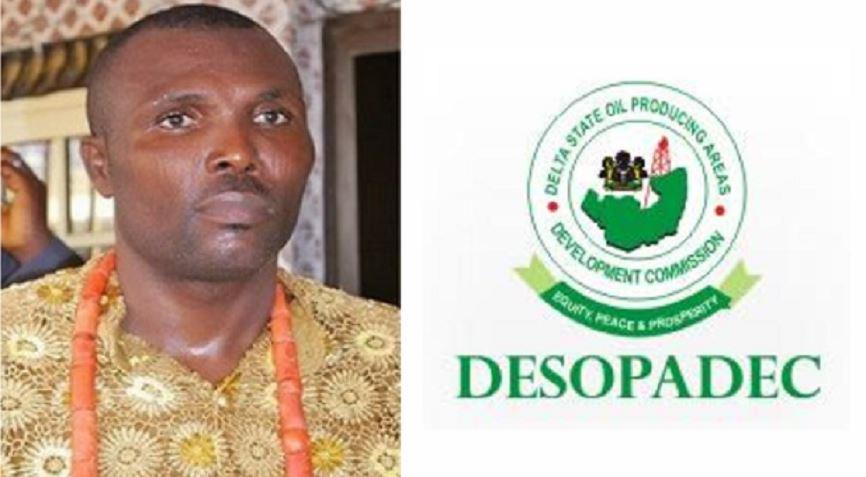
Group Seeks Removal of Ejele as DESOPADEC Chairman

Published

on

A Delta State High Court sitting in Warri, has been asked to nullify the appointment of Mr Michael Diden, popularly known as Ejele, by Governor Ifeanyi Okowa as Chairman, Board of the State Oil Producing Areas Development Commission (DESOPADEC).

An anti-corruption group known Centre for Human Rights and Anti-Corruption Crusade (CHURAC), in a case with suit No. W/154/2019, argued that the appointment of Ejele as DESOPADEC chairman negates the provision of the act establishing the interventionist agency.

The group emphasised it based its argument on the fact that the former chairman of the board, Mr Godwin Ebosa, hails from the same ethnic nationality (Itsekiri) with the defendant.

Joined as respondents in the suit are Governor Ifeanyi Okowa (1st defendant), Attorney General of Delta State (2nd defendant), Speaker of Delta State House of Assembly (3rd defendant) and DESOPADEC chairman, Hon. Michael Diden (4th defendant).

In a statement issued by a member, Board of Trustee/Publicity Secretary of the group, Mr Oyinkedi Fuofegha, the case has been slated for hearing on August 19, 2019 at the State High Court in Warri.

It maintained that Mr Okowa, by virtue of the provisions of Section 7(1) a, b & c and (2)a & b of the DESOPADEC Law, 2015 (as amended in 2019), cannot validly appoint the Ejele (4th Defendant) as chairman of the commission when the Governor had previously appointed the former chairman from the Itsekiri ethnic nationality.

The suit filed on behalf of the claimant by J.P Oromoni is seeking the declaration of the court to compel Governor Okowa (1st defendant) to withdraw the appointment of the Ejele (4th defendant) as he is not qualified to be appointed as board chairman pending the determination of the substantive suit.

According to it, “That by virtue of the provisions of Section 15(1), (2) a & b and (3) of the Delta State Oil Producing Areas Development Commission Law, 2015 (as amended in 2019) the 1st Defendant cannot nominate for appointment any person as a member of the Governing Board of Delta State Oil Producing Areas Development Commission (DESOPADEC) whose ethnic nationality produced the immediate past Board Member of the same office.

“Appointing the 4th Defendant as Chairman from Itsekiri Ethnic Nationality into the governing board of the Delta State Oil Producing Areas Development Commission having earlier appointed one Godwin Ebosa as Chairman in the Governing Board of the Delta State Oil Producing Areas Development Commission (DESOPADEC) from the same Itsekiri ethnic nationality in 2015 is an aberration.”

The group further prayed the court that by virtue of Sections 2, 7(1) a, b & c and (2) and Section 15(1), (2) a & b and (3) of the Delta State Oil Producing Areas Development Commission Law, 2015 (as amended in 2019) no Ethnic Nationality who has produced or is producing either the Chairman, the Managing Director or the Executive Directors can succeed itself without following the rotational circle as provided in the Law.

While also urging the court to compel the defendants to put up an appearance within 30 days after service of this summons on them, inclusive of the day of such service cause an appearance to be entered for them and file any other process in response to this summons which is issued upon the application of the Originating Summons of the Claimant.

Ejele was sworn in as chairman of DESOPADEC board alongside 16 others on July 31 by Governor Okowa in Asaba, the state capital.


Dipo Olowookere is a journalist based in Nigeria that has passion for reporting business news stories. At his leisure time, he watches football and supports 3SC of Ibadan. Mr Olowookere can be reached via [email protected]

Click to comment

Leave a Reply

Your email address will not be published. Required fields are marked *

General

Yellow Card Raises $40m to Expand Stablecoin Payment Infrastructure

Published

on

yellow card trade digital assets

By Adedapo Adesanya

Yellow Card, a global stablecoin infrastructure provider, has raised $40 million in a strategic funding round to accelerate its international expansion and strengthen its digital payment infrastructure.

The funding round attracted investments from SC Ventures, the innovation and investment arm of Standard Chartered, Sony Innovation Fund, Polychain Capital, Blockchain Capital, and other strategic investors. With the latest raise, Yellow Card’s total equity financing has now exceeded $120 million.

The company said the fresh capital will be used to scale its Global US Dollar Accounts, an end-to-end dollar account designed for businesses, while expanding the stablecoin payment rails that connect businesses to markets around the world.

Yellow Card’s chief executive, Mr Chris Maurice, described the investment as a strong endorsement of the company’s long-term vision, noting that the company has spent years building infrastructure that allows businesses to move money globally without relying on traditional correspondent banking systems.

He added that the next phase of growth will focus on helping banks connect directly to stablecoin payment rails, enabling faster and more efficient cross-border transactions while expanding access to US Dollar services for businesses.

SC Ventures chief executive, Mr Alex Manson, said stablecoins are becoming an important part of global payments, but noted that widespread adoption will depend on reliable infrastructure and practical use cases.

He said Yellow Card has built the payment rails businesses across Africa need to move money efficiently across borders and expressed confidence in the company’s ability to expand both within Africa and internationally.

The investment also marks growing interest from global institutions in stablecoin-based payments. Sony Innovation Fund said its backing reflects confidence in Yellow Card’s ability to build digital payment infrastructure for emerging markets.

Mr Austin Noronha, Managing Director at Sony Ventures-US, said the company believes Yellow Card is creating the technology needed to help banks, financial technology firms and enterprises move money faster and more securely.

He added that the company looks forward to supporting Yellow Card as it expands beyond Africa into Latin America, the Middle East, Europe and the Asia-Pacific region.

Yellow Card said the funding will also support the wider rollout of its Global USD Accounts, which allow businesses to hold U.S. dollars, manage treasury operations, swap stablecoins, and collect or make payments in local currencies across more than 50 countries.

The company noted that the platform is already being used by major customers, including Visa and Western Union.

Founded to simplify cross-border payments through digital assets, Yellow Card has processed more than $10 billion in transactions across its network. The company supports over 50 currencies and holds licences, authorisations and registrations in 22 jurisdictions across North America, Europe and Africa.

Yellow Card has also established strategic partnerships with global payment companies including Visa, Mastercard, PayPal and Coinbase as it positions itself as a key infrastructure provider for international digital payments.

Continue Reading

General

NEC Approves $4.5bn Refinancing of NNPC Oil-Backed Loan

Published

on

bayo ojulari nnpc

By Adedapo Adesanya

The National Economic Council (NEC) has approved a $4.5 billion arrangement for the Nigerian National Petroleum Company (NNPC) Limited aimed at strengthening the country’s external reserves and freeing up funds for infrastructure.

This is part of the refinancing of the $3.3 billion Project Gazelle Pre-Export Finance Facility through a new $4.5 billion facility named “Project Gazelle 2”.

The approval allows NNPC Limited to refinance the outstanding balance of approximately $1.5 billion under the original 2023 facility, while unlocking an additional $3 billion in liquidity to strengthen the country’s external reserves and support ongoing fiscal and infrastructure priorities of the government.

NEC’s approval followed a presentation by the Minister of Finance, Mr Taiwo Oyedele, which was presented by the Chairman of the Council, Vice President Kashim Shettima, underscoring the importance of the project.

NEC observed the significance of unlocking additional liquidity to the federation, among other benefits, pledging its support for the actualisation of the initiative.

The Finance Minister explained that the refinancing has been structured on more favourable terms than the original facility, including a reduction in the volume of pledged crude oil from 90,000 barrels of oil per day to approximately 78,750 barrels of oil per day – a 12.5 per cent reduction.

He noted that under the new arrangement, an additional 11,250 barrels of oil per day for the federation will be released, while there will be a reduction in the pledged crude volumes by the state oil company.

Mr Oyedele added that while accessing additional liquidity on improved terms, the arrangement is freeing up resources for strategic national priorities while strengthening the country’s financing structures.

“The arrangement is freeing up resources for strategic national priorities while strengthening the country’s financing structures,” he said.

VP Shettima called for a responsive, scalable, and data-driven social protection policy to tackle multidimensional poverty in Nigeria.

According to Mr Shettima, government policies are often heard before they are seen, speak through the price of food, condition of hospitals, records in schools, strain on families, the confidence of those who invest their labour in the nation’s future, and, very importantly, the ambitions of state governments.

He implored members of Council to ensure that every decision they make assure the citizens “that their government is paying attention to the pulse of the nation and is resolved to respond with competence, compassion and purpose.”

Continue Reading

General

FG Seeks Public Input on National Policing Bill

Published

on

state police bill

By Modupe Gbadeyanka

Members of the public have been invited to submit memoranda and policy proposals on the proposed National Policing Bill.

The Chairman of the Working Group, Mr Femi Gbajabiamila, announced this on Monday after the team’s meeting at the State House in Abuja.

The group, headed by the Chief of Staff to President Bola Tinubu, is calling for input from Nigerians as part of efforts to establish a comprehensive legal and operational framework for state policing.

It is reviewing the Police Act 2020, the Police Service Commission framework, police regulations, and other relevant laws to support the development of an effective, modern policing system.

The proposed framework will set national minimum standards, define state readiness and grant certification, clarify jurisdictional responsibilities, ensure independent oversight, uphold human rights, and guarantee sustainable funding. It would also spell out an orderly transition to a dual-policing structure.

The call for memoranda will run for two weeks, allowing citizens, professionals, civil society, security agencies, state and local governments, academics, and other stakeholders to contribute. Submissions will be reviewed and integrated into the draft bill, which will then be subject to further national consultation before being finalised and sent to the National Assembly.

The Working Group has adopted a seven-week work programme running from July 27 to September 14, 2026. The draft Executive Bill is scheduled for presentation to President Bola Ahmed Tinubu on September 3, 2026, with national consultations to follow before the final approval.

The new National Policing Bill will set out requirements for recruitment, training, oversight, funding, and transition arrangements to ensure credible, effective, and accountable policing nationwide.

“A proposed State Police Service must demonstrate that it has credible arrangements for recruitment, vetting, training, pay, pensions, equipment, custody, complaints, discipline, data, firearms control, independent oversight and financial sustainability before it begins policing,” Mr Gbajabiamila said.

The representative of the Nigeria Governors’ Forum and Governor of Ogun State, Dapo Abiodun, who described State Police as a landmark reform, described the initiative as one of the defining reforms of President Tinubu’s administration.

Responding to concerns about federal overreach, he clarified that there is no Federal attempt to control State Police. He added that the proposed legislation is intended to provide an operational framework rather than centralise control.

Prince Lateef Fagbemi, the Attorney-General of the Federation and Minister of Justice, said the proposed National Policing Bill is designed to guarantee the security of lives and property while ensuring that the establishment of state police does not become a tool for political persecution.

The Attorney-General added that states not immediately ready to establish their own police services would continue to benefit from the presence of the Federal Police until they meet the required standards.

Other participants at the meeting included the Inspector General of Police, Tunji Disu; President of the Nigerian Bar Association, Afam Osigwe; Chairman, Policy Advisory Committee, Justice Abdullahi Liman (rtd); Professor Olu Ogunsakin, Head, Nigeria Police Reform Secretariat; Senior Special Assistant to the President on Planning and Research, Nnadubem Moghalu; and Brigadier General Olutayo Muyiwa Adesuyi, representing the National Security Adviser.

Continue Reading