

Feature/OPED
The Generator Republic: Nigeria’s Most Expensive National Shame

By Sani Abdulrazak, PhD
There is something almost Kafkaesque about Nigeria’s electricity story, 66 years after independence, yet the country is still unable to provide stable, uninterrupted electricity to its citizens. All the ingredients of power generation are abundantly there: a country that proudly stands as the sixth largest producer of crude oil in the world, the world’s largest producer of cassava and the most populous black country in the world. It begs the uncomfortable, pesky question: are we cursed that we may never light up the country? If Nigeria has electricity as the government claims, why are Nigerians still in the dark? Truth is, most average Nigerians today are almost completely giving up on the government to provide stable electricity, and the same government somehow is surprisingly reaffirming that by its actions.
After claims of billions of dollars in investments in the sector by the APC-led administration over the past decade, the “banding” of Nigerians into colonies of preference, forcing them to pay through their noses. Add that to the institutionalised extortion called estimated billing, all under the guise of privatisation of the sector, and the question still remains: where is the power? After all, we as Nigerians are expected to celebrate megawatts as though they were trophies, use our hard-earned resources, after paying electricity bills, to fix our feebly old transformers and jubilate over it. It is also expected of us to roll out the drums over news of commissioning power plants, and still return home to the familiar cough of the generator.
Nigeria has recently recorded electricity generation and transmission above 5,000 megawatts, with available generation reaching 5,403.3MW. Yet the government has acknowledged that the improvement has not translated into dependable electricity for many Nigerians. The Nigerian Electricity Regulatory Commission also reported that an average of 4,758 MW was available for dispatch in August, of which about 4,102MW was utilised. And therein lies our peculiar paradox. We have electricity. But we do not have enough reliable electricity.
The answer is not as simple as blaming generation. Electricity generation and distribution involve a complex change of processes, with the required infrastructure operating at optimum. It is not a sack of rice that can be produced, counted and carried home. Between the power plant and the socket in a Nigerian home lies a whole procession of infrastructure, regulation, transmission, distribution, maintenance, finance and governance.
A megawatt trapped somewhere along that chain is of little consolation to the mother whose refrigerator has gone warm, the barber whose clippers are silent, the laboratory whose equipment cannot remain powered, or the small manufacturer whose production line waits for “NEPA” like a supplicant before a reluctant monarch.
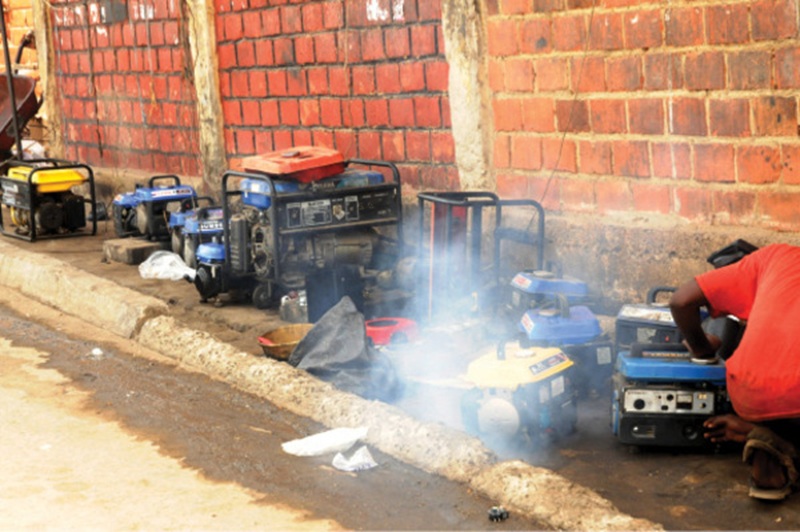
Today, a businessman does not calculate the cost of producing a loaf of bread. He calculates diesel. The tailor calculates fuel. The hairdresser calculates fuel. The laboratory scientist calculates fuel. The hospital administrator calculates fuel. The household calculates fuel. Even the small child doing homework has learnt that the arrival of darkness may also announce the arrival of the generator. The generator has become Nigeria’s unofficial power station. That should disturb us. Not because of what it costs our pockets, but because of what it costs our lungs.
As an environmental chemist, I find this part of the national conversation particularly disquieting. The generator is often treated as an innocent mechanical saviour, a little metallic deus ex machina that rescues Nigerians whenever the grid abandons them. But combustion knows no political party. Carbon monoxide and fine particulate matter do not know whether the generator belongs to a poor family or a wealthy business. The fumes from petrol and diesel generators enter the same atmosphere in which we breathe.
Research on generator use in Nigeria has documented emissions including carbon monoxide, carbon dioxide and fine particulate matter. The World Bank has also noted that diesel generator emissions include fine particulate matter and black carbon, with implications for respiratory and cardiopulmonary health, climate change and urban air quality.
This is the hidden invoice of unreliable electricity. We pay for power twice: first, the electricity bill; then we buy petrol or diesel to manufacture the electricity that the grid failed to deliver. And then, without seeing the figure on any receipt, we pay again through noise, fumes, heat, maintenance, lost productivity and environmental degradation. This is an olla podrida of economic absurdity Nigerians do not deserve. The Nigerian generator has therefore become more than an appliance. It is a symptom. It tells the story of a country that has gradually privatised the burden of public infrastructure. The citizen becomes his own electricity provider, his own fuel purchaser, his own maintenance officer and, occasionally, his own electrician. The state provides the grid; the citizen provides the contingency plan. There is something profoundly inequitable about that arrangement.
The wealthy may install solar systems, inverters and batteries. The middle class may operate a small generator beside an inverter. The poor may simply endure the darkness, or spend a disproportionate part of their income purchasing electricity in small, expensive increments. Thus, unreliable power does not inconvenience Nigerians. It stratifies them.
The World Bank’s current energy plans recognise the scale of the challenge. Nigeria has committed to achieving universal electricity access by 2030 and is pursuing distributed renewable energy, including mini grids and standalone solar systems, as part of that effort. The DARES programme alone is designed to extend clean energy access to more than 17.5 million Nigerians and replace hundreds of thousands of polluting petrol and diesel generators. Well, that is encouraging, but encouragement is not electricity. Nigeria needs to move beyond the psychology of the megawatt announcement and towards the reality of electricity delivered consistently to homes, hospitals, schools, laboratories, farms, workshops and factories.
The government should ask: How many homes received reliable electricity? How many businesses remained productive without switching to diesel? How many clinics operated without interruption? How many students studied without generator fumes? How many factories reduced their dependence on self-generation? How much particulate pollution did we avoid? These are the metrics that turn electricity from an engineering statistic into a human development instrument. The country does not need another ceremonial relationship with power. It needs a functional one.
We must also resist the temptation to imagine that the national grid alone will solve every problem. Nigeria’s geography, population growth and uneven infrastructure make distributed energy an important part of the equation. Solar mini-grids, battery storage, embedded generation and other decentralised solutions can help close the distance between the electricity system and the citizen. But even here, we must shun shilly shallying. Energy transition cannot become another magnificent phrase imprisoned in a government document.
There is an African proverb that says when the music changes, the dance must change with it. Nigeria’s energy music has changed. Population has grown. Cities have expanded. Digital businesses have multiplied. Climate pressures have intensified. The cost of diesel and petrol has altered the economics of self-generation. Yet our electricity conversation sometimes still sounds as though Nigeria were a country of a few million people waiting patiently beside a single national grid. We are no longer that country; we are now a young, restless and increasingly urban nation. Our electricity demand will not wait politely for infrastructure to catch up.
The generator, meanwhile, will continue to cough beside the roadside shop, behind the hospital, outside the restaurant and beneath the window of the child trying to read. And each cough is a small reminder that the price of unreliable electricity is not measured only in naira, but also in poisoned air, wasted hours, lost businesses, damaged equipment, interrupted education and opportunities that disappear quietly into the night.
The government says Nigeria has electricity, but the more pertinent question is whether Nigeria has built an electricity system capable of turning that electricity into prosperity. Until the answer is yes, the generator will remain our most faithful witness to the distance between what the nation produces and what the Nigerian actually receives, and that distance, more than any megawatt figure, is where the real darkness lies.
Dr Sani Abdulrazak, PhD, is an Analytical Chemist, Writer and Public Commentator based in Zaria. He writes on governance, public affairs, society and the environment


