Connect with us

General

Fashola Seeks More Effort for Economic Growth

Published

on

By Adedapo Adesanya

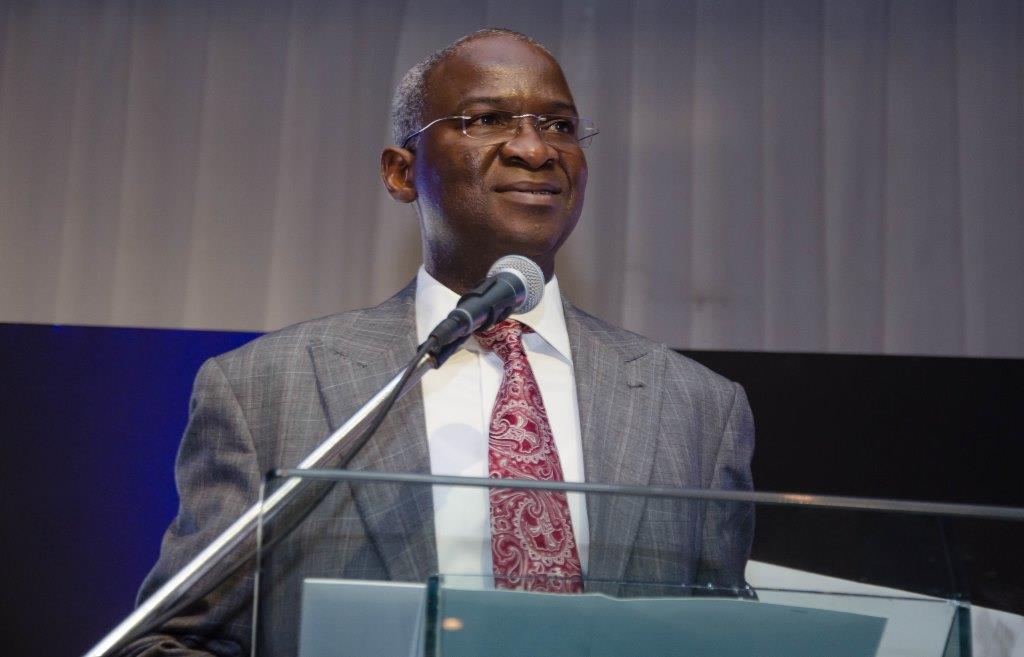
Minister of Works and Housing, Mr Babatunde Raji Fashola (SAN), has called for the need to increase the output in the ministry in order to achieve the mandate of the Federal Government for economic growth and development as well as job creation in the country expressing his resolve to provide the needed leadership.

This was made known in a statement released by the Special Adviser, Communications to the Minister, Mr Hakeem Bello, noting that the need to achieve the mandate aligned with the clear mandate of President Muhammadu Buhari who in his speech, while swearing in the ministers on Wednesday, wanted the Ministers to further grow and stabilize the nation’s economy.

Speaking to the senior management staff of the Ministry at the Conference Room in Mabushi soon after the inauguration at the State House, Mr Fashola expressed joy that the staff had remained faithful to some of the works left behind by his team during the last administration but warned that there was still work to be done.

The minister who was the immediate past Minister for Power, Works, and Housing said, “I am happy to see that some of the works we left you have remained faithful and that is in spirit of continuity and development which is what the nation needs”

He added, “There is still a lot of work ahead of us in spite of what we have done before and I offer myself ready and willing to do my part by providing leadership and I trust that all of you are ready as well.”

According to the Minister, the President was clear about the need to sustain the growth already experienced in the economy adding, “The economy has grown from recession and out of recession it has grown for consecutive eight quarters. But we need to double that growth and even multiply it, but that will depend on how we work this time. The central purpose is to create prosperity and to create jobs and I think this is possible.”

Mr Fashola declared that the ministry would be working on a budget in the next two weeks and called upon all the departments of the ministry to produce a budget worthy of note.

“One of the first things we have to do is quickly work out the budget for the Ministry of Works and Housing and we have to do that in the next two weeks”, the Minister was quoted.

Mr Fashola then pointed out that the leadership of the National Assembly has expressed commitment to conduct all the budget defenses in the month of October, calling for all leaves, travels, and other less compelling engagements to be put aside to make room for the budget preparation.

He then used the meeting to welcome the new minister of State, Works and Housing, Engineer Aliyu Abubakar and expressed joy with working with him again following the fact that both as served as governors of their states (Lagos and Yobe) and during the formative years of the All Progressives Congress (APC).

The Minister noted that Engineer Abubakar would be bringing a lot of experience that would be beneficial to the ministry due to his civil engineering background.

The inaugural meeting with the management staff of the Ministry was attended by the Permanent Secretary Works, Directors, heads of departments and agencies of the Ministry as well as Special Advisers and other top government functionaries.


Adedapo Adesanya is a journalist, polymath, and connoisseur of everything art. When he is not writing, he has his nose buried in one of the many books or articles he has bookmarked or simply listening to good music with a bottle of beer or wine. He supports the greatest club in the world, Manchester United F.C.

Click to comment

Leave a Reply

Your email address will not be published. Required fields are marked *

General

We Prioritised Personal Pension Plan, Others for Robust Pension System— PenCom

Published

on

Personal Pension Plan PenCom DG

By Modupe Gbadeyanka

The Director General of the National Pension Commission (PenCom), Ms Omolola Oloworaran, has highlighted strategies deployed by her organisation to ensure pension coverage is deepened in Nigeria.

Speaking at the ISSA Technical Seminar in Abuja recently, she said the steps taken were to build a more inclusive, transparent, and responsive pension system, where communication serves not just as information, but as a bridge to trust, accessibility, and sustained industry growth.

According to her, the Contributory Pension Scheme (CPS) has, over more than two decades, built a strong institutional foundation, but true inclusion goes beyond coverage to require trust and clear communication.

For this reason, PenCom has prioritised the Personal Pension Plan, strengthened stakeholder engagement, and invested in digital channels that reach contributors in accessible and relatable ways, she stated.

Ms Oloworaran further stressed that, “Effective communication is not a soft complement to regulation; it is a core instrument of coverage expansion, compliance, and public confidence.

“Every circular we issue, every benefit we pay, and every reform we introduce ultimately succeeds or fails on whether our members can understand it and act on it.”

The ISSA Technical Seminar, themed Improving Inclusivity and Accessibility of Social Security Services Through Effective Communication, was organised in collaboration with the International Social Security Association (ISSA).

It brought together key stakeholders across West Africa to advance dialogue on strengthening social security systems through clearer, more inclusive engagement.

Continue Reading

General

Nnaji Expresses Worry Over Lack of Power Plant Financing

Published

on

Gas Power Plant

By Adedapo Adesanya

Former Minister of Power, Mr Barth Nnaji, has run to the rooftop to declare that Nigeria has not secured financing for any major power plant in more than a decade, blaming policy reversals and weak government commitment for the prolonged investment drought.

Speaking at the Nigerian Association for Energy Economics conference in Lagos, Mr Nnaji said the country’s power sector lost momentum after a promising financing framework introduced under his watch was abandoned following a change in administration.

According to him, the partial risk guarantee instrument developed jointly with former Finance Minister, Mrs Ngozi Okonjo-Iweala, had begun attracting international investors by reducing the risks associated with power projects in Nigeria.

“The world was galloping to us to finance power plants because we were getting a service guarantee,” he said, noting that the framework helped secure funding for the Azura-Edo Power Station, one of Nigeria’s most significant independent power projects.

However, he said the policy was scrapped after the administration changed, abruptly halting investor interest.

“Till today, we have not financed any new major power plant in Nigeria. That’s about 11 years ago,” he said.

Mr Nnaji argued that policy inconsistency remains one of the biggest obstacles to power sector growth, without clear, stable and bankable policies.

He said Nigeria will continue to struggle to attract the long-term capital required for large-scale electricity projects.

He also urged Nigeria to adopt a pragmatic approach to energy transition, stressing that natural gas should remain the backbone of the country’s power strategy. With more than 210 trillion cubic feet of proven gas reserves, he said Nigeria is well-positioned to use gas as a bridge fuel for industrialisation and economic growth over the next two decades.

Yet, despite these vast reserves, inadequate infrastructure continues to constrain supply.

Mr Nnaji noted that the Nigeria LNG Limited is operating at only about 60 per cent of capacity due to insufficient gas availability, highlighting the urgent need for greater investment in gas production, processing and transportation.

He also cited the long-delayed Mambilla Hydroelectric Power Station as a symbol of Nigeria’s execution failures. Although technically viable, the project has remained on the drawing board for more than 40 years because of weak political will and inconsistent implementation.

He noted that Nigeria’s power challenge is not a lack of resources but a failure of execution. With an installed generation capacity of about 13,000 megawatts, the country still produces only 4,000 to 5,000 megawatts on average. Until policy becomes consistent and infrastructure investment accelerates, reliable electricity will remain frustratingly out of reach for millions of Nigerians.

Continue Reading

General

Terra Industries Unveils Defence Drones, Robots to Support Nigerian Military

Published

on

Terra Industries

By Adedapo Adesanya

Nigeria-backed startup Terra Industries has launched drones and mine-clearing robots for the country’s military use to fight Islamic militants and reduce reliance on imported defence equipment.

The startup on Monday unveiled interceptor drones, mine-clearing unmanned vehicles and battlefield intelligence software that officials said could help troops confronting insurgents who have increasingly used roadside bombs and drones in recent attacks.

The launch shows a growing effort by Nigeria to reduce dependence on imported military hardware and build domestic defence manufacturing capacity, after years of buying aircraft, armoured vehicles and surveillance systems from countries including China, Turkey, Pakistan and the United States.

However, procurement delays, maintenance bottlenecks and rising foreign exchange costs have strengthened the case for local production, with Terra Industries among the first of such beneficiaries.

Terra Industries had previously focused on civilian drones and security technology before expanding into defence systems. In February, it signed a pact with Defence Industries Corporation of Nigeria (DICON) as part of efforts to boost the country’s defence industrial capacity and advance indigenous high-technology development.

“We are unveiling new defence systems such as our interceptor UAVs, our minesweepers, ground vehicles that can detect IEDs on the ground, and our battlefield intelligence software,” according to Mr Nathan Nwachukwu, the chief executive officer of the firm.

The need for security has risen in recent years, as groups such as Islamic State and al-Qaeda are gaining ground in Africa, converging along a swathe of territory that stretches from Mali to Nigeria, which is also battling with Boko Haram and other cells which remain active despite repeated military offensives.

Militants have stepped up ​attacks against army positions using improvised explosive devices (IEDs) and drones, forcing armies to invest in counter-drone systems, electronic warfare and autonomous ground equipment.

Major General Babatunde Alaya, head of the state-owned DICON, said collaboration with Terra Industries was necessary, given troop casualties caused by hidden explosives and roadside bombs.

DICON has long been central to Nigeria’s ambition to produce more of its own defence equipment, but progress has historically been slow. Partnerships with private firms are increasingly seen as a faster route to innovation and scale.

Terra Industries, which is valued at $100 million, has also announced plans to expand beyond Nigeria, including a manufacturing facility in Ghana, signalling ambitions to serve a wider African market and position itself in the region’s growing security technology industry.

Continue Reading

Trending