Connect with us

Economy

Asian Shares Appreciate Amidst Weak Economic Data

Published

on

By Investors Hub

Asian stocks ended mostly higher on Monday as weak economic data from the U.S. and China raised hopes of further stimulus from global central banks.

Data released Friday showed weaker than expected U.S. jobs growth in the month of August, while data from China showed that the country’s exports unexpectedly fell during the month.

Buoying market confidence were expectations that the European Central Bank would also cut interest rates on Thursday to boost growth.

Chinese stocks advanced as the country’s central bank pumped 120 billion yuan (about $16.94 billion) into the financial system to shore up the flagging economy.

The benchmark Shanghai Composite Index gained 25.14 points, or 0.8 percent, to close at 3,024.74, although Hong Kong’s Hang Seng Index ended marginally lower at 26,681.40.

Investors shrugged off official data showing that Chinese exports unexpectedly decreased in August amid the ongoing trade dispute with the U.S. administration.

In dollar terms, exports decreased 1 percent on a yearly basis in August, confounding expectations for an increase of 2.1 percent. At the same time, imports declined 5.6 percent, slower than the expected fall of 6.3 percent.

As a result, the trade balance showed a surplus of $34.8 billion in August versus the $42.8 billion surplus forecast by economists.

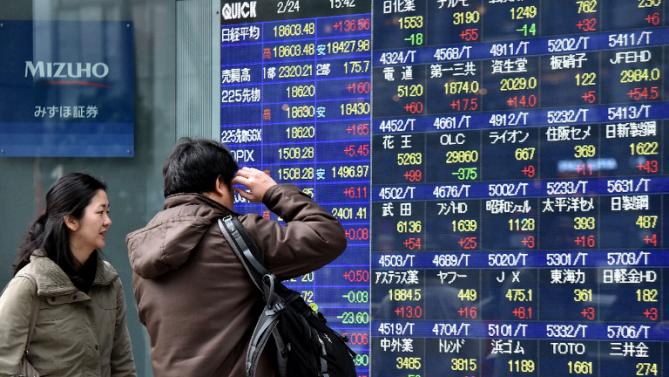
Japanese shares hit a 5-1/2-week high on hopes that central banks in some of the world’s largest economies would deploy new monetary stimulus to stave off a brewing global recession.

The Nikkei 225 Index rose 118.85 points, or 0.6 percent, to 21,318.42, its highest closing level since August 2, while the broader Topix Index closed 0.9 percent higher at 1,551.11.

Nissan Motor shares edged down slightly on a Nikkei report that Nissan CEO Hiroto Saikawa has expressed his intention to step down.

On the economic front, the Ministry of Finance said that Japan had a current account surplus of 1,999.9 billion yen in July, down 1.3 percent from last year. That was shy of expectations for a surplus of 2,046 billion yen and up from 1,211.2 billion yen in June.

The trade balance showed a deficit of 74.5 billion yen, shy of expectations for a deficit of 24.0 billion yen and down from the 759.3-billion-yen surplus in the previous month.

Japan’s economy grew an annualized 1.3 percent in the April-June quarter, weaker than the preliminary reading for 1.8 percent annualized growth on the back of softer capital spending, Cabinet Office data showed.

Australian markets fluctuated before ending roughly flat. Both the benchmark S&P/ASX 200 Index and the broader All Ordinaries Index closed marginally higher at 6,648 and 6,760.10, respectively.

The big four banks rose between 0.3 percent and 1 percent on expectations of further policy easing by the U.S. Federal Reserve and the European Central Bank. Investors are also betting that Australia’s central bank will cut interest rates more steeply than previously thought.

Mining and energy stocks ended on a subdued note as investors digested new data out of China showing that exports unexpectedly fell in August with a large contraction for shipments to the United States. Gold miners Evolution and Newcrest Mining dropped 2-3 percent as gold prices fell on improved risk appetite.

Australia’s mortgage approvals increased more-than-expected in July, figures from the Australian Bureau of Statistics showed today. The number of owner occupier loans increased 4.2 percent, much larger than the expected growth of 1.5 percent.

Seoul stocks extended gains for the fourth straight session on hopes the European Central Bank will announce new stimulus measures during its meeting slated for Thursday. Traders also remained optimistic about the upcoming U.S.-China trade talks.

The benchmark Kospi climbed 10.42 points, or 0.5 percent, to finish at 2,019.55. Market heavyweight Samsung Electronics rose 1.3 percent, while chipmaker SK Hynix rallied 2.9 percent.

Meanwhile, logistics firm Hyundai Glovis declined 1.6 percent on reports its ship accidentally tilted sideways off the east coast of the United States.


Modupe Gbadeyanka is a fast-rising journalist with Business Post Nigeria. Her passion for journalism is amazing. She is willing to learn more with a view to becoming one of the best pen-pushers in Nigeria. Her role models are the duo of CNN's Richard Quest and Christiane Amanpour.

Advertisement
Click to comment

Leave a Reply

Your email address will not be published. Required fields are marked *

Economy

Nigeria to Export New Crude Grade Cawthorne in March

Published

on

Cawthorne crude oil

By Adedapo Adesanya

The Nigerian National Petroleum Company (NNPC) Limited is set to commence export of a new light, sweet crude grade known as Cawthorne from March 2026.

According to a report by Reuters, an NNPC spokesperson confirmed the development, describing it as part of efforts to increase output and consolidate Nigeria’s recent recovery in crude oil production.

The move aligns with Nigeria’s broader strategy to boost production after years of constraints caused by pipeline vandalism, crude theft, and unrest in oil-producing regions.

This follows the launch of two other new grades, Obodo in 2025 and Utapate in 2024, Nigeria, whic,h as Africa’s top oil exporter, seeks to strengthen its standing within the Organisation of the Petroleum Exporting Countries and its allies (OPEC+)

Cawthorne crude is scheduled for export in the third week of March and has an API gravity of 36.4, making it similar in quality to Nigeria’s Bonny Light, which is prized for high petrol and diesel yields.

According to Reuters, citing a trading source, the state oil national company issued a tender last week for cargo loading between March 24 and 25.

Analysts at Kpler noted that the new grade is expected to be exported via the Floating Storage and Offloading (FSO) vessel Cawthorne, which has a storage capacity of about 2.2 million barrels. The vessel is designed to enhance transportation and production from Oil Mining Lease (OML) 18 and nearby assets in the Eastern Niger Delta.

Kpler estimates that, based on storage capacity, Cawthorne could increase Nigeria’s crude and condensate output from roughly 1.65 million barrels per day to around 1.7 million barrels per day for the remainder of the year.

Nigeria’s crude oil production recently dropped from the OPEC+ quota of 1.5 million barrels per day, with output at 1.48 million barrels per day recorded in January, according to OPEC data.

Beyond increasing Nigeria’s crude offerings to the international market, the introduction of Cawthorne could also attract buyers seeking specific light, sweet crude qualities, buoy foreign exchange earnings, which would help strengthen government revenue and ease borrowing needs.

New crude grades are typically differentiated by sulfur content, API gravity, and production source, enabling producers to target specific refinery configurations and market segments.

In November 2024, NNPC officially launched the Utapate crude oil blend in the international market, describing it as a milestone for Nigeria’s export profile.

Earlier in July 2024, NNPC and its partner, Sterling Oil Exploration & Energy Production Company (SEEPCO), lifted the first 950,000-barrel cargo of Utapate crude, which was shipped to Spain.

Continue Reading

Economy

Moniepoint Research Shows Diminishing Role of Cash in Nightlife Payments

Published

on

Moniepoint DreamDevs Initiative

By Modupe Gbadeyanka

A new report released by Africa’s leading all-in-one financial ecosystem, Moniepoint Incorporated, has revealed that the use of cash for financial transactions is gradually dying due to security concerns.

The study, which looked into transaction data of over 27,000 clubs, bars, and lounges, showed that bank transfers dominated, followed closely by card payments, with cash actively discouraged. It was observed that transfers outpace card payments by nearly 2 million transactions during peak nighttime hours across its network.

In the research titled The Business of Community Nightlife in Nigeria, findings provided a rare, data-driven look into the country’s informal night economy.

While high-end Detty December venues grabbed headlines with daily revenues of N360 million and table prices reaching N1.2 million, Moniepoint’s study shifted the spotlight to the “community nightlife” where roadside bars, suya spots, and neighbourhood joints form the bedrock of social life for millions of Nigerians.

One of the study’s most operationally significant findings concerns the timing of spending. Nightlife in Nigeria runs late, but economically, the night is decided early.

Transaction volumes begin climbing sharply from 8 pm, peak before midnight, and then decline steadily even as venues remain full. By the time the night is at its longest, purchasing activity has already wound down.

However, for bar operators, this has clear practical implications – the most critical hours for staffing, stocking, vendor payment and cash flow management are the earliest hours of the day between midnight and 6 am.

The report further underscores the sector’s role in employment, noting that local bars typically expand their workforce by 30-50 per cent on peak nights. Conservative estimates suggest that at least 54,000 people are engaged in nightlife labour every night across Nigeria.

It was also observed that the most common transaction narrations from the data sourced – “food”, “pay”, “sent”, “pos”, “cash” – reflect the full breadth of nightlife spending: street food, club entry, lounge tabs, transport, and afterparties. Digital payments have gained huge traction in Nigeria’s social space.

While alcohol remains a key revenue driver, the data shows that food is the quiet stabiliser of Nigeria’s night economy, particularly in local and informal settings. In several neighbourhood venues, bottled water and meals outsell beer and spirits, especially early in the evening.

Lagos leads in sheer concentration of nightlife establishments, with 4,856 bars, clubs, and lounges on the Moniepoint network. FCT follows with 2,515, then Rivers (2,362), Delta (1,930), and Edo (1,574).

Katsina leads the country in nighttime food truck payment value, with vendors pulling in over N130 million in the last 12 months. Kwara State leads in transaction count. Nigeria’s nightlife economy is distributed, not overly elitist.

On the lending side, the report noted that a significant share of loan requests from bar and lounge operators is directed toward renovations, furniture, lighting, and sound systems, showing that investments are intended to attract and retain customers in a competitive sector where ambience plays a decisive role.

Commenting on the report, the chief executive of Moniepoint, Mr Tosin Eniolorunda, said, “Nigeria’s local bars and night-time operators are not peripheral to the economy; they are a critical part of its architecture. We see a substantial and sustained economic sector that employs hundreds of thousands of Nigerians every night and deserves the same attention we give to agriculture, healthcare, and retail.

“Our goal is to make sure every one of those businesses has the tools to grow. From giving credit to finance renovations and sound systems to providing same-day settlement that allows vendors to restock and with tools like Moniebook that power inventory management and reconciliation, Moniepoint is ensuring that this vital artery of the nation’s economy remains viable and empowering.”

Continue Reading

Economy

CBN Reduces Interest Rate by 50 Basis Points to 26.50%

Published

on

African central banks Interest Rate Cut

By Adedapo Adesanya

The Central Bank of Nigeria (CBN) has cut the interest rate by 50 basis points to 26.50 per cent from 27 per cent.

Nigeria’s apex bank announced this during its two-day 304th Monetary Policy Committee (MPC) meeting, which concluded on Tuesday in Abuja.

This comes after the country’s interest rate cooled in January to 15.10 per cent from 15.15 per cent, according to the National Bureau of Statistics (NBS), strengthening the case for a reduction.

The CBN Governor, Mr Yemi Cardoso, said all members of the MPC unanimously agreed upon the decision.

“The committee decided to reduce the monetary policy rate by 50 basis points to 26.50 per cent,” he said.

Mr Cardoso stated that the liquidity ratio was maintained at 30 per cent, and the standing facilities corridor was adjusted to +50 to -450 basis points around the monetary policy rate.

He said the committee retained the Cash Reserve Ratio (CRR) at 45 per cent for commercial banks and 16 per cent for merchant banks, while the 75 per cent CRR on non-TSA public sector deposits was equally maintained.

The CBN uses the MPR, which works as the benchmark interest rate, to manage inflation, macroeconomic stability, and liquidity.

Last November, the MPC retained the Monetary Policy Rate (MPR) at 27.00 per cent. The last time the apex bank cut interest rates was in September last year, to 27 per cent from 27.50 per cent after a series of easing in inflation.

Market analysts had argued for higher interest cuts due to results seen in the CBN’s inflation targeting framework. Meanwhile, some say the 50 basis points reduction will offer a temporary reprieve as inflation heads for a single-digit target in the coming months.

Continue Reading

Trending