Connect with us

Economy

Asian Shares Appreciate Amid Fall in Chinese, Hong Kong Stocks

Published

on

By Investors Hub

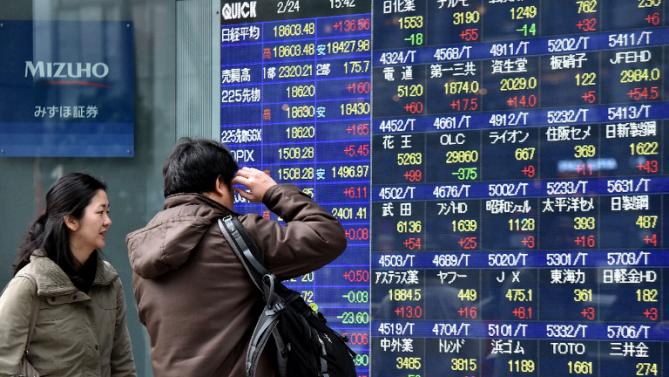
Asian stocks rose broadly on Thursday, though markets in China and Hong Kong ended in the red amid anxiety ahead of crucial meeting between President Donald Trump and Chinese President Xi Jinping on the sidelines of the G20 summit later this week.

While a substantive breakthrough is unlikely, the two sides may agree on a communiqué for a de-escalation of trade tensions.

Underlying sentiment remained supported across the region after Federal Reserve Chairman Jerome Powell said current interest rates are ?just below? neutral.

Chinese stocks fluctuated before closing sharply lower ahead of the much-anticipated meeting between the U.S. and Chinese presidents this weekend.

The benchmark Shanghai Composite Index tumbled 34.29 points or 1.3 percent to 2,567.44, while Hong Kong’s Hang Seng Index dropped 231.53 points or 0.9 percent to 26,451.03.

Japanese shares advanced despite the dollar weakening against the yen on expectations of a slowdown in the pace of rate hikes by the Fed. The Nikkei 225 Index rose 85.58 points or 0.4 percent to 22,262.60, while the broader Topix Index closed 0.4 percent higher at 1,659.47.

Consumer electronics and video game company Nintendo soared 4.1 percent after its Switch console set two new records from Thanksgiving to Cyber Monday. Nissan Motor rose 1.4 percent to snap a two-day losing streak.

In economic news, retail sales in Japan surged up a seasonally adjusted 1.2 percent in October, a government report showed. That exceeded expectations for an increase of 0.4 percent following the 0.2 percent decline in September.

Australian markets pared some gains after hitting a more than two-week high earlier in the day. The benchmark S&P/ASX 200 Index still closed up 33.30 points or 0.6 percent at 5,758.40 amid broad-based buying. The broader All Ordinaries Index climbed 35.60 points or 0.6 percent to 5,835.70.

Higher iron ore and copper prices helped lift miners. BHP Billiton gained 1.2 percent as its Spence copper mine resumed operations after a union strike. Rio Tinto advanced 1.7 percent after approving a $2.6 billion investment in its Koodaideri iron ore mine in Western Australia.

Financials followed their U.S. peers higher, with banks ANZ, Commonwealth and Westpac rising between half a percent and 0.7 percent.

On the other hand, waste management company Bingo Industries slumped 5.3 percent after the competition regulator criticized its proposed merger with rival Dial A Dump.

Energy stocks ended mixed despite oil prices falling more than 2 percent overnight. Poker machine maker Aristocrat Leisure declined 2.6 percent after reporting its full-year results.

In economic news, total new capital spending in Australia fell a seasonally adjusted 0.5 percent sequentially in the third quarter of 2018, official data showed, missing forecasts for an increase of 1.0 percent.


Dipo Olowookere is a journalist based in Nigeria that has passion for reporting business news stories. At his leisure time, he watches football and supports 3SC of Ibadan. Mr Olowookere can be reached via [email protected]

Click to comment

Leave a Reply

Your email address will not be published. Required fields are marked *

Economy

Organized Private Sector Raises Concerns Over Proposed Hike in Pension Contributions

Published

on

organised private sector of nigeria

By Modupe Gbadeyanka

The plan by the National Pension Commission (PenCom) to increase mandatory pension contributions and introduce an additional 3 per cent mandatory annual contribution equivalent to 3 per cent of the total wage bill is not going down well with the Organised Private Sector in Nigeria.

This group comprises the Manufacturers Association of Nigeria (MAN), the National Association of Chambers of Commerce, Industry, Mines and Agriculture (NACCIMA), the Nigeria Employers’ Consultative Association (NECA), the Nigerian Association of Small and Medium Enterprises (NASME), the Nigerian Association of Small Scale Industrialists (NASSI), and 25 sectoral employer associations.

In a statement made available to Business Post, the group described the proposal as a “Greek gift” to Nigerian workers because of the prevailing economic conditions in the country.

OPS argued that under the Pension Reform Act 2014, Nigeria’s minimum pension contribution already stands at 18 per cent of an employee’s monthly emoluments, comprising 10 per cent from the employer and 8 per cent from the employee.

“This is broadly comparable with the OECD average effective mandatory pension contribution rate of 18.8 per cent at the average-wage level in 2024.

“Nigeria’s existing contribution rate therefore cannot reasonably be regarded as inadequate, based on contribution percentages alone.

“Any proposal for an increase must be supported by Nigeria – specific actuarial evidence demonstrating that the current rate is insufficient and that a higher rate would not undermine employment, wages, compliance and enterprise sustainability,” it noted.

OPSN said the government’s attention should be directed toward reining in inflation, preserving workers’ immediate cash flow, and promoting business sustainability to create decent jobs and improve welfare.

It also asked for a detailed assessment to determine the likely effects of the proposal on employment costs, wage growth, recruitment, job security, investment, production costs, inflation, business formalisation and MSME sustainability.

The group stated that while the private sector is not entirely opposed to future adjustments, any increase must be the product of constructive, transparent social dialogue among all critical stakeholders and delayed until broader economic stability is achieved.

It stressed that no adjustment should be introduced without adequate consideration of its impact on existing jobs, future recruitment, inflation rate and the capacity of businesses to remain competitive and sustainable.

Also commenting on the matter in Lagos, the Director-General of NECA, Mr Adewale-Smatt Oyerinde, described the proposed hike as both premature and counterproductive, noting that, “The OPSN supports efforts aimed at strengthening Nigeria’s pension system and improving retirement outcomes for workers.

“However, announcing that contribution rates will increase while consultations are still ongoing risks prejudging the outcome of the process and reducing subsequent stakeholder engagements to a mere formality.”

He stressed that previous adjustments to pension contribution rates were preceded by extensive engagement among government, employers, organised labour and other relevant stakeholders.

“Any proposed adjustment must be supported by credible actuarial, economic and employment-impact assessments. It must also emerge from genuine and transparent social dialogue. Retirement security should not be pursued in a manner that threatens the businesses and jobs upon which the pension system itself depends,” he submitted.

On his part, the DG of MAN, Mr Segun Ajayi-Kadir, said, “Businesses are already contending with high energy costs, elevated interest rates, exchange-rate volatility, multiple regulatory obligations, weak consumer demand and rising production expenses. Imposing an additional statutory payroll cost without a comprehensive impact assessment will place further pressure on already struggling enterprises.”

He explained that higher employment costs could compel businesses to slow recruitment, postpone wage reviews, reduce staff strength, increase outsourcing, suspend expansion plans or pass additional costs to consumers through higher prices.

“The proposed increase may directly raise the existing employee contribution, but its wider consequences could still be borne by workers through weaker wage growth, reduced employment opportunities, job losses and higher prices of goods and services,” he added

The DG of NACCIMA, Mr Sola Obadimu, in his submission, warned against imposing additional financial levies on a struggling business environment, saying, “At a time when businesses are struggling to recover from prolonged economic pressures and the Federal Government is implementing reforms intended to improve competitiveness, imposing another statutory financial obligation on employers could undermine the benefits of those reforms.”

He maintained that government policies must be properly coordinated and evaluated based on their cumulative impact on businesses.

“A reform cannot be considered successful merely because it promises improved retirement benefits. Its impact on employment, investment, wage growth, prices, compliance and business survival must also be carefully considered,” he stated.

The DG of NASSI, Mr Ifeanyi Oputa, while speaking on the issue, stressed that micro, small and medium-sized enterprises would be disproportionately affected by any increase in mandatory employer pension contributions.

“MSMEs operate with narrow margins and limited access to affordable finance. Many are still struggling with rising energy costs, declining purchasing power, multiple levies and increasing operating expenses. An additional statutory burden could threaten their survival and discourage them from employing workers formally,” he said.

Mr Oputa warned that the proposal could also deepen non-compliance and push more businesses and workers into informal employment arrangements outside the pension system.

“A policy intended to strengthen the pension system must not produce the opposite result by shrinking the number of formal employers and contributors,” he added.

Continue Reading

Economy

Chevron Confirms Winning Bid for Nigeria Deepwater Oil Block

Published

on

Shut Down Chevron

By Adedapo Adesanya

Oil giant, Chevron, says it submitted the winning bid for a deepwater oil block offshore Nigeria, marking a fresh step in its efforts to strengthen its presence in the country’s offshore energy sector.

On Tuesday, the Nigerian Upstream Petroleum Regulatory Commission (NUPRC) opened commercial bids for its 2025 licensing round, with Star Deep Water Petroleum, a Chevron company and operator of the Agbami field, emerging as the top bidder for Petroleum Prospecting Licence (PPL) 2010.

“Chevron continues to evaluate high-potential exploration opportunities across our global portfolio, with Nigeria long being an important part of our business,” said Mr Kevin McLachlan, head of exploration at Chevron.

On his part, Mr Jim Swartz, chairman of Chevron companies in Nigeria and Mid-Africa, added: “Chevron remains committed to working collaboratively with the Nigerian government and our partners to support the development of Nigeria’s oil and gas industry and contribute to the country’s broader economic growth.”

The super oil major is among the 143 companies that submitted 200 bids for the oil facilities drawn from diverse terrains, including the Niger Delta Onshore, Niger Delta Shallow Water, Niger Delta Deep Offshore, Benin Basin Onshore, Anambra Basin Onshore, Chad Basin Onshore and Benue Trough.

Business Post gathered that investors, however, were only interested in 37 out of the 50 oil blocks put up for sale by the NUPRC. This is the first time in Nigeria’s energy history that frontier basins would attract such a level of investor interest.

The organisations that won the bids included SSonic Petroleum Limited (PPL 2A29), CFP Pipeline and Flowlines (2A30), Dutchford E&P Limited (2A32), Attabanson Global Company Limited (2A33 and PPL 901), Rosem Energy Limited (2A38), Pivot-GIS Limited (2A39), Network E&P (2A40), Asharami (2A41), LexOil (2A42), BVOF (2A43), GupscoEnergy Limited (2A44 and 2A51), Saratoga (2A45), Volante (2A46), Concept-Reel Petroleum Services Limited (2A47 and 2A55), Clinton Oil Field (2A48 and 2A62) and Nuway Oaklane Limited (2A49).

Others were Ramec (2A50), Italia (2A53), Blueridge E&P (2A54), Up Energies Limited (2A56), AYM Shafa (2A57), Blackrock Holdings Limited (2A58), Funtay Integrated Business Limited (2A59), Riparian Development and Production Limited (2A60), Nikstallis (2A61 and PPL 900), Stardeep Petroleum (PPL 2010), Dakoda & U Limited (PPL308 and PPL 800), Southborne Oil and Gas Limited (PPL 902), Lanaka Petroleum (PPL 903) HighbanResources Limited (PPL 700), Eyre Energy Limited (PPL 801).

Continue Reading

Economy

Okitipupa, MRS Oil, Others Crash Unlisted Securities Exchange by 1.40%

Published

on

unlisted securities exchange

By Adedapo Adesanya

The NASD Over-the-Counter (OTC) Securities Exchange was plunged into the danger zone by 1.40 per cent on Thursday, July 23, by five securities on the platform.

Leading the pack was Okitipupa Plc, which crashed by N20.20 to trade at N248.00 per share compared with the previous day’s N268.20 per share. MRS Oil Plc tumbled by N15.00 to close at N135.00 per unit versus the preceding session’s N150.00 per unit, Nipco Plc weakened by N7.00 to N415.00 per share from N422.00 per share, FrieslandCampina Wamco Nigeria Plc lost N3.92 to settle at N143.63 per unit compared with midweek’s N147.55 per unit, and Central Securities Clearing System (CSCS) Plc declined by N3.05 to quote at N95.27 per share versus N98.32 per share.

These losses contracted the value of the unlisted securities exchange by N36.77 billion to N2.594 trillion from N2.631 trillion, and decreased the NASD Security Index (NSI) by 61.26 points to 4,322.22 points from 4,383.48 points.

Business Post reports that there were two price gainers yesterday at the market, but they could not salvage the situation. NASD Plc grew by N1.36 to N37.36 per unit from N36.00 per unit, and Afriland Properties Plc gained N1.09 to end at N16.85 per share versus the previous session’s N15.76 per share.

As for the activity chart, the volume of trades crashed by 96.7 per cent to 377,635 units from 1.4 million units, the value of transactions slumped by 6.3 per cent to N40.4 million from N43.1 million, and the number of deals moderated by 20.4 per cent to 39 deals from 49 deals.

At the close of business, the most traded stock by value on a year-to-date basis remained Great Nigeria Insurance (GNI) Plc, with 3.4 billion units sold for N8.4 billion, followed by Infrastructure Credit Guarantee (Infracredit) Plc with 2.3 billion units worth N6.5 billion, and CSCS Plc with 75.5 million units traded for N5.4 billion.

GNI Plc also ended the session as the most traded stock by volume on a year-to-date basis, with 3.4 billion units exchanged for N8.4 billion, followed by Infracredit Plc with 2.3 billion units valued at N6.5 billion, and Resourcery Plc with 1.1 billion units transacted for N415.7 million.

Continue Reading