General
Experts Advocate Women Empowerment in Leadership
Some experts representing both international and local firms have joined forces to lend a voice to the empowerment of women and gender equality in leadership, especially as regards the workplace.
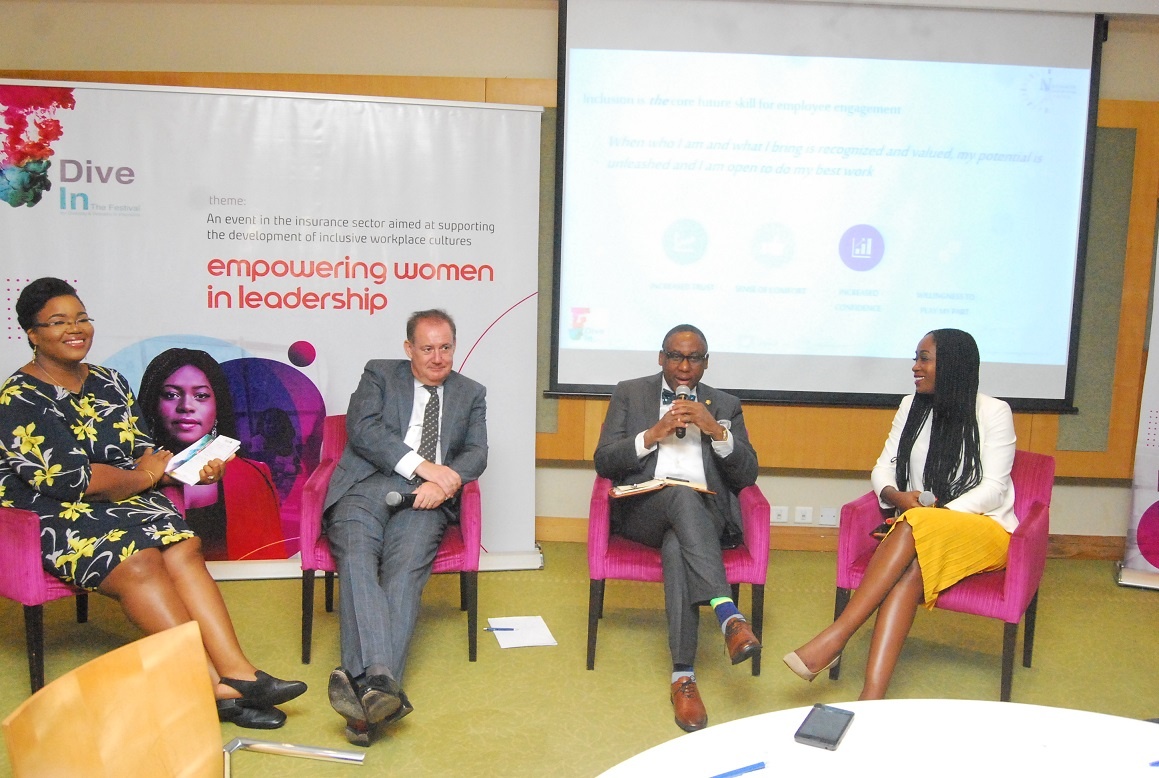
Chairman of Inclusion@Lloyd’s, who equally doubles as Global Chair of Aon Benfield Reinsurance, Dominic Christian; Executive Director, Navigate Consulting Africa Ltd., Egbe Oyegun-Adeoye; Managing Director, CMC Connect, Yomi Badejo-Okusanya and member Board of Directors, Global Reporting Initiative, GRI, Bekeme Masade-Olowola, were the panelists at the ‘Dive In Festival for Diversity & Inclusion In Insurance’, with the theme: ‘Empowering Women in Leadership’, which held recently in Lagos.
The event, which was a gathering of key players in the Insurance sector, basically talked to the issue of inclusion, especially of the women folk; stressing that by enabling and empowering women to lead in the workplace, an atmosphere of belonging with outstanding results is created.
According to Dominic Christian, Global Chairman, Aon, five years ago, when the first Dive In festival was launched in London, they wondered back then whether it would be popular enough to warrant an annual event.
“We had no idea how much support and enthusiasm was out there around the insurance industry for an initiative like this whose focus is on levelling the playing field for talent and supporting people to reach their true potential at work.
“Inclusion@lloyds created The Dive In Festival as an opportunity to enable open conversations around topics such as gender equality, social mobility and cultural differences, physical and mental health and well-being.
“We know that in order to unlock the business power of diversity, we need to build workplace cultures where people feel they can be themselves. We need to practice inclusive leadership – role modelling the behaviour we want to see in the business, respecting differences and creating space for everyone based on talent and equality.
“Our festival message, then as now, was that diversity and inclusion are good for business. Our industry must be one step ahead of the complex global challenges that are affecting business and the public sector – from globalisation, to climate change and cyber crime- and to do that, we need the brightest minds and the boldest innovation. That doesn’t come from groups of people who all think the same way. We need different perspectives, life experiences and cultures in our teams to see opportunities from different angles,” he said.
He added that since its launch in 2015, the festival message has spread across four continents. Christian also alluded to the fact that women represented 50 per cent of the global population, hence the importance of inclusion.
“Gender is one of the most apparent signs of diversity. Walk into any workplace and it is immediately apparent that there is a problem if the room is almost exclusively male”, he said.
Quoting from ‘The Business case for Change’, a global research published by the International Labour Organisation earlier this year which cited Nigerian companies among its respondents in Africa, he said: ‘Our findings indicate that enterprises with equal employment opportunity policies and gender-inclusive cultures are over 60 per cent more likely to have improved profits and productivity, and they are almost 60 per cent more likely to experience enhanced reputation, greater ease in attracting and retaining talent, and greater creativity and innovation. The business case for gender diversity, particularly for increasing the proportion of women in the management and board pipelines, is compelling.’
On their part, Bekeme Masade-Olowola and Yomi Badejo-Okusanya, were united in stressing the need for attitudinal change and a change of the mindset and thinking of the African woman, especially as it relates to cultural and traditional beliefs.
They were both of the opinion that the African cultural system of/and beliefs had done a lot in stifling the growth mindset of the African woman, and this, they say, had affected her performance in the work place. They also alluded to religious beliefs which had great influence on most African societies, as being a factor which had limited the Nigerian cum African woman’s ability to express herself in critical situations, rather seeing herself as being subject to the menfolk.
They unanimously posited a changed mindset and reorientation in order to get out of the mental rot affecting women.
General
INEC Declares Adeleke Winner of 2026 Osun Governorship Election
By Adedapo Adesanya
The Independent National Electoral Commission (INEC) on Sunday, August 16, 2026, declared the incumbent Governor of Osun State, Mr Ademola Adeleke, winner of the 2026 governorship election held a day earlier.
Mr Adeleke, who contested under the Accord Party, defeated his closest challenger, the All Progressives Congress (APC) candidate, Mr Bola Oyebamiji, to secure a second term in office.
The governor polled 511,067 votes, while Mr Oyebamiji scored 444,815 votes, giving Mr Adeleke a winning margin of 66,252 votes.
The African Democratic Congress (ADC) candidate, Mr Najeem Folasayo Salaam, came a distant third with 17,180 votes.
Mr Salaam had entered the election as one of the candidates expected to potentially emerge as a third force, particularly following the backing he received from former Osun Governor and former Minister of Interior, Mr Rauf Aregbesola.
However, that expectation did not translate into the numbers needed to seriously challenge the two leading candidates.
Mr Adeleke’s victory means he becomes only the third governor in Osun State’s history to win a second term through an election.
He joins Mr Olagunsoye Oyinlola and Mr Aregbesola in the state’s political history, although Mr Oyinlola’s tenure was later cut short following a court decision that nullified his election over irregularities.
Mr Aregbesola subsequently succeeded Oyinlola and went on to secure a second term, completing eight years in office.
Mr Adeleke’s re-election comes after a fiercely contested campaign marked by intense competition and reported violence from competing parties.
Despite those challenges, the governor consolidated his support across the state and secured a decisive victory over the APC candidate, extending his administration for another four years in the southwest states.
General
Five Transmission Towers Collapse Along Ikot Abasi–Eket 132kV Line
By Modupe Gbadeyanka
The Transmission Company of Nigeria (TCN) has confirmed the collapse of five transmission towers along the Ikot Abasi–Eket 132kV Double Circuit Transmission Line.
This was attributed to severe acts of vandalism, as TCN disclosed that the structure collapsed after vandals removed critical structural bracing members.
The affected towers were N9, J4, N10, N11 and N12, the organisation said in a statement on Friday.
It explained that the extensive damage was discovered during a routine joint line patrol conducted on August 9, 2026, by TCN linesmen.
Further inspection revealed that structural members from seven additional towers along the same transmission corridor had also been removed and stolen. The towers, J3, N8, N13, N14, N15, N18 and N19, are now structurally compromised and pose a risk of further collapse.
TCN condemned this act of sabotage and reiterated its commitment to working hard to maintain a robust and reliable national grid.
The statement said that to mitigate the impact on electricity supply, the network has been reconfigured to prioritise supply to Ekim transmission station, leaving Ibom Power as the only station without supply.
TCN said it is mobilising an urgent intervention to complete the reconstruction of the affected sections of the line, with security agencies also notified to aid investigations and prevent further acts of vandalism along the line route.
General
Abbas Warns Against Delay in Implementing New Ports Regulatory Act
By Adedapo Adesanya
The Speaker of the House of Representatives, Mr Tajudeen Abbas, has urged all relevant government agencies to promptly initiate actions for the full implementation of the Nigerian Ports Economic Regulatory Agency Act, 2026, following its signing into law by President Bola Tinubu.
The bill, sponsored by Speaker Abbas, was aimed at repealing the Nigerian Shippers’ Council Act, Cap. N133, Laws of the Federation of Nigeria, 2004, and establish the Nigerian Ports Economic Regulatory Agency to ensure effective economic regulation of Nigerian ports while safeguarding the interests of shippers, service providers, and users of regulated port services. With the President’s assent, it has now been enacted as an Act of Parliament.
The legislation represents one of the landmark achievements of the 10th National Assembly. It reflects the Speaker’s commitment to legislative excellence, institutional reform, and sustainable economic growth, according to a press statement by the Special Adviser on Media and Publicity to the Speaker, Mr Musa Krishi.
The bill underwent a rigorous and inclusive legislative process, including extensive stakeholder consultations and a public hearing. It was passed by both Chambers of the National Assembly and subsequently assented to by the President.
The Act provides a robust legal and institutional framework to ensure effective economic regulation of Nigerian ports by fostering transparency, competitiveness, and efficiency in port operations; protecting the rights and interests of shippers, service providers, and other port users; and aligning Nigeria’s port regulatory system with global best practices, thereby enhancing the ease and cost-effectiveness of doing business.
Despite receiving presidential assent, the Act has yet to be fully operationalised.
He warned that any further delay would undermine the legislative intent of the reform, prolong the exposure of port users to arbitrary charges and operational inefficiencies, and deny the nation the anticipated benefits of increased revenue, improved trade facilitation, and stronger investor confidence in the marine and blue economy sector.
The Speaker urged the Federal Ministry of Marine and Blue Economy, in collaboration with all relevant Ministries, Departments and Agencies (MDAs) of the federal government, to take the necessary administrative, institutional, and financial measures for the prompt implementation of the Act.
He said this should include the formal transition to, as well as operational empowerment of, the Nigerian Ports Economic Regulatory Agency to discharge its statutory mandate effectively.
The full implementation of the Act is critical to unlocking the economic potential of Nigeria’s ports, reducing the cost of doing business, strengthening trade competitiveness, and positioning Nigeria as the leading maritime and logistics hub in West and Central Africa.
The statement noted that the Speaker reaffirmed the 10th House’s commitment to exercising the necessary legislative oversight to ensure this landmark legislation, along with others assented to by the President, is fully implemented and achieves its intended goals for the benefit of the Nigerian people.