Connect with us

Economy

Economic Advisory Squad to Focus on Data Collection

Published

on

Buhari economic advisory council

By Modupe Gbadeyanka

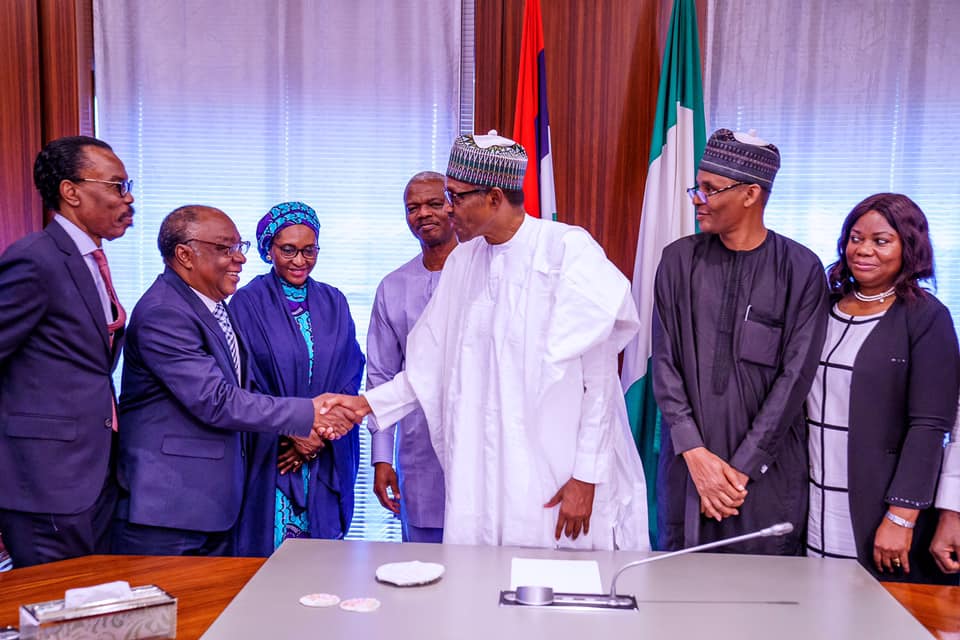
President Muhammadu Buhari on Wednesday inaugurated the newly appointed members of the Presidential Economic Advisory Council (PEAC) with a task to “focus on primary data collection.”

Mr Buhari, while administering oaths on his economic squad today in Abuja, said the 8-man council chaired by Prof. Doyin Salami must develop reliable data that will properly reflect what is happening in the country.

According to the President, “Today, most of the statistics quoted about Nigeria are developed abroad by the World Bank, IMF and other foreign bodies.

“Some of the statistics we get relating to Nigeria are wild estimates and bear little relation to the facts on the ground.

“This is disturbing as it implies we are not fully aware of what is happening in our own country,” he told the team.

He further said, “We can only plan realistically when we have reliable data. As you are aware, as a government, we prioritised agriculture as a critical sector to create jobs and bring prosperity to our rural communities.

“Our programs covered the entire agricultural value chain from seed to fertiliser to grains and ultimately, our dishes.

“As you travel in some rural communities, you can clearly see the impact. However, the absence of reliable data is hindering our ability to upgrade these programmes and assure their sustainability.”

The President also used the occasion to set agenda and expectations from the Council, constituted on September 16, 2019, to replace the Economic Management Team (EMT).


Charges Team on Social Welfare

On the Social Investment Programmes (SIPs), the President told members that his administration was working to measure the impact of the programme targeted at improving the well-being of millions of poor and vulnerable citizens.

As such, the President said he had directed the new Minister for Humanitarian Affairs to commence a comprehensive data-gathering exercise in all Internally Displaced Persons (IDP) camps in the North East.

“Today, we hear international organisations claiming to spend hundreds of millions of dollars on IDPs in the North East. But when you visit the camps, you rarely see the impact.

“In 2017, when the National Emergency Management Agency took over the feeding of some IDPs in Borno, Yobe and Adamawa, the amount we spent was significantly lower than the claims made by these international organisations.

“Therefore, actionable data is critical to implement effective strategies to address pressing problems such as these humanitarian issues.

“I, therefore, look forward to receiving your baseline study as this will help us shape ideas for a sustainable and prosperous future,” the President said.


Buhari’s Expectations

On his expectations from the council, the President urged them to proffer solutions on how to move the country and economy forward.

The President directed the Council to coordinate and synthesize ideas and efforts on how to lift 100 million Nigerians out of poverty in 10 years, working in collaboration with various employment generating agencies of government.

“I am told you worked throughout last weekend in preparation for this meeting.

“I have listened attentively to findings and ideas on how to move the country and the economy forward.

“Yes, Nigeria has exited the recession. But our reported growth rate is still not fast enough to create the jobs we need to meet our national ambition of collective prosperity.

“Reason being we had to tread carefully in view of the mess we inherited.

“Many of the ideas we developed in the last four years were targeted at returning Nigeria back to the path of growth.

“I am sure you will also appreciate that during that time, our country was also facing serious challenges especially in the areas of insecurity and massive corruption.

“Therefore, I will be the first to admit that our plans were conservative. We had to avoid reckless and not well thought out policies.

“However, it was very clear to me after we exited the recession that we needed to re-energise our economic growth plans. This is what I expect from you, ” he said.

Buhari Promises Cooperation

President Buhari also assured the Council that the Federal Government will ensure that all their needs and requests were met before the next technical sessions in November.

He said all key ministries, departments and agencies will be available to meet and discuss with them on how to collectively build a new Nigeria that caters for all.

“Now, no one person or a group of persons has a monopoly of knowledge or wisdom or patriotism.

“In the circumstances, you may feel free to co-opt, consult and defer to any knowledgeable person if in your opinion such a move enriches your deliberations and add to the quality of your decisions, ” he said.

Chairman of Council, Professor Salami, said the mandate was about “Nigeria first, Nigeria second, and Nigeria always,” adding that it was about Nigerians, not as numbers, but as people.

He added: “Our goal is that the economy grows in a manner that is rapid, inclusive, sustained and sustainable, so that Nigerians will feel the impact.”


Modupe Gbadeyanka is a fast-rising journalist with Business Post Nigeria. Her passion for journalism is amazing. She is willing to learn more with a view to becoming one of the best pen-pushers in Nigeria. Her role models are the duo of CNN's Richard Quest and Christiane Amanpour.

Click to comment

Leave a Reply

Your email address will not be published. Required fields are marked *

Economy

Bellwether Equities Shrink Nigerian Stock Market by 2.35%

Published

on

Nigerian Stock Market

By Dipo Olowookere

The Nigerian stock market crashed by 2.35 per cent on Wednesday after some bellwether equities performed badly as a result of profit-taking in them.

BUA Cement, Dangote Cement, and Geregu Power lost 10.00 per cent each to settle at N340.20, N963.00, and N917.40, respectively. Custodian Investment shrank by 9.97 per cent to N73.15, and Academy Press weakened by 9.88 per cent to N28.12.

On the flip side, SAHCO gained 9.92 per cent to trade at N171.20, International Energy Insurance grew by 9.66 per cent to N6.70, Tantalizers improved by 6.98 per cent to N4.60, Omatek added 5.70 per cent to close at N2.04, and AIICO Insurance increased by 5.19 per cent to N4.26.

At the close of business, the Nigerian Exchange (NGX) Limited recorded 10 appreciating stocks and 21 depreciating stocks.

Data from the activity log revealed that 488.1 million shares worth N20.9 billion exchanged hands in 46,239 deals at midweek compared with the 564.9 million shares valued at N39.4 billion traded in 49,230 deals on Tuesday, representing a fall in the trading volume, value, and number of deals by 13.60 per cent, 46.95 per cent, and 6.08 per cent, respectively.

On top of the activity chart yesterday was First Holdco, which sold 57.4 million equities for N3.5 billion. Chams transacted 42.3 million shares valued at N166.9 million, Access Holdings traded 36.1 million stocks worth N831.1 million, Linkage Assurance exchanged 32.0 million equities for N49.4 million, and Sterling Holdings traded 29.4 million shares valued at N224.8 million.

Business Post observed that the bears dominated Customs Street during the trading day, resulting in all the major sectors closing in the red.

The industrial goods space suffered the heaviest loss, 8.31 per cent, as a result of the sell-offs in cement stocks. The insurance counter shed 0.97 per cent, the banking segment declined by 0.71 per cent, the consumer goods landscape gave up 0.29 per cent, and the energy sector crumbled by 0.11 per cent.

Consequently, the All-Share Index (ASI) retreated by 5,668.65 points to 235,074.54 points from 240,743.19 points, and the market capitalisation moderated by N3.637 trillion to N150.847 trillion from N154.484 trillion.

Continue Reading

Economy

Nigeria’s Inflation Outlook Improves as US-Iran Tensions Ease

Published

on

nigeria inflation outlook

By Adedapo Adesanya

Easing tensions between the US and Iran in the Middle East is expected to offer more respite to the Nigerian economy in the coming months.

Analysts at Comercio Partners noted in a report that there is an increased likelihood of a gradual moderation in inflation from July into the third quarter of 2026.

The analysts opined that the near-term outlook for inflation “has become less tilted to the upside” following the peace deal reached by the warring parties in the Middle East conflict and the sharp decline in global oil prices.

The report read in part: “May inflation data showed that price pressures remain sticky, but the near-term outlook has become less tilted to the upside following the peace deal and the sharp decline in global oil prices.

“Headline inflation rose to 15.93 per cent year-on-year from 15.69 per cent in April, while food inflation climbed to 16.96 per cent and core inflation increased to 16.82 per cent, suggesting that both food and underlying non-food price pressures remain elevated.

“However, the easing in crude oil prices below $85/bbl reduces the risk of a renewed energy-led inflation shock. This is important for Nigeria, where fuel, diesel, transport, logistics, and food distribution costs are key channels through which global energy prices feed into domestic inflation.

“If lower oil prices are sustained and domestic fuel prices remain stable or decline, pressure on transport and production costs should gradually ease.”

It noted that in June, inflation may remain sticky because the pass-through of lower oil prices to consumer prices is unlikely to be immediate.

It added that food prices remain elevated, and core inflation picked up month-on-month in May, indicating that underlying price pressures have not fully faded. According to the National Bureau of Statistics (NBS), the inflation rate on a month-on-month basis was 1.75 per cent, which was 0.39 per cent lower than the rate recorded in April 2026 (2.13 per cent).

“However, the balance of risks has shifted. The likelihood of another sharp energy-driven acceleration has reduced, while the probability of gradual moderation from July into Q3 has improved.”

The analysts said in the report that while the latest CPI data, “still supports a cautious tone across rates and fixed income, as annual headline, food, and core inflation all moved higher in May,” the decline in oil prices gives the Central Bank of Nigeria (CBN) “more room to maintain a wait-and-see stance rather than respond aggressively to external energy-price risks, provided domestic prices begin to reflect the easing in global crude markets.”

Continue Reading

Economy

All On Invests $1m in Eja-Ice Nigeria Limited to Strengthen Cold-Chain Infrastructure in Off-Grid Markets

Published

on

All One Eja-Ice Nigeria Limited

All On, an impact investing company focused on expanding access to renewable energy solutions in Nigeria, has announced a $1 million investment in Eja-Ice Nigeria Limited, a provider of solar-powered refrigeration and cold chain infrastructure.

The investment will support Eja-Ice’s manufacturing and operational scale-up as the company enters its next phase of growth. It is expected to enable the expansion of its cold-chain solutions and improve access to reliable cooling services for households, small businesses, and institutions operating in off-grid and weak-grid environments.

Access to dependable cold storage remains a significant constraint across Nigeria, particularly in coastal and rural communities where limited energy infrastructure contributes to post-harvest losses and income instability for small-scale agro-producers.

By delivering energy-efficient refrigeration systems, Eja-Ice is helping to address these challenges while supporting the preservation of perishable goods and strengthening local value chains.

“All On’s investment in Eja-Ice reflects our approach of supporting solutions that improve energy access while enhancing livelihoods, reducing costs, and enabling businesses to grow. Strengthening cold-chain infrastructure is an important step towards building more resilient local economies and expanding opportunities in underserved markets,” the chief executive of All On, Ms Caroline Eboumbou, commented on the investment.

Eja-Ice’s integrated cold-chain model allows for greater control over product design, operational efficiency, and service delivery, ensuring that its solutions are tailored to the needs of underserved markets. The company’s systems are already supporting micro enterprises, cooperatives, and community-level infrastructure, particularly in areas where reliable electricity remains limited.

Also commenting, the founder and chief executive of Eja-Ice Nigeria Limited, Mr Yusuf Bilesanmi, said, “This capital raise is a huge step forward in our vision to power homes and businesses with products designed, assembled, and optimised right here on the continent. It’s not just about access to electricity—it’s about dignity, productivity, and opportunity for the over 600 million people across sub-Saharan Africa who are still off-grid.”

Through this investment, All On continues to advance its mission of closing Nigeria’s energy access gap by supporting the renewable energy ecosystem and businesses that deliver sustainable, market-driven solutions.

All One Eja-Ice Nigeria Limited $1m

Continue Reading

Trending