General
Mindshift Advocacy Designs Initiative for New Nigeria
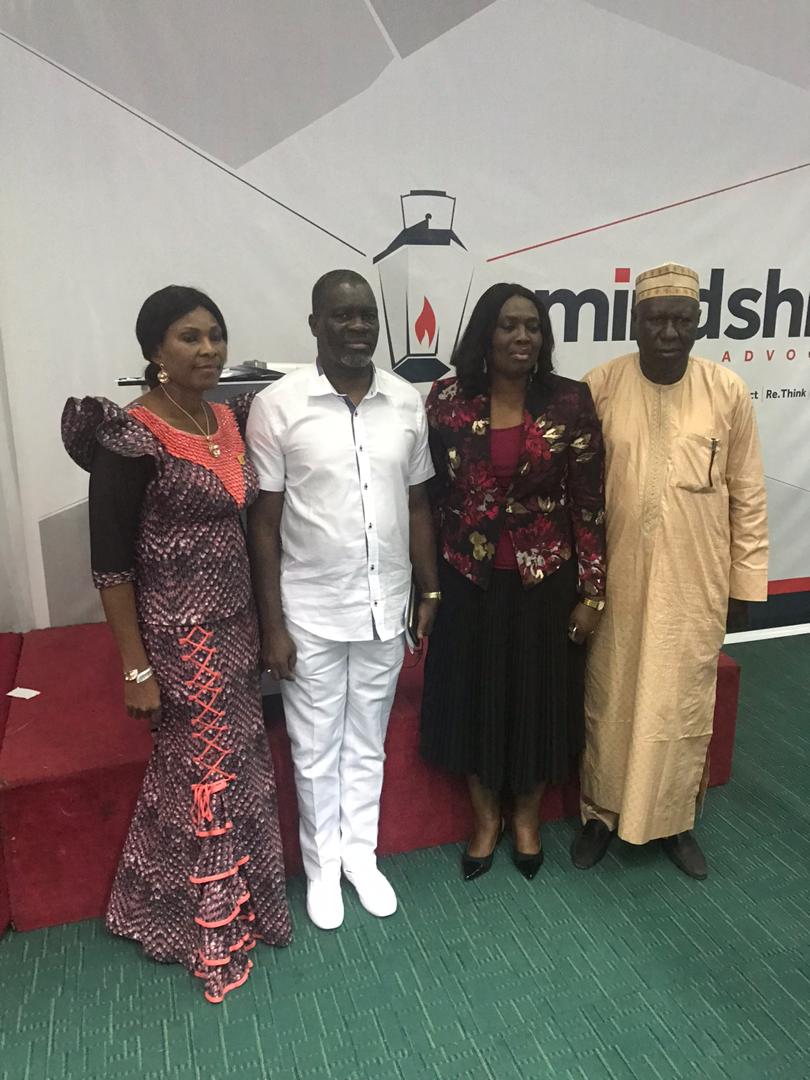
In its determination and resolve to foster a new mindset among Nigerians, the Mindshift Advocacy for Development Initiative has unveiled a new blue print to get Nigerians to think differently, believe differently and to act differently, so as to generate a mindset geared towards development.
The event which was attended by dignitaries and the media held Thursday, October 17, 2019, at the prestigious Benue Hall of the International Conference Centre, Abuja.
In his address Mr Joko Okupe, the Founder and Board of Trustee member of the Mindshift Advocacy for Development Initiative said that “the bane of Nigeria and by extension Africa’s problems is the mindset of Africans as individuals, communities and nations, about themselves and the mindset of the rest of the world about Africa.
The wrong mindset of Nigerians and Africans in general which influences the way we do things, has created problems such as lack of visionary and purposeful leadership, bad governance standards, erosion and loss of good value systems, corruption, poor understanding of global issues and how it impacts their lives; unprecedented never-ending poverty, heavy debt burdens, over dependence on international aids, endless conflicts, inadequate education etc.”
According to him, the Initiative was incorporated on November 28, 2016 as a non-partisan, non-governmental organization aimed at re-directing citizens’ mindsets from negative mindsets in private lives, societies and nations to positive mindsets that foster meaningful holistic personal, social and national development.
The initiative also seeks to activate a radical and positive change in the mindset of the Nigerian youth – and by extension, African youth.
According to Mr Okupe, the Mindshift Advocacy is actually focused on shifting mindsets from negative to positive. The movement is focused on redirecting the mindset of Nigerians from negative, unproductive and unprogressive mindsets to positive, productive and progressive mindsets.
A destructive person has a destructive mindset and a destructive thinking pattern. There is so much capacity in the power of the mind that the way and manner that the mind is directed, determines the outcome of a man’s action. When you look at the great nations of the world, you will discover that their people have mindsets of greatness.
The average Nigerian’s mindset is anti-progress and anti-development. How can we have progress and development when majority of our citizens have the wrong mindset? We cannot achieve any meaningful transformation without a re-orientation of the citizens’ mindsets.
Even when government decides to run a campaign on changing attitudes, the success will depend on whether the mindsets of the citizens have changed or not. We cannot but pay attention to how people think. We must have that clear understanding. That essentially is the crux of the Mindshift Advocacy.
He stressed that every effort geared at re-orientating the citizens with a view to making them develop positive and progressive mindsets as individuals, society and at national levels, would put us on the road to meaningful and effective transformation of the continent for sustainable growth and development. This is why: “The changes we wish to make have more to do with how we think than what we actually do, because thinking patterns ultimately influence actions. We need to get our citizens to embrace positive mindsets that can impact thought and action for our progress and development. We must also lead by example by thinking and acting differently.”
He cited Mr Paul Kagame, the President of Rwanda, who once said that Africa’s transformational change will first happen at the level of mindsets before it is translated into concrete actions. Okupe firmly believes that Africa’s journey of transformation starts with changing how people think. “It is vital for citizens of all ages and social classes to have the right mindset because they are the ones who would be actively involved in the day-to-day actions that bring about sustainable transformation.”
In order to achieve these, the initiative has in place well-articulated key focus areas toward its agenda. These areas are: family and society, government and politics, education, business and economy, media, arts and entertainment, innovation and technology, religion, culture, and health and wellness.
Additionally, it will approach this systematically through social research, targeted issues campaigns, action-oriented initiatives, knowledge sharing, events, and public discourse platforms.
Fielding questions to reporters at the launch event on what methods Mindshift Advocacy will deploy to achieve its goal, Joko responded, “It is all a matter of approach and method. Our initiatives would be determined by research and insight. There is a reason or rationale behind every mindset. How much have we researched into why we behave the way we do? Why do we think the way we do? We will make efforts to dig into the foundation to understand the issues and gain necessary insights before we develop initiatives. A man whose mind is conditioned to darkness tends to acclimatise to the situation and live in it. People’s eyes can only be opened through enlightenment which will serve as an illumination to the thick, engulfing darkness and ignorance around us. Adequate exposure to realities will compel them to see and think differently. If we continue at the current pace, we are definitely on a suicide mission as a nation, though we may be fully aware of this”.
Earlier in her welcome address Mrs Debo Onabowale, a core member of the Mindshift Advocacy for development Initiative said that “Mindshift Advocacy for Development Initiative is set to do a new thing in Nigeria by approaching the Nigerian problem from a different perspective. We believe that Nigerians, both leaders and followers, rich and poor, young and old need a different orientation to be able to chart a new direction and behaviour to propel peace and development.”
General
Tether Records $10bn Net Profit in 2025, $6.3bn in Excess Reserves
By Adedapo Adesanya
Tether, issuer of the world’s most popular stablecoin, USDT, wrapped up 2025 with a net profit of over $10 billion, bolstered by steady growth in its flagship token and growing exposure to US Treasuries and gold.
The fourth-quarter attestation showed Tether holding $6.3 billion in excess reserves, a buffer over its $186.5 billion in liabilities tied to issued tokens. USDT’s circulating supply grew by $50 billion over the year to over $186 billion.
The firm continued ramping up its holdings of US Treasuries, reaching $122 billion in direct exposure and $141 billion including overnight reverse repurchase agreements, positioning it among the largest holders of US government debt globally.
Tether also maintained significant allocations to gold and Bitcoin, reporting holdings of $17.4 billion and $8.4 billion, respectively.
Tether’s investment portfolio, which is separated from reserve assets, was valued at $20 billion.
“With USDT issuance at record levels, reserves exceeding liabilities by billions of dollars, Treasury exposure at historic highs, and strong risk management, Tether enters 2026 with one of the strongest balance sheets of any global company,” said the chief executive of Tether, Mr Paolo Ardoino, in a statement shared with Business Post.
“This has been made possible by the trust accrued by our strong risk management setup, unprecedented in the financial sector, and the decisions we make around asset quality, allocation, and liquidity are designed to ensure USD₮ remains reliable and usable at a global scale, even during periods of extreme demand,” he added.
The latest report comes amid rising global demand for stablecoins, with Tether’s USDT remaining the dominant digital dollar in circulation.
General
SERAP Sues NNPC Over Missing N22.3bn, $49.7m, £14.3m, €5.2m Oil Funds
By Adedapo Adesanya
The Socio-Economic Rights and Accountability Project (SERAP) has filed a lawsuit against the Nigerian National Petroleum Company (NNPC) Limited over its failure to account for the alleged missing or diverted N22.3 billion, $49.7 million, £14.3 million and €5.2 million oil funds.
Disclosing this in a statement on Sunday, SERAP Deputy Director, Mr Kolawole Oluwadare, said the suit followed the damning allegations documented in the 2022 audited report by the Auditor-General of the Federation, which was published on 9 September 2025.
The suit was filed last Friday at the Federal High Court in Abuja, with the organisation seeking “an order of mandamus to direct and compel the NNPCL to account for the alleged missing or diverted N22.3 billion, $49.7 million, £14.3 million, and €5.2 million oil money.”
It also asked the court to “direct and compel the NNPCL to disclose the specific financial transactions carried out in respect of the alleged missing or diverted N22.3 billion, $49.7 million, £14.3 million and €5.2 million oil money, including details of disbursement, the contractors, and other individuals who collected the money.”
“The diverted or misappropriated oil revenues reflect a failure of NNPCL accountability more generally and are directly linked to the institution’s continuing failure to uphold the principles of transparency and accountability,” SERAP argued, noting that, “Granting the reliefs sought would strike a blow against the impunity of those responsible for the missing or diverted oil money, and ensure that the money is returned for the sake of NNPCL’s victims—Nigerians.”
“The allegations have also undermined the economic development of the country, trapped the majority of Nigerians in poverty and deprived them of opportunities.
“The Auditor-General has for many years documented reports of disappearance of oil money from the NNPCL. Nigerians continue to bear the brunt of these missing oil money meant to provide essential public services for Nigerians,” it added.
SERAP is also arguing that, “Combating the corruption epidemic in the oil sector would alleviate poverty, improve access of Nigerians to basic public goods and services, and enhance the ability of the government to meet its human rights and anti-corruption obligations.”
General
Minister Advocates Coordinated, Trust-Driven Government Communication
By Aduragbemi Omiyale
The Minister of Information and National Orientation, Mr Mohammed Idris, has emphasised that unified government messaging remains very critical to restoring public trust, especially in delivering the Renewed Hope Agenda of President Bola Tinubu.
He said this on Thursday in Abuja at an interactive session with Directors of Information and Resident Information Officers (RIOs) on grade level 14-17, deployed across Ministries, Departments and Agencies (MDAs).
The event, according to a statement issued on Friday by the Director Public Relations and Protocol of the ministry, Mr Suleiman Haruna, was themed Aligning Public Information with the Renewed Hope Agenda: Rebuilding Trust Through Effective, Transparent Communication.
The Minister noted that government officials must adopt a unified, coordinated, and trust-driven approach to government communication.
He posited that public trust remains the most valuable asset of government communication, stressing that information officers must be guided by honesty, credibility, and consistency in their work.
“Public trust is our most important capital. Once credibility is lost, no amount of messaging can fix it,” the Minister said, warning that fragmented messaging and parallel communication channels weaken government credibility and confuse citizens, insisting that the government must speak with a single, clear, and consistent voice.
“We are one government serving one national interest, and our communication must reflect that unity,” he said.
Mr Idris urged Resident Information Officers to see themselves as active partners within their host MDAs rather than passive observers, encouraging them to engage proactively with Ministers, Permanent Secretaries, and agency leadership, noting that professionalism, relevance, and initiative are key to earning trust and influence.
Addressing the growing pressure of misinformation and the speed of digital media, the founder of Blueprint Newspaper stressed the importance of timely and accurate communication, noting that delays often create space for false narratives. While reaffirming the federal government’s commitment to freedom of expression, he said such freedom must be exercised responsibly.
The Minister also outlined steps being taken to strengthen professionalism within the information cadre, including mandatory periodic reporting, improved deployment processes, continuous training, and stronger institutional support. He disclosed that the Federal Government has begun restoring the National Institute of Public Information to boost capacity building for public communicators.
He called for teamwork and mutual respect, reminding participants that they are central to the projection of government policies and achievements and that they must align their work with the priorities of the Renewed Hope Agenda.
-
Feature/OPED6 years agoDavos was Different this year
-
Travel/Tourism9 years ago
Lagos Seals Western Lodge Hotel In Ikorodu
-
Showbiz3 years agoEstranged Lover Releases Videos of Empress Njamah Bathing
-
Banking8 years agoSort Codes of GTBank Branches in Nigeria
-
Economy3 years agoSubsidy Removal: CNG at N130 Per Litre Cheaper Than Petrol—IPMAN
-
Banking3 years agoSort Codes of UBA Branches in Nigeria
-
Banking3 years agoFirst Bank Announces Planned Downtime
-
Sports3 years agoHighest Paid Nigerian Footballer – How Much Do Nigerian Footballers Earn