Connect with us

General

Nigeria’s New Ease of Doing Business Ranking Delights Buhari

Published

on

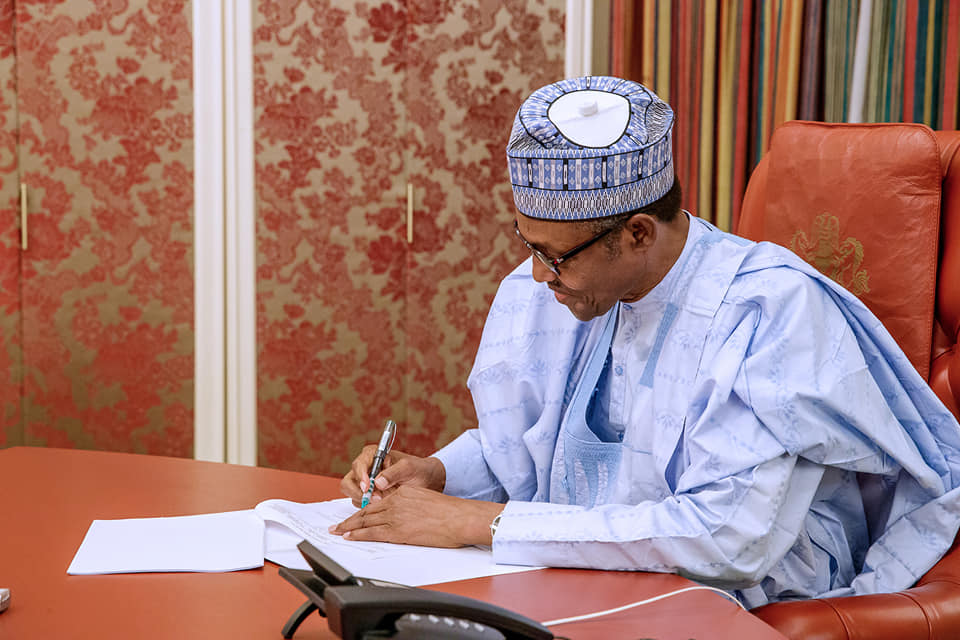
The upward movement of Nigeria by 15 steps on the latest World Bank’s 2020 Doing Business Index (DBI) has been received with joy by President Muhammadu Buhari.

A statement on Thursday by one of the President’s media aides, Mr Femi Adesina, quoted Mr Buhari as saying that “the movement of 15 places to 131 as well as the recognition being given to Nigeria as one of the top 10 most improved countries, that have implemented the most reforms this year, is significant because we were not even able to achieve some of the key reforms we had pursued, but what we have done so far is being recognized. This validation confirms that our strategy is working and we will continue to push even harder to deliver more impactful reforms.”

“With the impending ratification of the Companies and Allied Matters Bill and the introduction of the Business Facilitation (Omnibus) Bill, 2019 in view, along with other pending and ongoing regulatory, judicial and sub-national reforms, the President declared that “the announcement by the World Bank indicates that our mandate to move into the top 70 doing business destinations by 2023 remains achievable,” Mr Buhari added.

Nigeria was in 2018 at 146th position, but the latest ranking placed the Africa’s largest economy at 131 out of 190 countries.

The report, which was released today, also named Nigeria one of the top 10 most improved economies in the world for the second time in three years. Nigeria is one of only two African countries to make this list. With this year’s leap, Nigeria has improved an aggregate of 39 places in the World Bank Doing Business index since 2016.

The Doing Business Index is an annual ranking that objectively assesses prevailing business climate conditions across 190 countries based on 10 ease of doing business indicators.

The index captures ease of doing business reforms that have been validated by the private sector, and offers comparative insights based on private sector validation in the two largest commercial cities in countries with a population higher than 100 million. The report consequently features Lagos and Kano for Nigeria.

Briefing President Buhari on the rankings, Minister of Industry, Trade and Investment and Vice Chair of the Presidential Enabling Business Environment Council (PEBEC), Mr Niyi Adebayo, had stated that, “The steady improvement in Nigeria’s ease of doing business score and rank is a testament to the reforms implemented by this Administration over the past four years in line with the reform agenda being implemented at national and sub-national levels across the country since the establishment of the Presidential Enabling Business Environment Council (PEBEC) by President Muhammadu Buhari in July, 2016.

“The PEBEC works towards the fulfillment of the projections of the Economic Recovery and Growth Plan (ERGP 2017-2020), which is striving to deliver sustainable economic growth in Nigeria by restoring growth, investing in our people, and building a competitive economy as we work towards delivering Mr President’s mandate of bringing 100 million people out of poverty.

“The 2020 Doing Business report from the World Bank has reaffirmed the commitment of the newly constituted PEBEC to making Nigeria a progressively easier place to do business and removing the bureaucratic constraints to doing business in the country as we forge ahead in this Next Level.”

The PEBEC, chaired by Vice President Yemi Osinbajo, with 13 ministers as members amongst others, has through the Enabling Business Environment Secretariat collaborated with ministries, departments and agencies (MDAs), the National Assembly, the Judiciary, State governments and the private sector to carry out over 140 reforms so far in a bid to remove bureaucratic constraints to doing business in Nigeria and make the country a progressively easier place to start and grow a business.

On the new ranking, Dr Jumoke Oduwole, Special Adviser to the President, Ease of Doing Business/Secretary PEBEC, said, “The private sector remains the fulcrum of the ease of doing business interventions. We are committed to more engagements among reform-implementing organs of government and the private sector players, and we are happy to see that these have resulted in a more favourable validation of the reforms by the private sector.

“This result will serve as encouragement to sustain the deepening of these reforms and make it even more tangible for businesses and the citizenry. The PEBEC is focused on delivering even more substantive reforms for the improvement of the general business climate.”

She noted that over the past four years, Nigeria’s score has steadily improved in the World Bank Doing Business Report, after years of decline in both score and ranking in the years preceding 2016.

She also recalled that in 2017, Nigeria moved up by an unprecedented 24 places on the Doing Business rankings, and was for the first time ever, recognized as one of the top 10 reformers in the area of doing business that year.


Dipo Olowookere is a journalist based in Nigeria that has passion for reporting business news stories. At his leisure time, he watches football and supports 3SC of Ibadan. Mr Olowookere can be reached via [email protected]

Advertisement
Click to comment

Leave a Reply

Your email address will not be published. Required fields are marked *

General

FG Insists Prepaid Meter is Free, Warns Nigerians Against Payment

Published

on

Ikeja Electric Prepaid meter

By Adedapo Adesanya

The federal government has reaffirmed that electricity meters being deployed under the Distribution Sector Recovery Programme (DISREP) are free for customers, warning Nigerians not to pay any money for meter supply or installation.

The Director General of the Bureau of Public Enterprises (BPE), Mr Ayodeji Ariyo Gbeleyi, stated this in Abuja at a joint media briefing on DISREP with the managing directors of Nigeria’s 11 Electricity Distribution Companies (DisCos). DISREP is financed through a $500 million World Bank facility.

The DG said the concessional nature of the funding, which comes at single-digit interest rates, makes it more sustainable than commercial borrowing and supports long-term stability in the power sector.

Under the DISREP IPF, 3.2 million smart meters are being procured and installed nationwide over four years through competitive international and local bidding. According to him, close to 700,000 meters have already been delivered, while about 200,000 have been installed across different DisCos.

The DG said, “With DISREP and other Federal Government interventions, the journey to power sector reliability is underway. DISREP is not just a short-term intervention, but part of a broader and coordinated plan of the Renewed Hope Agenda of President Bola Ahmed Tinubu, GCFR, towards building a financially viable and service-oriented electricity market

“Nigerians deserve a power sector that works, one that delivers reliable electricity, protects consumers, ensures value for money, and supports economic growth.

“Together, we shall achieve that! The supply and installation of these meters for customers is free.

It was also disclosed that the government had already paid the contractors to supply and install the meters. DISREP is integrated with other metering initiatives, including the Presidential Metering Initiative and the Meter Acquisition Fund, to accelerate the closing of Nigeria’s metering gap.

On his part, the Managing Director of Abuja Electricity Distribution Company, Mr Chijioke Okwuokenye, warned customers not to pay for meters.

“These meters are to be deployed and installed freely. Anybody asking you to bring money should be reported,” he said.

MD of Eko Electricity Distribution Company (Eko Disco), Mrs Wola Joseph-Condotti, said the company is working closely with the authorities to weed out bad eggs who extort money from customers for meter procurement and installation.

The programme offers significant benefits to consumers, including the removal of upfront meter purchase and installation costs, accurate billing, the elimination of arbitrary estimated billing, improved service accountability by DisCos, better transparency and dispute resolution, and long-term improvements in supply reliability as the sector becomes more financially viable.

For DisCos, Mr Gbeleyi said DISREP provides access to concessional World Bank financing for metering and network upgrades, reduces Aggregate Technical, Commercial and Collection (ATC&C) losses, improves liquidity and revenue assurance, and strengthens operational performance for long-term investment.

He disclosed that $250 million of the facility is dedicated to Investment Project Financing, which supports bulk procurement of the 3.2 million smart meters, deployment of Meter Data Management Systems, and provision of technical assistance and capacity-building programmes to strengthen DisCos’ operations and processes.

Describing DISREP as a landmark transaction, Mr Gbeleyi said it is the first initiative of its kind in which the government, beyond investing in distribution network infrastructure, is deploying meters at scale to bridge the country’s metering gap. He cited official figures showing that Nigeria currently has about 5.66 million unmetered electricity customers.

“The plan is to quickly close that gap. These meters are for everybody. They are for Nigerians. Priority is on unmetered customers,” he said.

He clarified that while the policy targets unmetered customers, DisCos have been allowed to deploy up to 20 per cent of the meters to replace faulty or technologically obsolete units, following feedback from the field.

Continue Reading

General

NSC Revamps PSSP to Solve Complaints, Boost Ease of Doing Business in Ports

Published

on

Port Service Support Portal

By Adedapo Adesanya

The Nigerian Shippers’ Council (NSC) has successfully concluded the review of the Port Service Support Portal (PSSP) application, which is aimed at ensuring seamless handling and efficient resolution of stakeholders’ commercial disputes across the maritime sector.

The Head of NSC-ICT, Mr Benjamin Ivwigheghweta, and his team; the Head of the Complaints Unit, Mr Bashir Ambi and his team; as well as consultants from BrandOne, all collaborated to complete the platform’s final implementation stage.

Mr Ivwigheghweta expressed satisfaction with the successful integration of the revamped PSSP for streamlined dispute resolution. He encouraged the team to fully engage with the new system and to ask questions where necessary, ensuring that every member is well equipped to meet stakeholder needs with precision and efficiency.

On his part, Mr Ambi applauded the deployment of the PSSP as a tool for accelerating grievance resolution, adding that the platform would significantly strengthen the council’s dispute resolution framework by promoting transparency, boosting stakeholder confidence, and generating reliable, data-driven records to support national economic growth.

He further commended the ICT team for its unwavering support-particularly in ensuring extended network availability to support the Unit’s after-hours operations.

Describing the PSSP as a critical modern upgrade for dispute resolution, Mr Ambi revealed that the Council’s operations are now about 90 percent digital. “We rely heavily on electronic platforms to serve our stakeholders,” he said, adding that the ICT Unit has remained the backbone of these efforts by providing consistent support, even over weekends, to ensure uninterrupted online service delivery.

This digital-first approach, he noted, keeps the NSC at the forefront of maritime efficiency.

Following a productive three-hour technical review and interactive question and answer session, the PSSP is now in its final phase.

The next steps include the configuration of individual user access by the ICT Unit and a live demonstration of the platform to Management. Upon completion of these tasks, the council will be ready to go live-ushering in a new era of digital efficiency in port service delivery.

The Port Service Support Portal was officially launched by the former Vice President, Mr Yemi Osinbajo, in June 2016 in Abuja. The launch was held alongside the unveiling of the Port Harmonized Standard Operating Procedures (SOPs). The portal was designed as an online, real-time platform to enhance service delivery, address stakeholder complaints, and curb corruption at Nigerian ports.

Continue Reading

General

Tinubu Deploys Army to Kwara, Condemns Terrorist Attack

Published

on

kwara state map

By Adedapo Adesanya

President Bola Tinubu has deployed an army battalion to Kaiama district in Kwara State after suspected jihadist fighters killed about 170 people in an overnight attack on Tuesday.

The terrorists stormed Woro and Nuku communities in Kaiama Local Council, according to Kwara State lawmaker, Mr Saidu Ahmed.

The violence highlights fears that jihadist factions prevalent in Northern Nigeria are pushing south along the Niger-Kwara axis toward the Kainji forest.

According to a statement from the Presidency, the new military command will spearhead Operation Savannah Shield to checkmate the barbaric terrorists and protect defenceless communities.

He condemned the attack as “cowardly and barbaric,” saying the gunmen targeted villagers who had rejected attempts to impose extremist rule.

“It is commendable that community members, even though Muslims, refused to be conscripted into a belief that promotes violence over peace,” President Tinubu said in the statement.

The President urged collaboration between federal and state agencies to provide succour to members of the community and ensure that those who committed the atrocities do not go scot-free.

President Tinubu prayed for the repose of the souls of the deceased and condoled with those who lost family members as well as the people and government of Kwara State.

Similarly, suspected bandits stormed Doma community in Tafoki Ward, Katsina State, on Tuesday afternoon, killing several residents, injuring many others and setting vehicles and houses ablaze.

There were conflicting figures over the casualty toll, with police putting the number of deaths at 13, while the executive chairman of Faskari Local Council estimated more than 20.

Continue Reading

Trending