Connect with us

Economy

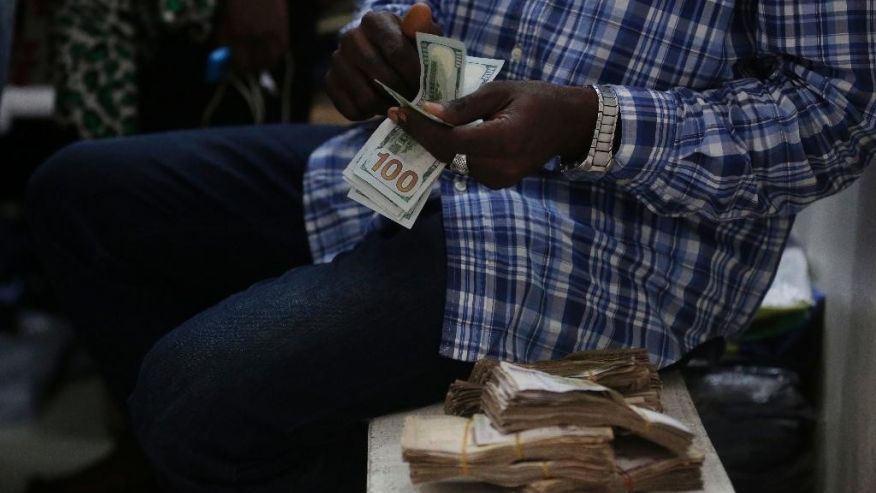
1,065.4% Rise in Demand for Dollars Weakens Naira at I&E

Published

on

Demand for Dollars

By Adedapo Adesanya 

The Naira, backed by Christmas activities, gained against major foreign currencies at the parallel market for the second consecutive trading day on Tuesday, December 24. At the close of business, the local currency appreciated against the US Dollar, British Pound Sterling and the Euro.

Business Post reports that the highest gain at the segment of the foreign exchange (forex) market was against the Euro as the Nigerian Naira appreciated by N2 to close at N398/€1 compared with N400/€1 it transacted on Monday at the same market window.

For the second time this week, the Naira closed stronger against the American Dollar, growing by another N1 to settle at N361 per Dollar compared with N362/$1 it traded at the previous session.

In the same vein, the domestic currency gained more strength against the British Pound at the black market on Tuesday, appreciating by N1 to quote at N477/£1 in contrast to N478/£1 it exchanged on Monday.

Meanwhile, at the Investors and Exporters (I&E) segment of the market, the Nigerian currency depreciated marginally against the Dollar by 4 Kobo equivalent to 0.01 percent to close at N364.20 against the greenback compared with N364.17 to one Dollar on Monday.

Data obtained by Business Post from FMDQ showed that the value of transactions recorded at the investors on the eve of Christmas broadly increased by a staggering 1,065.4 percent or $1.3 billion.

At the close of business on Tuesday, the market turnover stood at $1.42 billion compared with $121.68 million recorded at Monday’s trading session, causing pressure on the local currency. This pressure is expected to continue at the market segment till after the New Year holiday next week because of persistent huge demand for Dollars.

But at the official window of the Central Bank of Nigeria (CBN), which is also referred to as the interbank segment, the Naira experienced no change against the US Dollar as it closed at N307/$1 on Tuesday.


Adedapo Adesanya is a journalist, polymath, and connoisseur of everything art. When he is not writing, he has his nose buried in one of the many books or articles he has bookmarked or simply listening to good music with a bottle of beer or wine. He supports the greatest club in the world, Manchester United F.C.

Click to comment

Leave a Reply

Your email address will not be published. Required fields are marked *

Economy

Dangote Refinery Broadens Feedstock Base With UAE Crude Purchase

Published

on

dangote refinery trucks

By Adedapo Adesanya

The Dangote Petroleum Refinery has purchased two cargoes of crude oil from the United Arab Emirates (UAE), marking its first-ever procurement of Middle Eastern crude as it diversifies its feedstock sources ahead of continuous expansion.

According to a report by S&P Global Commodity Insights, the two cargoes will be the first sourced by the 700,000-barrels-per-day refinery from any Middle Eastern supplier, signalling a shift from its traditional reliance on Nigerian, African, and United States crude grades.

The report said the purchases followed the resumption of oil exports from the Middle East after the United States and Iran reached an interim peace agreement that restored confidence in shipping through the Strait of Hormuz.

The refinery, designed primarily to process Nigeria’s light sweet crude, has increasingly diversified its crude slate as operations ramp up. The company sources crude from Brazil, Equatorial Guinea, Angola, Algeria, and the US, among others.

The refinery and the Nigerian National Petroleum Company (NNPC) Plc had agreed on the supply of between 13 and 15 cargoes of Nigerian crude monthly in Naira, but the volumes often fluctuate. In May, the state oil company allocated seven cargoes to the plant, up from five in previous months.

The chief executive of the Dangote Refinery, Mr David Bird, had previously disclosed that these constraints had compelled the company to seek additional crude sources outside Nigeria.

According to S&P Global, the refinery has been broadening the range of crude grades it processes as part of its ambition to operate as a fully merchant refinery. The report noted that in 2025, about 70 per cent of the refinery’s crude imports came from Nigeria, while 24 per cent originated from the United States.

The report added that the refinery’s expansion plans would further increase its crude requirements. Dangote plans to double the refinery’s processing capacity to 1.4 million barrels per day by the end of 2028, a level that would enable it to process about 80 per cent of Nigeria’s recent crude oil production in a single day.

Business Post understands that since NNPC cargoes are cheaper for the ​refinery because of lower ​shipping costs, importation of crude could translate to higher fuel prices, with Nigerians possibly buying as high as N1,300 – N1,400 at the pump.

Continue Reading

Economy

FCCPC Laments Lack of Price Relief Despite Falling Global Oil Prices

Published

on

Petrol Prices

By Adedapo Adesanya

The Federal Competition and Consumer Protection Commission (FCCPC) has expressed concern that Nigerian consumers have yet to benefit from lower prices despite the recent sharp decline in global crude oil prices.

Business Post reports that crude prices currently trade around $69 and $71 per barrel in the international market.

The commission stated on Sunday that following a market surveillance exercise, the review of gantry prices from local refiners, marketers, depot operators and retail outlets showed only token reductions, not aligned with the steep drop in international crude prices.

The chief executive of the agency, Mr Tunji Bello, said that though the FCCPC does not set petroleum prices in a deregulated market, it is mandated by the Federal Competition and Consumer Protection Act, 2018, to promote competition and protect consumers from unfair business practices.

“To be clear, the commission does not regulate or approve petroleum prices in a deregulated downstream market. Our responsibility under the Federal Competition and Consumer Protection Act, 2018, is to promote competitive markets, prevent anti-competitive conduct, and protect consumers from unfair, deceptive and exploitative business practices,” Mr Bello said.

“We are concerned that while dealers often respond swiftly by hiking pump prices whenever crude prices rise, it is curious that it is taking forever for consumers to benefit significantly when crude prices fall. Competitive markets must work fairly in both directions,” he added.

The organisation noted that crude prices fell to about $73 per barrel after a recent ceasefire between the United States and Iran and the reopening of the Strait of Hormuz, down from a peak near $120 per barrel in April.

During the April–May price spike, petrol prices rose to between N1,350 and N1,500 while diesel traded around N2,000. In February, PMS averaged between N800 and N900. Presently, average retail PMS nationwide is about N1,200, with some local refiners listing gantry prices between N1,025 and N1,075.

The FCCPC acknowledged that domestic fuel prices are affected by multiple commercial factors, including refining costs, foreign-exchange movements, logistics, financing and distribution expenses, but said competitive market dynamics should have passed more of the recent international cost declines to consumers.

“Market liberalisation does not diminish businesses’ obligations to compete fairly or consumers’ right to fair treatment,” Mr Bello added. “Where credible evidence indicates conduct that undermines competition, exploits consumers or otherwise contravenes the Federal Competition and Consumer Protection Act, the Commission will investigate and take appropriate enforcement action,” urging consumers to report suspected anti-competitive conduct, misleading pricing or other unfair market behaviour via its established complaint channels.

Continue Reading

Economy

Four Securities Erase N51.17bn from NASD Exchange

Published

on

NASD Exchange

By Adedapo Adesanya

Four securities weakened the NASD Over-the-Counter (OTC) Securities Exchange by 1.95 per cent on Friday, erasing N41.17 billion from the bourse, which had its market capitalisation at N2.567 trillion compared with the previous session’s N2.618 trillion.

In the same vein, the NASD Unlisted Security Index (NSI) decreased at the close of business by 85.28 points to 4,277.07 points from 4,362.32 points.

The price decliners were led by 11 Plc, which gave up N20.50 to sell at N200.50 per share compared with the preceding day’s N221.00 per share, FrieslandCampina Wamco Nigeria Plc dropped N16.94 to close at N155.20 per unit versus Thursday’s closing price of N172.14 per unit, Central Securities Clearing System (CSCS) Plc went down by N2.11 to N84.68 per share from N86.79 per share, and Afriland Properties Plc lost 11 Kobo to end at N16.74 per unit, in contrast to the N16.85 per unit it closed a day earlier.

During the trading day, the value of transactions jumped by 172.1 per cent to N29.9 million from the preceding session’s N10.9 million, and the volume of trades soared by 136.5 per cent to 955,096 units from the previous 403,901 units, while the number of deals went down by 11.4 per cent to 31 deals from 35 deals.

Great Nigeria Insurance (GNI) Plc remained the most active stock by value on a year-to-date basis, with 3.4 billion units valued at N8.4 billion, followed by Infrastructure Credit Guarantee (Infracredit) Plc with 2.3 billion units worth N6.5 billion, and CSCS Plc with 68.6 million units sold for N4.7 billion.

GNI Plc also ended the session as the most traded stock by volume on a year-to-date basis, with 3.4 billion units exchanged for N8.4 billion, trailed by Infracredit Plc with 2.3 billion units traded for N6.5 billion, and Resourcery Plc with 1.1 billion units transacted for N415.7 million.

Continue Reading

Trending