Connect with us

Economy

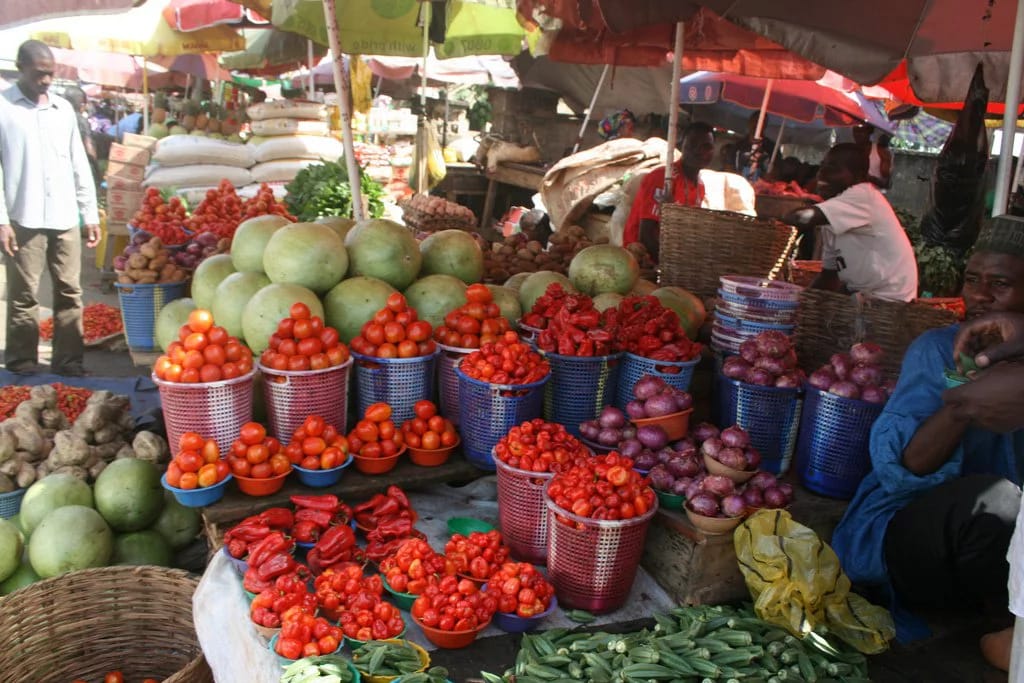
Prices of Oil, Foodstuffs Escalate as Border Closure Bites Harder

Published

on

prices of foodstuffs

By Adedapo Adesanya

Nigeria’s inflation rose to 11.98 percent in December 2019, driven by increases recorded in food prices as a result of the border closure. Not too long ago, the National Bureau of Statistics (NBS) released a report on selected food price watch for the month.

From the report, Business Post gathered that rice, one of the major commodities consumed in the country, which was once of the reasons for the closure of the land borders due to smuggling into Nigeria, recorded a 3.2 percent increase in price from N445 (per kg) in November 2019 to N460 in December, while it saw a 24.1 percent increase year-on-year.

It was stated that the locally produced variant equally recorded an increase of 0.84 percent month-on-month to N382/kg from N379/kg recorded in the previous month, while there was 20 percent rise year-on-year.

Titus frozen fish, according to the stats office, increased in the period under review by 0.6 percent to N981 per kilo, which showed a year-on-year increase of 5.9 percent. Also, mackerel fish went up by 0.2 percent to N953 per kg, while year-on-year, prices rose 2.0 percent.

For tomato, there was an increase by 5.1 percent to N264 per kg in December compared to N251/kg in November 2019, while on a year-to-year basis, it went down by 2.8 percent.

At the dairy session, with the country’s restriction on frozen birds from neighbouring countries, the price of frozen chicken dropped by 0.64 percent in the month of December to N1996 per kg, despite a 22.8 percent year-on-year increase. Chicken feet recorded a 1.80 percent rise to N699 per kg on average while it saw a 5.3 decrease in price in the same period of 2018. The price of chicken wings also rose by 2.5 percent in December to N916 per kg, while on a year-on-year, it dropped by 3.0 percent.

The average price of one dozen of Agric eggs medium size decreased month-on month by 1.32 percent to N457.80 in December 2019 from N463.91 in November and year-on-year by 1.96 percent, while the average price of piece of Agric eggs medium size (price of one) decreased year-on-year by 4.37 percent and month-on-month by 1.13 percent to N40.72 in December 2019 from N41.18 in November 2019.

Brown beans dropped 2.5 percent month-on-month to N299 per kilo and on year-on-year basis, it decreased by 23 percent in price, while white beans dropped by 1.1 percent to N281 per kg and 18.3 percent year-on-year.

The price of beef – with bones rose in the month of December by 1.91 percent to N1,046, and by 4.8 percent year-on-year, while the boneless variety dropped by 0.04 percent in December to N1293 per kg, but recorded a 1.71 percent increase year-on-year.

For the price of white gaari at the market, it dropped by 0.41 percent in December to average of N159 per kg, which is a 4.4 percent year-on-year decrease, while on the other hand, the yellow gaari increased by 1.1 percent to N183 per kg in December, but dropped 6.5 percent year-on-year.

Yam recorded a 1.8 percent rise to average N207 per kilo month-on-month in December 2019 and 2.7 percent year-on-year.

The price of groundnut oil rose by 0.07 percent month-on-month in December to N580 for a litre, while it dropped 0.87 percent year-on-year. Also, the price of vegetable oil rose by 0.7 percent in December to N516 per litre and increased by 1.67 percent year-on-year. For the price of palm oil, it increased by 0.5 percent month-on-month to N469, but decreased by 1.1 percent year-on-year.


Adedapo Adesanya is a journalist, polymath, and connoisseur of everything art. When he is not writing, he has his nose buried in one of the many books or articles he has bookmarked or simply listening to good music with a bottle of beer or wine. He supports the greatest club in the world, Manchester United F.C.

Click to comment

Leave a Reply

Your email address will not be published. Required fields are marked *

Economy

Crude Oil Prices Jump Over $3 on Escalating Hormuz Tensions

Published

on

crude oil prices

By Adedapo Adesanya

Crude oil prices spiked by about $3 a barrel on Thursday as Iran tightened its grip on the Strait of Hormuz, with peace talks with the United States remaining distant.

Brent crude futures ‌settled at $105.07 a barrel after gaining $3.16 or 3.1 per cent, while the West Texas Intermediate futures finished at $95.85 a barrel, up $2.89 or 3.11 per cent.

Progress toward reopening the passage remains stalled as Iran’s parliament speaker said the US blockade was “bullying” and a “flagrant breach of the ceasefire,” adding that negotiations would not resume with it in place.

US President Donald Trump said the blockade would continue. An American can wage war without Congressional approval for 60 days, a deadline which expires May 1.

Ahead of that, Reuters reported that air defences were engaging targets ​over Tehran. That followed reports of drone attacks ​on Iranian Kurdish opponents of the Iranian government at a base in Iraq.

President Trump also said in a social media post that he had ordered the US Navy “to ​shoot and kill any boat” mining the strait.

While he extended a ceasefire between the countries after a request by Pakistani mediators, Iran and the US are still restricting transit of ‌ships ⁠through the strait, which carried about 20 per cent of daily global oil supplies until the start of the war on February 28.

This week, one ship passed through the waterway on Tuesday. However, by Wednesday, more ships tried, but Iran attacked two and reportedly seized two more.

The US also blockaded traffic to and from Iranian ports in the Persian Gulf, but it appears that the blockade has not stopped traffic completely. It was reported that as many as 34 sanctioned and Iranian-linked tankers moved in and out of the waterway between April 13 and 21.

The US military has intercepted at least three Iranian-flagged tankers in Asian waters and is redirecting them away from positions near India, Malaysia and Sri Lanka.

Meanwhile, the executive director of the International Energy Agency (IEA), Mr Fatih Birol, said the war in the Middle East and the closure of the Strait of Hormuz have created the largest energy security threat the world has ever faced.

“As of today, we’ve lost 13 million barrels per day of oil … and there are major disruptions in vital commodities,” Mr Birol said in an interview, adding that the IEA-coordinated record emergency release of 400 million barrels of oil stocks last month cannot offset the massive supply loss.

Continue Reading

Economy

Customs Street Gains 1.48% as Year-to-Date Return Hits 43.20%

Published

on

Customs Street Nigerian Stock Exchange

By Dipo Olowookere

The year-to-date return of the Nigerian Exchange (NGX) Limited stretched to 43.20 per cent after a 1.48 per cent rise on Thursday.

Demand pressure on the consumer goods, banking and industrial goods stocks contributed to the surge recorded during the session.

Data showed that the consumer goods counter expanded by 4.67 per cent, the banking index rose by 1.53 per cent, and the industrial goods segment improved by 1.03 per cent. They offset the 0.91 per cent loss suffered by the insurance space and the 0.06 per cent cut posted by the energy industry.

When the closing gong was struck, the All-Share Index (ASI) of Customs Street increased by 3,251.48 points to 222,837.68 points from 219,586.20 points, and the market capitalisation moved up by N2.093 trillion to N143.477 trillion from N141.384 trillion.

The duo of Unilever Nigeria and UAC Nigeria led the advancers’ log after growing by 10.00 per cent each to sell for N121.00 and N133.10, respectively. Trans-Nationwide Express jumped 9.97 per cent to N8.71, Tantalizers appreciated by 9.80 per cent to N3.81, and Dangote Sugar expanded by 9.78 per cent to N73.50.

On the flip side, McNichols lost 9.93 per cent to close at N6.44, Multiverse depreciated by 9.85 per cent to N23.35, Coronation Insurance retreated by 9.26 per cent to N2.45, Abbey Mortgage Bank moderated by 9.24 per cent to N5.40, and Japaul slipped by 5.94 per cent to N3.01.

Business Post reports that there were 35 price gainers and 37 price losers during the session, representing a negative market breadth index and weak investor sentiment.

Access Holdings was the busiest equity for the day with 39.5 million units worth N1.3 billion, UBA traded 37.5 million units valued at N2.0 billion, Zenith Bank exchanged 36.3 million units for N4.8 billion, Fidelity Bank sold 32.1 million units valued at N700.8 million, and GTCO transacted 27.6 million units worth N3.6 billion.

At the close of transactions, investors bought and sold 667.9 million units valued at N38.1 billion in 53,062 deals compared with the 683.7 million units worth N36.2 billion traded in 51,694 deals at midweek.

This showed that the trading volume shrank by 2.28 per cent, and the trading value and number of deals soared by 5.25 per cent and 2.65 per cent apiece.

Continue Reading

Economy

Dangote Refinery Takes 1.1 billion Litres of Aviation Fuel to Europe

Published

on

Modular Refinery for Aviation Fuel

By Modupe Gbadeyanka

About 1.1 billion litres of aviation fuel have been exported to Europe by the Dangote Petroleum Refinery and Petrochemicals after supplying over 95 per cent of the volume needed by airlines operating in Nigeria.

This development was confirmed by the spokesperson of the Airlines Operators of Nigeria (AON), Mr Obiora Okonkwo, during a television interview.

It was gathered that the volume of the petroleum product taken out of the country by the Lagos-based private refinery was between March and April 20.

“It is a matter of fact that over 95 per cent of aviation fuel supplied across the country comes from the Dangote refinery. To airline operators in Nigeria, Dangote is not just a refinery; it is a game changer and, indeed, a lifesaver,” Mr Okonkwo said.

He noted that despite the refinery’s consistent supply, airlines continue to face severe operational strain due to escalating Jet A1 prices, which he attributed to sharp practices within the downstream distribution chain.

According to him, some fuel marketers are allegedly creating artificial scarcity in spite of available supply from the refinery, leading to disproportionate price increases. He disclosed that airline operators have recorded Jet A1 price hikes of up to 300 per cent since the onset of the Middle East crisis.

“We consider this exploitation. The refinery has not indicated any shortage, yet we are witnessing artificial scarcity and unjustifiable price increases. What airlines pay does not reflect depot prices,” he said, suggesting the presence of racketeering within the market.

Echoing these concerns after a closed‑door meeting between AON and the federal government, the chief executive of Air Peace, Mr Allen Onyema, described the situation as deeply troubling, particularly given that the Dangote refinery sells its products at comparatively lower rates.

“The truth is that marketers must be called to account. How do prices rise by as much as 300 per cent when Dangote’s supply remains the cheapest and some marketers source directly from the refinery?” Mr Onyema asked. “So, why the astronomical increase?”

Meanwhile, the Dangote Refinery continues to expand its footprint in the international aviation fuel market. Industry data indicate that the facility exported approximately 876,000 metric tonnes of jet fuel to Europe within the period under review—about 456,000 tonnes in March and an additional 420,000 tonnes by April 20.

These export volumes underscore the refinery’s growing capacity and improved logistics, further reinforcing Nigeria’s emerging role in the global downstream oil and gas market, even as it strengthens domestic energy security.

Continue Reading

Trending