Connect with us

General

GE Sets Aside $500,000 Scholarship Funding for Nigerians, Others

Published

on

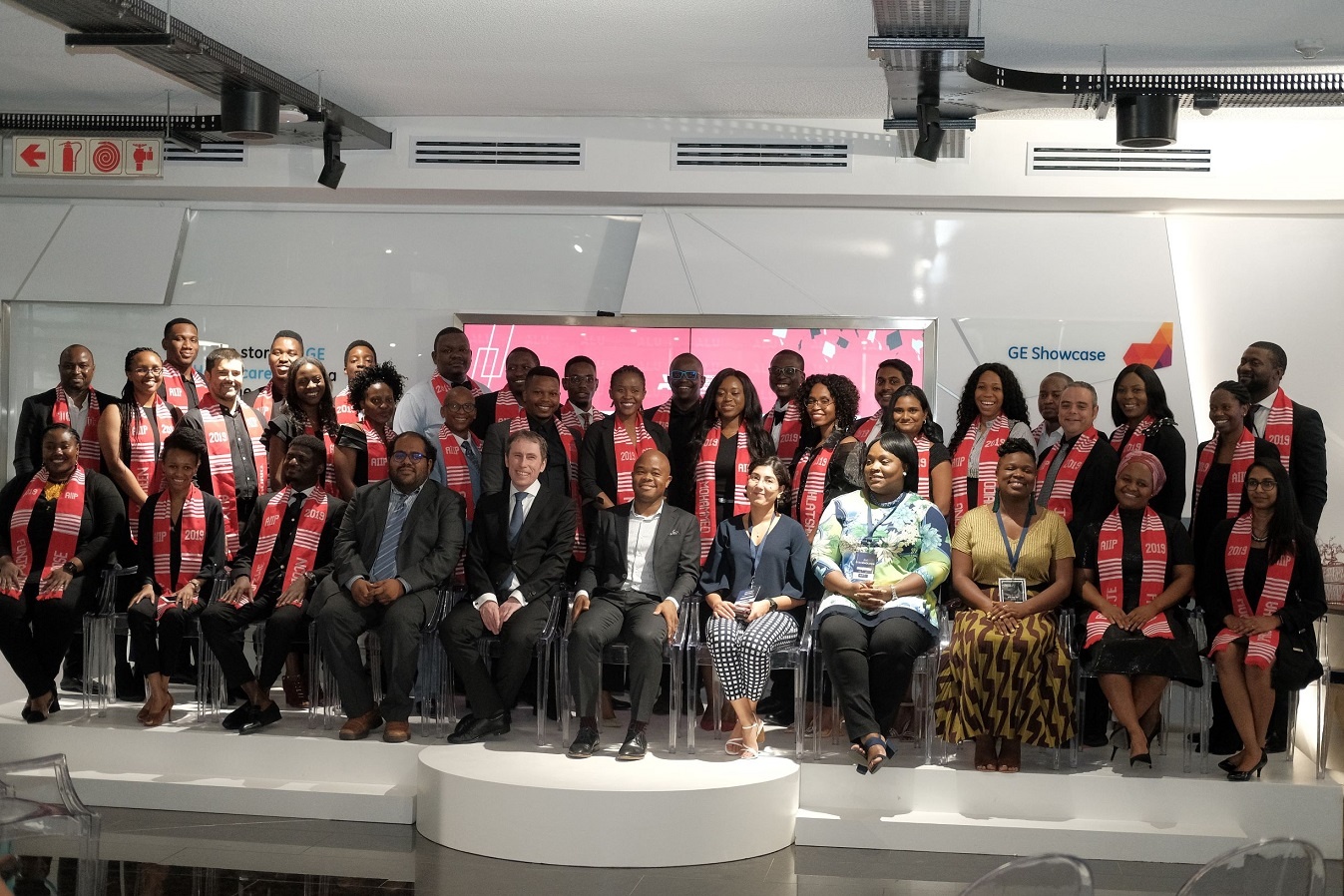
GE AIIP Class of 2019 Graduation

By Modupe Gbadeyanka

The commencement of a scheme aimed at equipping young Africans with skills that will enable them to take part in the fourth industrial revolution has been announced by General Electric and the Africa Leadership University (ALU).

Tagged the cohort of the Africa Industrial Internet Programme (AIIP), the 2020 edition, the third in the series, has enrolled 35 students from eight countries across Africa, including nine Nigerians, drawn from different sectors like the oil & gas, transportation, power, energy, manufacturing, healthcare, telecoms and aviation.

Over the last two years, the rigorous training programme has graduated 64 students, 21 of them Nigerians, of which 50 were fully sponsored by GE from a scholarship fund totalling $500,000.

Launched in 2018, the programme has empowered participants with essential skills for building applications for the Industrial Internet, which enables machine-to-machine communication that results in systems that can collect, analyse, and deliver data in real-time. These features provide significant benefits such as predicting when a device will require maintenance, enhancing logistics management, enhancing quality and optimizing safety.

The training takes place at a time when spending on the Internet of Things is predicted to reach $1 trillion by 2021, with the total number of connected devices being projected to rise to 75.44 billion worldwide by 2025, a fivefold increase in 10 years.

Commenting on the Programme,  Farid Fezoua, President & CEO for GE Africa said, “As a digital industrial company, it’s exciting  to see how over the last two years the AIIP has developed an ecosystem of digital engineers that utilise data science as an enabler for their work across industries, developing solutions for the most pressing challenges.

“Our partnership with ALU for the AIIP is a testament of our commitment to develop the next generation of leaders that will drive solutions made in Africa for Africa in this transformative digital age.”

The AIIP is designed using a project-based approach where participants get to apply their learning in real world contexts. The programme includes regular assessments in each module culminating with a final project where participants are tasked with applying their learning to solve an existing problem either in their business or in a partner organization’s business operations.

This is achieved through modules in machine learning and big data analytics, Industrial Internet of Things (IIoT) and Cloud-based Application Development.

A unique aspect of the programme is a deliberate focus on creating links to industry for participants by inviting industry experts to intensives to share case studies, projects of interest, trends and opportunities, through industry field visits and mentorship opportunities with data science professionals.

“African Leadership Group is thrilled to be partnering with GE to build a new generation of digital leaders for Africa” said Fred Swaniker, Founder of African Leadership Group, which includes African Leadership Academy, African Leadership University, and ALX. “We share GE’s passion for data, and what it can bring to the African continent and the world. The Programme enables mid-career engineers to build new skills in data analytics, data science, data engineering and data visualization. By leveraging the power of data, today’s engineers can significantly improve the performance of high-tech industrial machinery and processes, thereby increasing the bottom line for companies. The Africa Industrial Internet Programme is creating globally competitive, digital engineers right here in Africa, and we can’t wait to see their full impact on the continent”.

In 2019 five female candidates from Kenya, South Africa and Nigeria received the Jay Ireland Africa Rising Scholarship for women in tech in honour of GE Africa’s former CEO, Jay Ireland.

Speaking about her experience with the programme, Funmi Somoye, a 2019 cohort graduate from Nigeria said, “More than Machine Learning and Data Science, I have learned more about myself, and what I am capable of doing. I can’t wait to change the world!”


Modupe Gbadeyanka is a fast-rising journalist with Business Post Nigeria. Her passion for journalism is amazing. She is willing to learn more with a view to becoming one of the best pen-pushers in Nigeria. Her role models are the duo of CNN's Richard Quest and Christiane Amanpour.

Click to comment

Leave a Reply

Your email address will not be published. Required fields are marked *

General

AFC Mobilises $2bn From Global Lenders for African Infrastructure Projects

Published

on

African Infrastructure Projects

By Adedapo Adesanya

The Africa Finance Corporation (AFC) has raised $2 billion via a syndicated loan, with considerable participation from Asian and European banks seeking to capitalise on growing demand for infrastructure projects across the continent.

Barclays Bank, Commerzbank, First Abu Dhabi Bank PJSC, and FirstRand Bank led the debt facility. Other participating lenders include Export-Import Bank of India, Bank of Communications, Industrial and Commercial Bank of China, and Industrial Bank of Korea, among others.

Each region accounted for about 35 per cent of the creditors, according to a statement by AFC.

AFC chief executive, Mr Samaila Zubairu, said the money would enable more master planning around infrastructure and industrial planning for economies, regions and economic corridors across the continent.

According to Mr Zubairu, the lender is also in discussions to invest in a proposed oil refinery to be built by billionaire Aliko Dangote in East Africa.

The financer initially sought $1.6 billion via the facility but scaled it up to $2 billion amid strong demand from Asian financial institutions.

“In this round, we saw a lot more of Asian banks. We have banks from China, Hong Kong, and Korea. They are a lot more engaged,” he said.

Mr Zubairu said the loan underscored AFC’s strong track record, pointing to its financing for projects including Nigeria’s 650,000 barrels per day Dangote oil refinery and Africa’s largest copper smelter in the Democratic Republic of Congo.

“There’s a lot more confidence, a lot more partners,” Mr Zubairu said of those participating in the loan. “We are constantly demonstrating that Africa is executing. Africa is building.”

“The capital that we raise goes into African infrastructure build out, African industrialisation build up – essentially creating jobs for Africans,” Mr Zubairu said.

The AFC chief said the lender is also working to reform capital rules and create structures that will allow more African money to stay on the continent and be invested in crucial infrastructure projects.

AFC, founded in 2007, has assets surpassing $19 billion and counts 48 African countries as members.

In January, the infrastructure-focused multilateral lender secured an A rating from S&P. It has an A3 rating from Moody’s, an AAAspc rating from S&P Ratings (China) and an A+ rating from the Japan Credit Rating Agency.

Continue Reading

General

NERC Orders DisCos to Pay 20% Compensation to Affected Band A Customers

Published

on

Prepaid Meters DisCos

By Adedapo Adesanya

The Nigerian Electricity Regulatory Commission (NERC) has ordered electricity distribution companies (DisCos) to pay 20 per cent compensation to eligible Band A customers who were affected by power shortfalls between February and March 2026.

In Directive No. NERC/2026/002, the commission said, generation constraints, which were largely caused by inadequate gas supply and vandalism of gas and transmission infrastructure, prevented DisCos from meeting committed service levels for some Band A feeders.

NERC Mandated that for feeders that supplied less than 18 hours per day, affected Band A feeders will not be downgraded during the covered period, and eligible customers will receive special compensation equal to 20 per cent of approved energy figures for February 2026.

However, for Band A feeders that recorded an average daily supply of between 18 and 20 hours, the existing compensation framework under Addendum No. NERC/2024/003 applies to both Maximum Demand (MD) and Non-Maximum Demand (Non-MD) customers.

MD customers are high-consumption users who typically have their own dedicated transformer and operate with a load of 45 kVA and above; they include large residential estates, banks, hotels, supermarkets, industrial facilities and oil and gas complexes.

Non-MD customers do not have a dedicated transformer and instead share public transformers, and they generally consume less, often below 45–50 kVA.

For Non-MD customers, compensation is set at 20 per cent of the approved February 2026 energy cap applicable to the affected feeder.

For MD customers, compensation is 20 per cent of the average energy billed per MD customer in February 2026.

According to NERC, prepaid customers will receive their compensation as token credits, while postpaid customers will receive bill adjustments.

The commission said that compensation for February must be completed by 31 May 2026, while compensation for March must be completed by 30 June 2026.

The commission prohibited Distribution companies from using compensation credits to offset any existing customer debt, adding that customers must be clearly informed of the value and period of the compensation they receive.

NERC said it will monitor implementation and verify compliance to ensure all eligible customers receive what they are due.

The commission reaffirmed its commitment to protecting electricity consumers while ensuring the stability and sustainability of the electricity market.

Continue Reading

General

TCN Confirms Destruction of Six Transmission Towers in Nasarawa

Published

on

Transmission Towers

By Adedapo Adesanya

The Transmission Company of Nigeria (TCN) has confirmed the destruction of six transmission towers along the Apir–Lafia 330kV line in Nasarawa State, causing significant disruption to electricity supply in parts of the country.

In a statement issued on Wednesday, TCN spokesperson, Mrs Ndidi Mbah, said the incident occurred on May 30 at about 1:15 a.m. during a heavy downpour.

She explained that the transmission line initially tripped, prompting operators to attempt a trial reclosure of Line II at about 2:08 a.m., but the effort failed.

A subsequent inspection of the transmission corridor, however, revealed extensive damage to key components of towers T125 to T130, confirming that the infrastructure had been vandalised.

“The tripping of the lines prompted a physical line trace to determine the fault, which revealed damage to critical components of towers T125 to T130, confirming vandalism on the affected sections of the transmission corridor,” Mbah said.

The incident has forced both Apir–Lafia 330kV Transmission Lines I and II out of service pending the reconstruction of the damaged towers.

TCN said its engineers have been deployed to the site to assess the extent of the damage and determine the materials required to restore normal transmission along the corridor.

As an interim measure, the Lafia 330kV Transmission Station is being supplied through an alternative line to minimise the impact on electricity consumers within the franchise areas of Abuja Electricity Distribution Company (AEDC) and Jos Electricity Distribution Company (JEDC).

The company condemned the persistent vandalism of power infrastructure, warning that such acts undermine investments in the electricity sector and threaten the stability of the national grid.

It also urged residents and host communities to remain vigilant and report suspicious activities around transmission installations to security agencies or the nearest TCN office.

TCN stressed that safeguarding critical national infrastructure requires collective responsibility to ensure a reliable and uninterrupted electricity supply nationwide.

Continue Reading

Trending