Connect with us

Economy

Capital Market Vital to National Economy—Anyaoku

Published

on

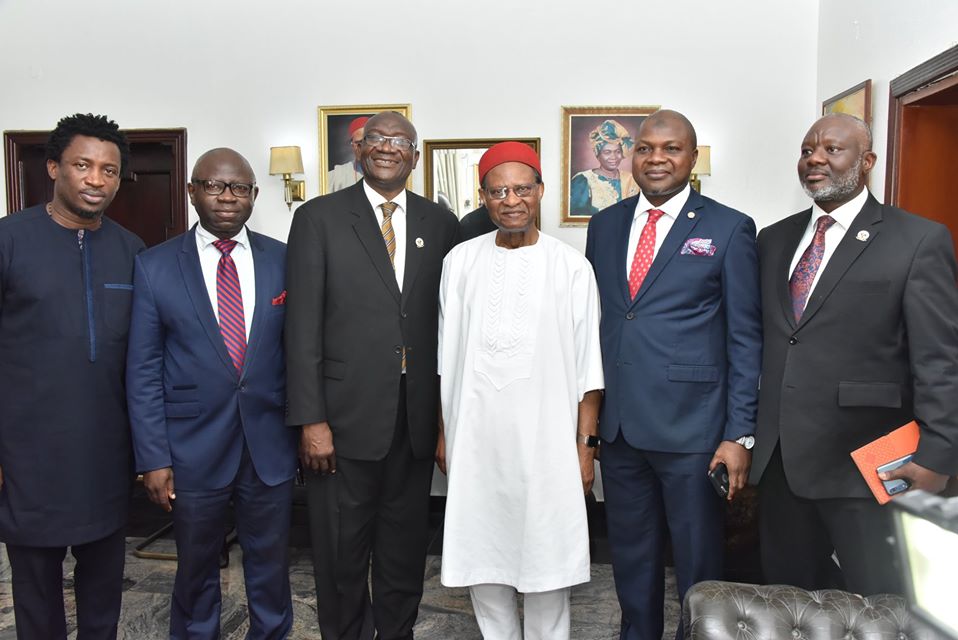
CIS visit Anyaoku

By Modupe Gbadeyanka

Former Secretary General of Commonwealth, Mr Emeka Anyaoku, has advised government to explore the capital market to source for funds to execute developmental projects across the country.

According to him, the capital market remains a vital sector for the improvement of the national economy because long-term funds can be sourced from there at cheaper rates.

Speaking when some executives of the Chartered Institute of Stockbrokers (CIS) paid him a courtesy visit in Lagos, Mr Anyaoku said most developed nations of the world approached the capital market to seek for funds to carry out some projects the third world countries admire today.

“Most developed countries did not get to their present levels by accident, but by taking advantage of the capital market to raise funds at cheaper rates. They also worked together with the private sector for some developmental projects,” Mr Anyaoku told his visitors.

Speaking further, he urged “government to tap into the capital market because it has important roles to play in the national economy just as the managers and operators in the capital market also have vital roles to play.”

“I am happy that the Central Bank of Nigeria (CBN) is collaborating with Bankers Committee on how to fund the huge infrastructure gap in Nigeria through Public Private Partnership (PPP),” he continued, pointing out that some “big companies in Nigeria are performing below average because of lack of resources.”

Mr Anyaoku applauded the CIS team for being thorough professionals, urging them to keep the standard very high to boost investor confidence in the capital market.

“I am happy with the way the institute has remained highly professional. In fact, I am impressed with training of manpower and implementation of initiatives by the institute because these have helped to enhance investor education,” he said.

In his remarks, President and Chairman of Council of CIS, Mr Adedapo Adekoje, who led the team to the former diplomat, explained that the institute felt it was necessary to honour him for his immense service to Nigeria and also seek his participation in the institute’s activities as an elder statesman, which the host gladly accepted.


Modupe Gbadeyanka is a fast-rising journalist with Business Post Nigeria. Her passion for journalism is amazing. She is willing to learn more with a view to becoming one of the best pen-pushers in Nigeria. Her role models are the duo of CNN's Richard Quest and Christiane Amanpour.

Click to comment

Leave a Reply

Your email address will not be published. Required fields are marked *

Economy

For Third Straight Month, Nigeria Meets OPEC Quota in July

Published

on

crude oil output

By Aduragbemi Omiyale

Nigeria slightly surpassed its quota set by the Organisation of the Petroleum Exporting Countries (OPEC) in July 2026.

In the month under review, the country produced about 1.57 million barrels of crude oil per day.

It was the third consecutive month Africa’s largest oil-producing nation was meeting its monthly quota, set to stabilise the price of the commodity on the global market by the oil cartel.

Data released by the Nigerian Upstream Petroleum Regulatory Commission (NUPRC) on Wednesday showed that the 1.5 million barrels per day ceiling for Nigeria was surpassed last month.

The agency disclosed in a statement today that the country produced 1.505mbpd of crude oil and 0.17mbpd of condensate, bringing the combined daily production to 1.67mbpd.

In the month under review, the daily peak production of crude oil and condensate was 1.78mbpd, while the lowest daily production was 1.57mbpd.

Although Nigeria met its OPEC quota in the month of July, the statistics show that on a month-on-month basis, production fell by 4 per cent.

This was attributed to the decline in production due to operational challenges experienced at the Erha and Akpo fields, which impacted crude oil output during the period under review.

These disruptions constrained production volumes and contributed significantly to the overall reduction in national crude oil output.

Despite the challenges, production operations across most other producing assets remained relatively stable, with operators implementing measures aimed at maintaining production efficiency and minimising the impact of operational constraints, NUPRC stated.

Continue Reading

Economy

Lasaco Assurance Lists N18.5bn Shares from Rights Issue on Stock Exchange

Published

on

Lasaco Assurance New Logo

By Aduragbemi Omiyale

The over 9 billion shares of Lasaco Assurance Plc issued to shareholders of the company via a rights issue have been listed on the Nigerian Exchange (NGX) Limited.

The equities were brought to Customs Street on Wednesday by the organisation, increasing its total issued and fully paid-up share capital.

Lasaco Assurance, which scaled the recapitalisation hurdle of the National Insurance Commission (NAICOM) in July 2026, raised fresh capital from the capital market to shore up its capital base.

The underwriting firm got about N18.5 billion from the rights issue, which involved the issuance of 9,236,321,546 ordinary shares at a unit price of N2.00.

The exercise was on the basis of five new ordinary shares for every existing six ordinary shares held as of the close of business on Friday, February 20, 2026.

Confirming the listing of the additional stocks of Lasaco Assurance today, the Head of Issuer Regulation Department of NGX RegCo, Mr Godstime Iwenekhai, announced in a circular that, “Trading licence holders are hereby notified that an additional 9,236,321,546 ordinary shares of 50 Kobo each of Lasaco Assurance Plc were today, Wednesday, August 12, 2026, listed on the daily official list of Nigerian Exchange Limited.

“The additional shares arose from the company’s rights issue of 9,236,321,546 ordinary shares of 50 Kobo each at N2.00 per share on the basis of five new ordinary shares for every existing six ordinary shares held as of the close of business on Friday, February 20, 2026.

“With the listing of the additional 9,236,321,546 ordinary shares, the total issued and fully paid-up share capital of Lasaco Assurance Plc has now increased from 11,083,585,855 to 20,319,907,401 ordinary shares of 50 Kobo each.”

Continue Reading

Economy

Recapitalisation: Well-Capitalised Insurers Will Strengthen Nigeria’s Economy—NIA

Published

on

insurance industry

By Adedapo Adesanya

The Nigerian Insurers Association (NIA) has said the successful recapitalisation of the insurance industry will strengthen the sector’s ability to support financial stability and economic growth.

NIA Chairman, Mrs Ebelechukwu Nwachukwu, said a well-capitalised insurance industry would be better positioned to meet its obligations promptly, underwrite complex and large-scale risks and serve as a dependable pillar of the Nigerian economy.

She made the remarks while commending the National Insurance Commission (NAICOM) for its structured implementation of the new minimum capital requirements under the Nigerian Insurance Industry Reform Act (NIIRA) 2025.

Mrs Nwachukwu said NAICOM’s clear guidelines, systematic verification process, defined timelines and rigorous supervision had provided operators with a credible framework for navigating the recapitalisation exercise.

She described the outcome as a major milestone for the industry and congratulated the 43 insurance and reinsurance companies that have successfully met the prescribed minimum capital requirements.

According to her, the exercise represents “a major win not just for regulators and operators, but for policyholders, investors and the wider Nigerian economy.”

Mrs Nwachukwu said the association would continue to work with NAICOM and other stakeholders to consolidate the gains of the exercise, with emphasis on sustainable industry growth, stronger market conduct and improved consumer confidence.

The official also expressed solidarity with the eight companies still undergoing final verification and regulatory review, urging them to remain confident as NAICOM completes the process within the 14-day review period.

The NIA chairman assured policyholders and the wider business community that the insurance industry would emerge from the recapitalisation exercise stronger, more resilient and better positioned to contribute to Nigeria’s economic development.

Continue Reading