Connect with us

Economy

COVID-19 Second Wave Panic Pulls Down Oil Prices

Published

on

oil prices fall

By Adedapo Adesanya

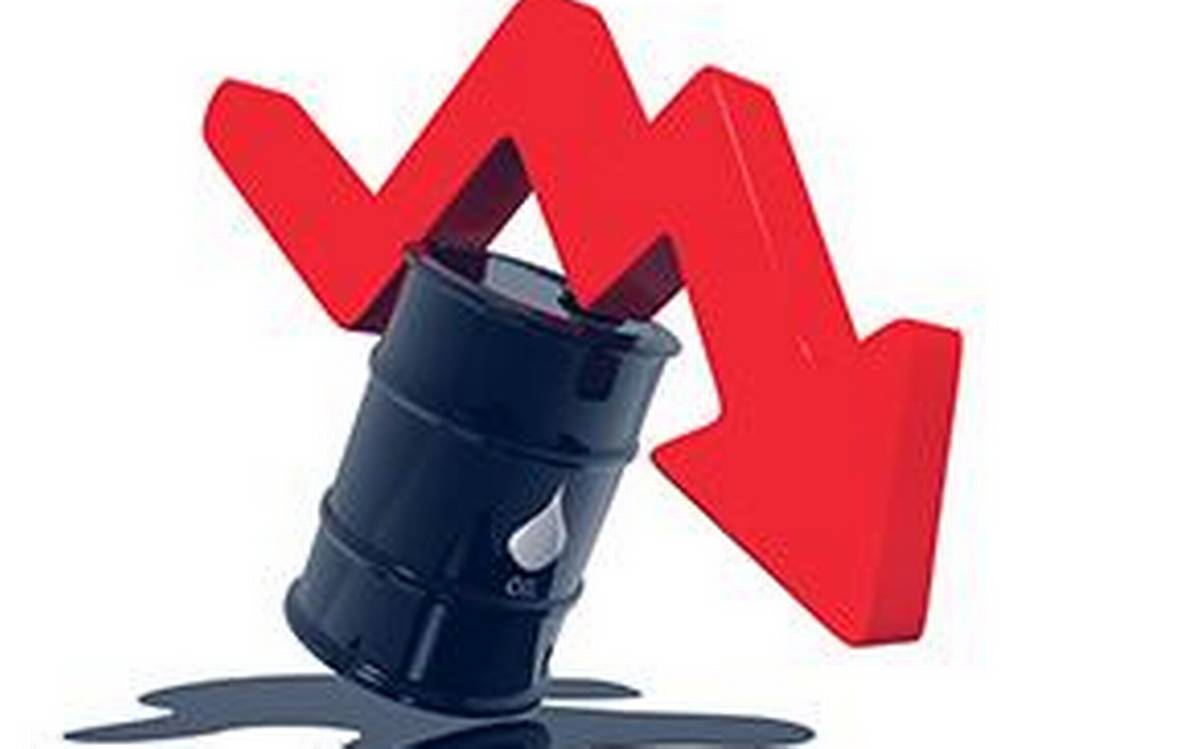
Oil prices pointed south on Monday as investors worried about a second wave of coronavirus infections that could threaten the markets even as demand shows signs of slow recovery.

Even the announcement of new output cut from Saudi Arabia and Kuwait could not do much to lift prices during the trading day.

However, the market welcomed development, expressing optimism that it could play a part in solving the oversupply problem threatening the crude oil space.

At market yesterday, the Brent crude futures fell $1.34 or 4.3 percent to $29.63 per barrel, while the US West Texas Intermediate (WTI) crude fell 60 cents or 2.43 percent to $24.14 per barrel.

Global oil demand has slumped by about 30 percent as the coronavirus pandemic brought about restrictions to movement across the world and this grew inventories globally, with storage soon to fill up.

While crude futures prices have fallen more than 55 percent alone this year, prices recorded gains during the past two weeks, supported by a modest rebound in demand as some travel restrictions were eased.

Now, a second wave of the pandemic threatens to upturn everything. Lockdowns have been reimposed in China and South Korea on Monday after a spike in new infections of the virus, which started in China last December.

According to reports, at least 15 cases of the virus have been confirmed in Shulan, China, prompting officials to quarantine 290 people connected with the outbreak, enforce martial law and lock down the northeastern city.

Meanwhile, South Korea, which eased social distancing requirements last week, saw a spike in cases linked to nightclubs in Seoul, the capital city.

Prices of the commodity received a boost, however, after Saudi Arabia, the largest producer of the Organisation of the Petroleum Exporting Countries (OPEC), directed its national oil company, Saudi Aramco, to reduce its production for June by an extra 1 million barrels per day.

This was followed by its counterpart, Kuwait, pledging to slash its production by 80,000 barrels per day in June, on top of the cut already agreed under a pact by major oil producing countries.

An allied producer group known as OPEC+ agreed to cut production from May 1 by about 10 million bpd in an effort to support prices.


Adedapo Adesanya is a journalist, polymath, and connoisseur of everything art. When he is not writing, he has his nose buried in one of the many books or articles he has bookmarked or simply listening to good music with a bottle of beer or wine. He supports the greatest club in the world, Manchester United F.C.

Economy

Worries Intensify as Attacks in Nigeria Spread Southwards

Published

on

bandits as terrorists

By Adedapo Adesanya

Nigeria’s security crisis is spreading southwards as jihadists and armed gangs step up attacks in parts of the country largely untouched by decades of violence.

Over the last few months, there had been an alarming increase in violence, especially in relatively low-conflict areas. The Nigerian government has long been fighting an array of jihadist groups, including Boko Haram and IS-linked factions, but largely in the North-East. However, some new groups are gaining footholds, spreading south.

Earlier this month, 162 people were killed in an attack in Kwara State. The gruesome murder in the central part of the country last week highlighted the fundamental shift in the nature and geography of the insecurity crisis facing Africa’s most populous nation.

The increased attacks come even as President Bola Tinubu declared a security emergency and the United States deployed troops to the nation, as part of cooperation efforts to tackle insecurity.

This weekend, at least 32 people were killed after gunmen launched simultaneous attacks on three separate communities in Niger State, which has the Federal Capital Territory (FCT) to the southeast and Kwara State to its southwest.  The communities of Tunga-Makeri, Konkoso, and Pissa, all located in the Borgu area of Niger state, were targeted in early raids on Saturday, February 14.

According to Niger State police spokesman, Mr Wasiu Abiodun, six people died in the assault on Tunga-Makeri, adding that it was not clear how many people had been abducted.

Mr Abiodun said that Konkoso was also attacked, but gave no other details other than that security teams have been sent to the scene and a rescue operation for those who were abducted was under way.

A resident, Mr Abdullahi Adamu, from Konkoso, reportedly said 26 people were killed in the attack there, describing how the attackers were “operating freely without the presence of any security”.

The attack on Tungan Makeri reportedly began on Friday, when over 200 armed men stormed the village, shooting sporadically and setting several houses on fire.

There were also reports that an Air Force aircraft was sighted around Tungan Makeri after the initial attack, a development some residents believe forced the bandits to withdraw from the village.

Continue Reading

Economy

Stock Market Gains N2.367trn as All-Share Index Rises 2.06%

Published

on

stock market bulls

By Dipo Olowookere

The Nigerian Exchange (NGX) Limited appreciated by 2.06 per cent on Friday, amid a rush for local equities due to encouraging earnings of companies for 2025.

Business Post reports that the buying pressure was across the key sectors of Customs Street yesterday, with the banking index growing by 2.49 per cent. The energy industry appreciated by 2.05 per cent, the consumer goods counter grew by 0.78 per cent, the insurance space improved by 0.64 per cent, and the industrial goods sector expanded by 0.44 per cent.

At the close of trades, the market capitalisation went up by N2.367 trillion to N117.027 trillion from N114.660 trillion, and the All-Share Index (ASI) gained 3,687.45 points to close at 182,313.08 points compared with the previous day’s 178,625.63 points.

Cornerstone Insurance, Infinity Trust, and Nestle Nigeria appreciated by 10.00 per cent each to sell at N6.38, N9.90 and N2,662.00, respectively, while Okomu Oil rose by 9.99 per cent to N1,327.00, with RT Briscoe up by 9.97 per cent to N17.42.

Conversely, SAHCO depleted by 10.00 per cent to M135.00, Guinness Nigeria lost 9.97 per cent to trade at N103.00, Omatek shrank by 9.39 per cent to N2.99, NPF Microfinance Bank decreased by 6.51 per cent to N5.60, and eTranzact slipped by 6.33 per cent to N10.80.

A total of 53 stocks ended in the green side and 33 stocks finished in the red side, representing a positive market breadth index and strong investor sentiment.

Data showed that 936.4 million shares valued at N52.7 billion were transacted in 50,068 deals on Friday versus the 698.3 million shares worth N28.438 billion traded in 50,886 deals on Thursday, indicating a rise in the trading volume and value by 34.10 per cent, and 85.56 per cent apiece, and a slip in the number of deals by 1.61 per cent.

First Holdco closed the session as the most active equity with 106.3 million units worth N5.1 billion, Zenith Bank transacted 72.6 million units valued at N5.7 billion, United Capital traded 45.4 million units for N963.2 million, GTCO sold 45.0 million units worth N4.9 billion, and Fidelity Bank exchanged 31.4 million units valued at N639.0 million.

Continue Reading

Economy

OTC Securities Exchange Extends Positive Run by 0.86%

Published

on

unlisted securities exchange

By Adedapo Adesanya

The NASD Over-the-Counter (OTC) Securities Exchange rose further by 0.86 per cent on Friday, February 13, with the market capitalisation growing by N20.27 billion to N2.378 trillion from the previous session’s N2.357 trillion, and the NASD Unlisted Security Index (NSI) rising by 33.87 points to 3,974.77 points from the 3,940.90 points it ended a day earlier.

The improvement recorded by the bourse yesterday was influenced by six price gainers led by Okitipupa Plc, which went up by N18.00 to sell at N260.00 per share compared with the previous day’s N242.00 per share.

Further, Central Securities Clearing System (CSCS) Plc added N3.39 to quote at N80.47 per unit versus N77.08 per unit, IPWA Plc chalked by 31 Kobo to finish at N3.44 per share versus N3.13 per share, Lagos Building Investment Company (LBIC) Plc gained 31 Kobo to settle at N3.41 per unit versus N3.10 per unit, Afriland Properties Plc appreciated by 31 Kobo to N16.51 per share from N16.20 per share, and Food Concepts Plc increased by 8 Kobo to N3.28 per unit from N3.20 per unit.

There were three price losers, led by MRS Oil Plc, which weakened by N10.00 to close at N170.00 per share compared with Thursday’s price of N200.00 per share, FrieslandCampina Wamco Nigeria Plc lost N2.59 to sell for N65.52 per unit compared with the preceding session’s N68.10 per unit, and Geo-Fluids Plc depreciated by 33 Kobo to N3.30 per share from N3.63 per share.

During the session, the volume of securities transacted by the market participants went up by 9.5 per cent to 9.4 million units from 8.6 million units, the value increased by 1,206.5 per cent to N703.6 million from N53.9 million, and the number of deals grew by 7.1 per cent to 45 deals from 42 deals.

CSCS Plc remained the most traded stock by value (year-to-date) with 27.1 million units exchanged for N1.5 billion, followed by Resourcery Plc with 1.05 billion units traded at N408.6 million, and Geo-Fluids Plc with 29.9 million units valued at N152.6 million.

Resourcery Plc ended the day as the most traded stock by volume (year-to-date) with 1.05 billion units sold for N408.6 million, followed by Geo-Fluids Plc with 29.9 million worth N152.6 million, and CSCS Plc with 27.1 million units sold for N1.5 billion.

Continue Reading

Trending