Connect with us

Economy

GBfoods Boosts Tomato Paste Market with N20bn Factory

Published

on

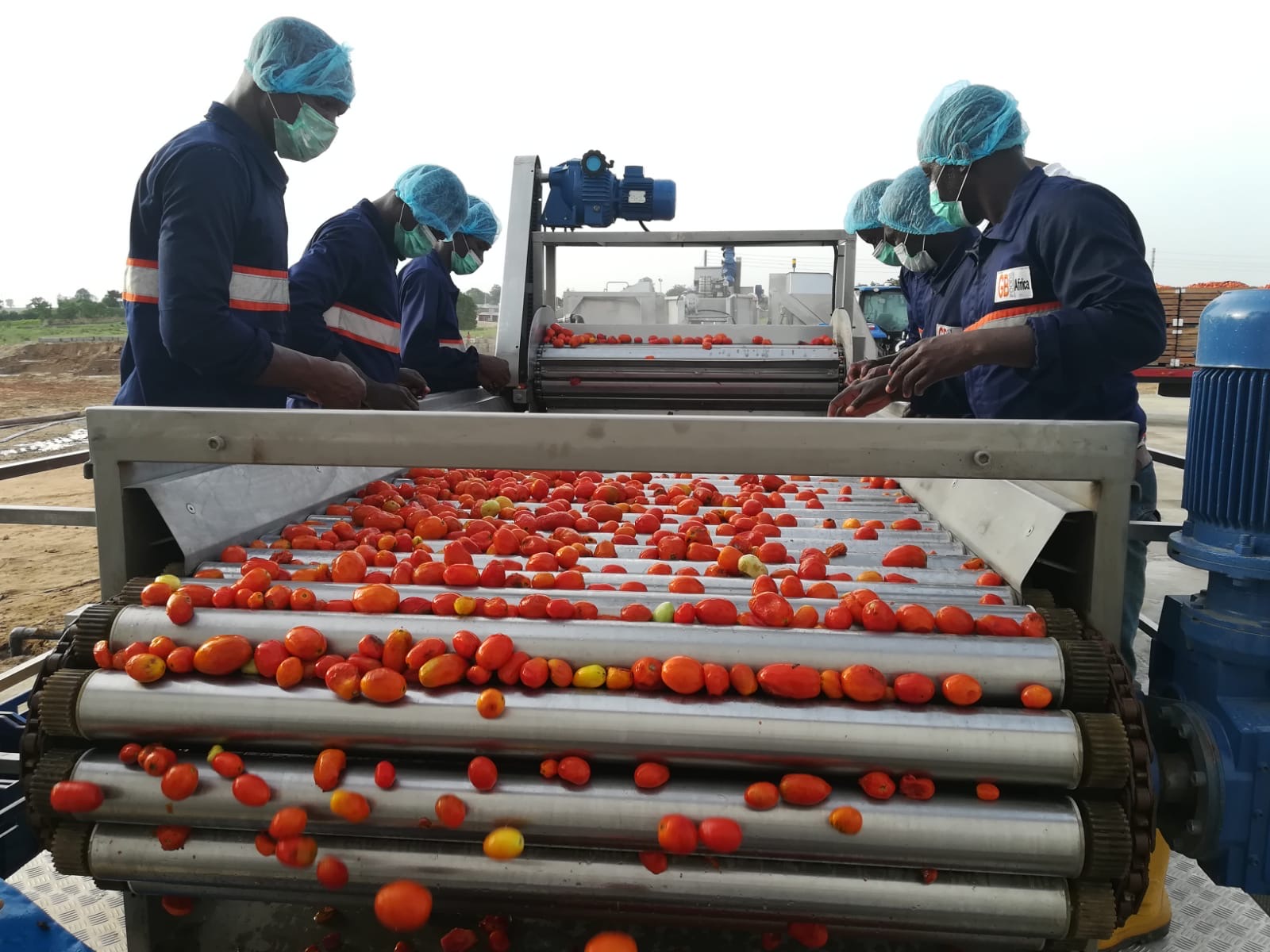
GBFoods tomato paste factory

By Modupe Gbadeyanka

A N20 billion tomato processing factory aimed to boost the tomato paste market has been completed in Kebbi State by a global leader in culinary product manufacturing, GBfoods.

The project was put in place by the company in partnership with the Central Bank of Nigeria (CBN), Kebbi State Government and the Emirate of Yauri.

The factory is the second largest in Nigeria and the only fully backward integrated plant in ECOWAS – and has the largest single tomatoes farm in Nigeria.

When all phases of the project are finished, the factory will be the largest fresh tomatoes processing factory in Sub-Saharan Africa.

The investment, in the world-class factory and adjoining farm, includes a drip irrigation and fertigation infrastructure, greenhouses, seed planting robots, an incubation chambers and a plethora of agricultural machinery.

The farm will serve a dual purpose, it will produce industrial tomatoes in the dry season and soya beans in the raining season.

The tomato factory will convert fresh tomatoes into tomato concentrate used for producing Gino Tomatoes Paste and Gino Tomato Pepper Onion Paste, while the soya bean will be used to process soya-bean oil which is a critical ingredient for GBfoods’ Bama and Jago Mayonnaise.

The project created over 1,000 jobs including 500 farming jobs, 150 factory jobs and 150 construction jobs. GBfoods also engaged many small holder farmers as out-growers.

Apart from training the out-growers on good agricultural practices, GBfoods provided them with tomatoes seedlings, agrochemicals and various equipment such as water pumps and hose pipes, enabling the farmers access to water in the dry season.

The firm also supported the host communities by providing and maintaining 16 boreholes of drinking water, a first for some of the surrounding villages. The factory is fully backwardly integrated to the company’s farm and dedicated out-growers.

In the coming tomatoes season, the plant will also source most of its raw material from out-growers who will grow the tomatoes on their own farms and from GBfoods’ owned and operated farm.

The factory is engaging over 5,000 small holder farmers as out-growers, in the coming tomatoes season, to grow fresh tomatoes.

The CEO of GBfoods Africa, Mr Vicenç Bosch, commended the federal government for encouraging and supporting GBfoods to engage with CBN, Ministries, Departments and Agencies to ensure the successful completion of the factory.

He also expressed his gratitude to the Federal Ministry of Industry Trade and Investments, Federal Ministry of Agriculture & Rural Development, Kebbi State Government and the Ngaski Local Government Authorities for their tremendous support towards the actualization of the project.

“Our team of extension workers, consultants and agronomists are ensuring that the Nigerian farmers benefit from the technology transfer of our best practices and know-how built through over 40 years of successful tomato operations in Italy and Spain,” Mr. Bosch added.

Speaking during opening of the factory, Mr Vincent Egbe, the Country Manager, GBfoods Nigeria said, “The commissioning of this processing factory is a great milestone for us.

“It further demonstrates the company’s commitment towards helping Nigeria achieve its food security ambitions, in this case, of self-sufficiency in tomato concentrate production.

“We will continue to work with the federal government towards food security and local production and processing of fresh tomatoes.

“The company is dedicated to reducing pre and post-harvest losses, and also developing the value chain so as to improve revenue streams for tomato farmers.

“Over the past three years, in the three states of Kaduna, Katsina and Kebbi, GBfoods has worked with smallholder out-growers to boost their incomes by providing seedlings, fertilizers, training, and irrigation pumps, further to reduce post-harvest losses GBfoods also provided free plastic crates to farmers.”

“GBfoods is working with the Federal Government of Nigeria and the CBN to make Nigeria not only a shining example in food security, but also to become the food basket of Africa,” he added.

He especially thanked the President Muhammadu Buhari administration; the Kebbi Governor, Mr Atiku Abubakar Bagudu; the CBN Governor, Mr Godwin Emefiele; and the Emir of Yauri, Dr Muhammad Zayyanu Abdullahi for working tirelessly to create an enabling investment environment for GBfoods backwards integration project in tomatoes.

Additional land is expected in September 2020 to be cleared and prepared for the farming season of October 2021. This expansion will be similarly accompanied by an upgrade in the factory’s capacity. With the expansion, new jobs will also be created.

GBfoods has a wide range of quality well-established brands in Nigeria such as Gino, Bama and Jago, under which they manufacture a wide range of quality products that make the daily lives of many African families easier.

Products under their brands include Gino Tomatoes Mix; Gino Pepper Onion, Gino Thyme; Gino Curry; Gino Chicken and Beef Cubes; Bama Mayonnaise as well as Jago Mayonnaise.

GBfoods investments aim to satisfy local culinary habits and preferences whilst offering the healthiest and best ingredients for the Nigerian cuisine.


Modupe Gbadeyanka is a fast-rising journalist with Business Post Nigeria. Her passion for journalism is amazing. She is willing to learn more with a view to becoming one of the best pen-pushers in Nigeria. Her role models are the duo of CNN's Richard Quest and Christiane Amanpour.

Advertisement
Click to comment

Leave a Reply

Your email address will not be published. Required fields are marked *

Economy

Nipco, 11 Plc Crash OTC Securities Exchange by 4.76%

Published

on

NIPCO LPG Depot

By Adedapo Adesanya

Energy stocks influenced the 4.76 per cent loss recorded by the NASD Over-the-Counter (OTC) Securities Exchange on Friday, December 5.

The culprits were the duo of 11 Plc and Nipco Plc,with the former shedding N32.17 to end at N291.83 per share compared with the previous day’s N324.00 per share, and the latter down by N21.00 to sell at N195.00 per unit versus the previous session’s N216.00 per unit.

Consequently, the NASD Unlisted Security Index (NSI) slumped by 170.16 points to 3,401.37 points from 3,571.53 points and the market capitalisation lost N101.81 billion to close at N2.035 billion from the N2.136 trillion quoted in the preceding session.

The OTC securities exchange suffered the decline yesterday despite the share prices of three companies closing green.

Central Securities Clearing System (CSCS) Plc was up by N1.80 to close at N39.80 per share compared with Thursday’s price of N38.00 per share, Air Liquide Plc appreciated by N1.09 to N11.99 per unit from N10.90 per unit, and FrieslandCampina Wamco Nigeria Plc grew by 78 Kobo to N56.57 per share from N55.79 per share.

During the session, the volume of transactions rose by 6,885.3 per cent to 18.2 million units from 4.3 million units, the value of transactions ballooned by 10,301.7 per cent to N389.7 million from N347.2 million, but the number of deals declined by 29.7 per cent to 26 deals from 37 deals.

Infrastructure Credit Guarantee Company (InfraCredit) Plc ended the day as the most traded stock by value on a year-to-date basis with 5.8 billion units worth N16.4 billion, followed by Okitipupa Plc with 170.4 million units valued at N8.0 billion, and Air Liquide Plc with 507.5 million units worth N4.2 billion.

InfraCredit Plc also finished the day as the most traded stock by volume on a year-to-date basis with 5.8 billion units transacted for N16.4 billion, followed by Industrial and General Insurance (IGI) Plc with 1.2 billion units sold for N420.2 million, and Impresit Bakolori Plc with 536.9 million units worth N524.9 million.

Continue Reading

Economy

Naira Depreciates to N1,450/$1 at Official Forex Market

Published

on

Naira-Dollar exchange rate gap

By Adedapo Adesanya

The Naira depreciated further against the US Dollar in the Nigerian Autonomous Foreign Exchange Market (NAFEX) on Friday, December 5, as FX demand pressure mounts.

The Nigerian currency lost N2.60 or 0.18 per cent against the greenback to close at N1,450.43/$1 compared with the previous day’s N1,447.83/$1.

Equally, the domestic currency declined against the Pound Sterling in the official forex market during the session by N4.48 to trade at N1,935.45/£1, in contrast to Thursday’s closing price of N1,930.97/£1 and shrank against the Euro by 43 Kobo to end at N1,689.17/€1 versus the preceding session’s rate of N1,688.74/€1.

Similarly, the local currency performed badly against the US Dollar at the GTBank FX counter by N2 to close at N1,455/$1 versus Thursday’s N1,453/$1 but traded flat at the parallel market at N14.65/$1.

As the country gets into the festive period, pressure mounted on the local currency reflecting higher foreign payments and lower FX inflows.

However, there are expectations that the Nigerian currency will be stable, supported by interventions by to the Central Bank of Nigeria (CBN) in the face of steady dollar Demand and inflows from Detty December festivities that will give the Naira a boost after it depreciated mildly last month.

Traders cited by Reuters expect that the Naira will trade within a band of N1,443-N1,450/$1 next week, buoyed by improved FX interventions by the apex bank.

As for the crypto market, it was down yesterday due to profit-taking associated with year-end trading. However, the December 1-Year Consumer Inflation Expectation by the University of Michigan fell to 4.1 per cent from 4.5 per cent previously and 4.5 per cent expected. The 5-Year Consumer Inflation Expectation fell to 3.2 per cent from 3.4 per cent previously and 3.4 per cent expected.

With the dearth of official economic data of late, these private surveys have taken on a new level of significance and the market banks of them to make decisions.

Cardano (ADA) depreciated by 5.7 per cent to $0.4142, Dogecoin (DOGE) slid by 5.1 per cent to $0.1394, Ethereum (ETH) dropped by 3.9 per cent to $3,039.75, Solana (SOL) declined by 3.8 per cent to $133.24, and Litecoin (LTC) fell by 3.7 per cent to $80.59.

Further, Bitcoin (BTC) went down by 2.6 per cent to sell at $89,683.72, Binance Coin (BNB) slumped by 2.2 per cent to $883.59, and Ripple (XRP) shrank by 2.1 per cent to $2.04, while the US Dollar Tether (USDT) and the US Dollar Coin (USDC) remained unchanged at $1.00 each.

Continue Reading

Economy

Oil Market Climbs on Federal Reserve Rate-Cut Signals, Supply Concerns

Published

on

global oil market

By Adedapo Adesanya

The oil market was up on Friday on increasing expectations the US Federal Reserve will cut interest rates next week, which could boost economic growth and energy demand.

Brent futures rose by 49 cents or 0.8 per cent to $63.75 per barrel and the US West Texas Intermediate (WTI) futures expanded by 41 cents or 0.7 per cent to $60.08 per barrel.

Investors digested a US inflation report and recalibrated expectations for the Federal Reserve to reduce rates at its December 9-10 meeting.

US consumer spending increased moderately in September after three straight months of solid gains, suggesting a loss of momentum in the economy at the end of the third quarter as a lackluster labor market and the rising cost of living curbed demand.

Traders have been pricing in an 87 per cent chance that the US central bank will lower borrowing costs by 25 basis points next week, according to CME Group’s FedWatch Tool.

Investors also focused on news from Russia and Venezuela to determine whether oil supplies from the two sanctioned members of the Organisation of the Petroleum Exporting Countries and allies (OPEC+) will increase or decrease in the future.

The failure of US talks in Moscow to achieve any significant breakthrough over the war in Ukraine has helped to boost oil prices so far this week.

A loss of Venezuelan oil production in case of a US military intervention will materially impact global benchmark prices as the market will have to replace Venezuela’s heavy crude.

Venezuela is estimated to pump about 1.1 million barrels per day of crude oil at present, so if the US-Venezuela tension escalation into an invasion in the South American country, this volume of crude would be at risk.

Reuters reported that the Group of Seven countries and the European Union are in talks to replace a price cap on Russian oil exports with a full maritime services ban in a bid to reduce the oil revenue that helps finance Russia’s war in Ukraine.

Any deal that could lift sanctions on Russia, the world’s second-biggest crude producer after the US, could increase the amount of oil available to global markets, weakening prices.

Continue Reading

Trending